People on the go
You want to smooth the creases from an outfit straight out of your suitcase without setting up an ironing board. Portability, weight and how quickly it heats up matter more than its ability to tackle a pile of laundry.


For smoothing a few light creases from an outfit on a hanger, a handheld steamer saves you from getting out the ironing board. If you have several garments to deal with at home, consider a standing garment steamer instead. For stubborn creases or a precise finish, stick with an iron – or consider a steam generator iron if you have a large pile of laundry. In every case, check the garment care label and the appliance instructions before using steam.
You want to smooth the creases from an outfit straight out of your suitcase without setting up an ironing board. Portability, weight and how quickly it heats up matter more than its ability to tackle a pile of laundry.
Before work or a special occasion, you want to freshen up a shirt, dress or jacket. UFC-Que Choisir describes a garment steamer as a tool for smoothing light creases, not as a replacement for a full ironing session.
If you work through several garments at home, tank capacity and ease of filling become more important than saving space in a bag.
Start with the result you want: smoothing creases from a garment on a hanger is not the same as pressing a crease into trousers. Then compare appliances based on how many garments you need to tackle and how much space you have.
Consider it: for a quick touch-up on a hanging garment, especially before heading out or while travelling.
Bear in mind: a small tank may mean pausing to refill when steaming several garments, and the result won’t give you the sharp crease you can achieve with an iron.
Consider it: for steaming several garments on hangers at home, when capacity matters more than portability.
Bear in mind: it takes up more space, and there’s no guarantee it will create sharp creases.
Consider it: when an outfit needs a precise finish or sharp creases.
Bear in mind: you’ll need a suitable surface and more preparation than for a quick touch-up on a hanger.
Consider it: if you regularly iron large loads of laundry – a use UFC-Que Choisir associates with this type of appliance.
Bear in mind: it’s bulkier than an appliance designed for the occasional touch-up.
| What matters | What to check | Who it suits |
|---|---|---|
| Portability and quick touch-ups | Size when stored, appliance weight when filled and tank capacity. | When I’m travelling, I want to take the appliance with me and freshen up an outfit straight from my suitcase without carrying too much. Around 34% of consumers prioritise portability. |
| Quick results without an ironing board | Stated heat-up time, ease of use on a hanger and how easy it is to fill. | Just before heading out, I’d rather smooth creases from a hanging garment than set up for an ironing session. Around 33% of consumers prioritise this quick fix. |
| Quality of finish | Whether you need sharp creases, the type of fabric and whether you can iron it flat. | If trousers need a sharp crease or a shirt is very creased, I want a more precise finish than a quick touch-up can offer. Around 20% of consumers prioritise this result. |
| Several garments | Tank capacity, ease of filling and how much space it takes up at home. | When I have several garments waiting, I want to avoid stopping to refill between them. Around 13% of consumers prioritise being able to use their appliance continuously. |
UFC-Que Choisir presents a garment steamer as a way to smooth light creases; it won’t create sharp creases like an iron. This matters particularly if your outfit needs a structured finish.
Use a steamer for quick touch-ups on a hanger. Consider an iron or steam generator if sharp creases or ironing lots of garments is your main priority.
A steam output figure on its own doesn’t tell you how well an appliance works on different fabrics or how easy it is to handle. UFC-Que Choisir’s testing protocol, for example, assesses measured steam output separately from crease-removal performance and ease of use.
Compare the weight when filled, tank capacity and maintenance requirements too. If you’re looking at test results, check which fabrics were tested and under what conditions.
A compact appliance may be fine for an occasional touch-up, but if you’re steaming several items in a row, how often you’ll need to refill becomes more important.
If you mainly steam clothes at home, compare the capacity and ease of filling with those of a standing model.
The time needed to stop and refill adds to the length of your steaming session.
Smoothing creases from a garment does not prove that it has been disinfected or effectively treated for bed bugs. UFC-Que Choisir excludes disinfection claims from its assessment of garment steamers.
Choose this appliance for freshening fabrics, not as a proven disinfection or pest-control solution.
These ranges showcase different types of garment steamer. The features listed apply to the models mentioned, not every appliance made by each brand.
The 3000 Series includes the STH3000/20, a foldable handheld steamer that Philips France presents for touch-ups at home and on the go.
According to Calor, the Pure Force 2-in-1 DT8720C0 can be used vertically or horizontally, so you can switch between steaming on a hanger and working on a flat surface.
The QuickStyle range includes the Mini GS1071BK, designed for touch-ups on the go, and QuickStyle 7 models that, according to Braun, can be used vertically or horizontally.
SteamOne distinguishes between its handheld steamers for travel and its standing models for use at home.
These models are suited to freshening up hanging garments, whether after a journey or before heading out. Compare their size and tank capacity based on whether portability or several touch-ups at home matters more to you. A handheld steamer won’t necessarily replace the iron or steam generator mentioned above.
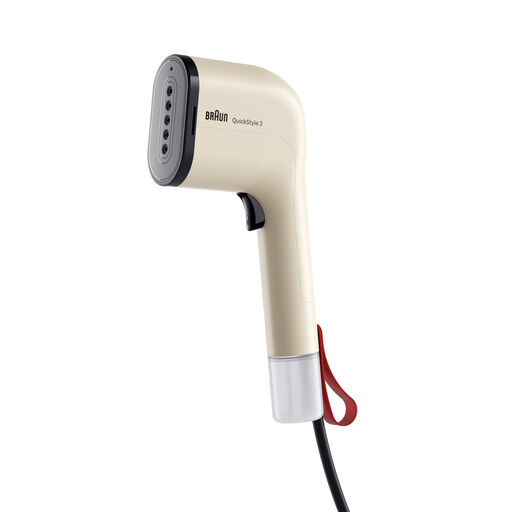 Image unavailable
Worth considering for freshening up an outfit on a hanger if you’re looking for an appliance to take with you.
If you have several items to steam in a row, check that the tank capacity suits your needs. Read the instructions for suitable fabrics and guidance on switching off and storing the appliance.
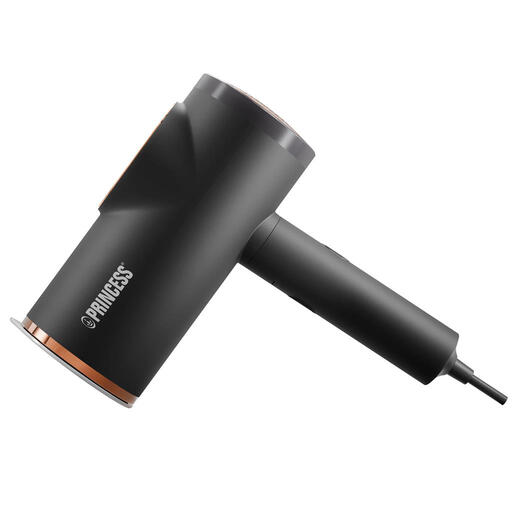 Image unavailable
The foldable design is useful if you want to store your steamer away between occasional touch-ups, especially when travelling.
The lint remover is a separate function from steaming. Check the garment care label and the instructions before using steam.
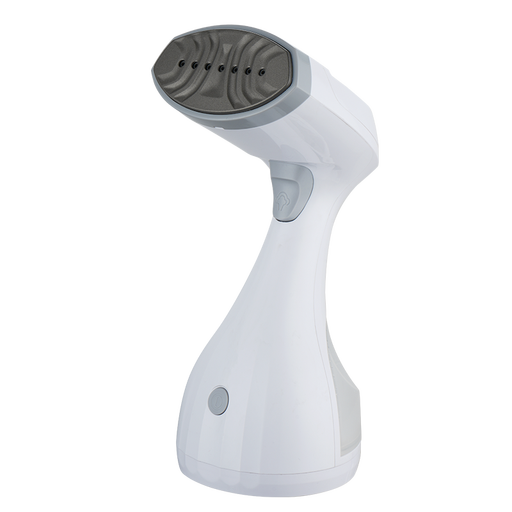 Image unavailable
Its stated 300 ml tank is worth comparing with more compact designs if you’re planning several touch-ups between refills.
The product title states that it has a 1,500 W power rating and comes with a brush. These features alone don’t tell you how it will perform on a particular fabric. Check the care label and the instructions before use.
No – don’t assume that every fabric is suitable for steaming. Check the care label on each garment and the appliance instructions, especially if the material is delicate or the care guidance is restrictive.
Not if you need to iron clothes fully or create sharp creases: UFC-Que Choisir describes a garment steamer primarily as a way to smooth light creases. For a precise finish, choose an iron. If you iron large loads of laundry, consider a steam generator too.
Read the instructions for your model before you start, and keep your hands away from the steam. Follow the guidance on letting the appliance cool down before handling or storing it. Depending on the model, the first bursts of steam may contain droplets of water.
Not necessarily. If you only need to freshen up clothes occasionally, weigh up how much you’d use a new appliance against borrowing or hiring one, or buying refurbished. These are options suggested by the French Ministry for the Ecological Transition.