
Livraison le jour même ou le lendemain

Qualité garantie

Débloquez vos offres de bienvenue: Livraison GRATUITE | Jusqu'à -80 % | 30 jours d'essai gratuits à JoyPlus
Téléchargez l'application
Buying stationery supplies for school, the office, drawing or journaling might seem straightforward. Yet a poorly thought-out choice can quickly prove costly: ink that bleeds, tips that snag, notebooks that don't meet school requirements, or pencils that are uncomfortable to hold.
Before you fill your basket, here are the main pitfalls to avoid and the criteria you can use to compare products on a concrete basis.
A 0.5 mm or 0.38 mm tip indicates the theoretical line width, but the result also depends on the technology used, the consistency of the ink flow and the paper. A gel pen can be very comfortable for fine annotations, while a ballpoint pen generally offers a more sober, versatile writing experience.
For small characters, tables or diagrams, check both the tip diameter and its nature: needlepoint, ball or felt tip.
Quick-drying ink can help reduce smudging, but the result varies depending on the pressure applied, the paper weight and your writing speed. Left-handed people, in particular, would do well to choose an ink that minimises smudging and to test it on the notebook they actually use.
You should also distinguish between permanent pens and erasable pens. The thermosensitive ink in the latter makes corrections easier, but it is not suitable for documents to be archived or for receipts printed on thermal paper.
A set of 40 or 50 pens can be useful for a classroom, an administrative office or a large family. For personal use, a smaller pack can sometimes prevent you from accumulating colours or models you rarely use.
The best value for money therefore depends on how often you write, the number of users and how long you plan to use them. Also remember to check what the pack contains: caps, refills, erasers, a sharpener or a storage case.
The shape of the grip also plays a role. A non-slip coating or a triangular barrel can improve control during long writing sessions, without replacing a comfortable hand position.
For Seyès notebooks, the 17 × 22 cm format and French ruling meet the most common school requirements. For homework, lessons and folders, the 24 × 32 cm format offers more surface area and makes layout easier.
Paper weight directly affects writing comfort and ink show-through. Clairefontaine Velin Velouté 90 g paper, for example, is renowned for its smooth surface. However, before adopting it for drawing or journaling, it's best to check its compatibility with rollerballs, fine felt tips and heavily pigmented inks.
Caps and small parts should be kept out of the reach of children under three years old. Close pens after use, store them away from heat and follow the manufacturer's instructions. For pencils, a suitable sharpener helps prevent broken leads. With erasable pens, avoid extreme temperatures and documents that require permanent ink.
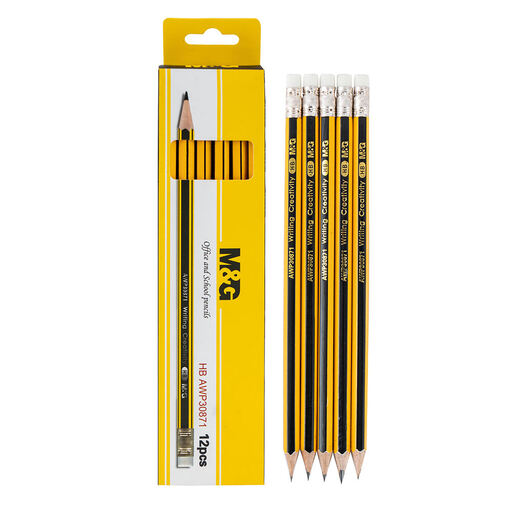
Why this choice suits this profile: this pack of 12 pre-sharpened HB graphite pencils covers the needs of school, home and early sketching without multiplying your purchases.
The hexagonal barrel reduces the risk of the pencil rolling off your desk. Each pencil also has an integrated eraser, so you don't need to buy several accessories straight away.
HB lead, non-slip hexagonal shape and pack of 12 with erasers.
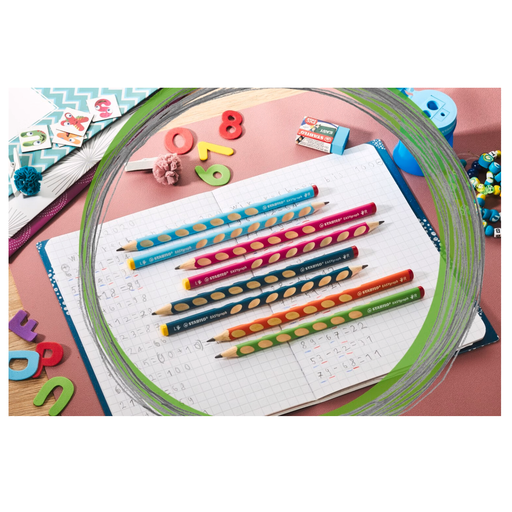
Why this choice suits this profile: its triangular shape and grip grooves are ideal for users who want more precise control, especially left-handed children.
The model is clearly identified as a left-handed version and states a 3.15 mm HB lead – a detail worth checking before ordering.
Triangular barrel, grooves along the entire length and stated HB lead.
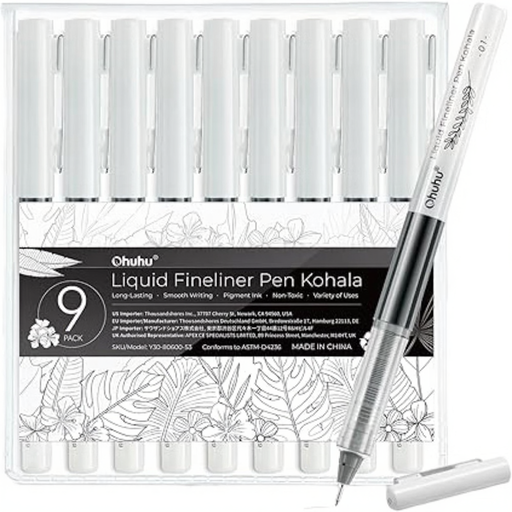
Why this choice suits this profile: with nine tip sizes, from 0.15 mm to a brush tip, this set lets you move from technical drawing to journaling and detailed line work.
The sizes are marked on the caps and the transparent barrels. This makes it easier to choose the right tip and to visually check the ink level.
Nine assorted tips, pigmented black ink stated to be water-resistant and quick-drying.
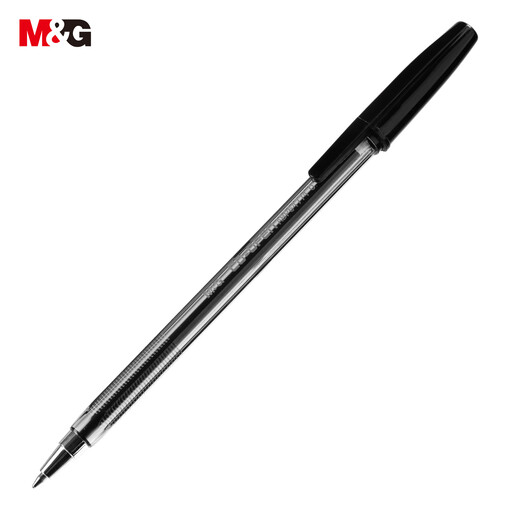
Why this choice suits this profile: this pack is designed for places where pens get passed around a lot: classrooms, shared offices, exams or the family home.
The product page specifies a 0.7 mm ceramic ball, oil-based black ink and a pack of 40 pens.
0.7 mm tip, black ink and pack of 40 pens for recurring needs.
We have compiled a comprehensive, real-time updated list of products that meet these demanding selection criteria and European safety regulations.
For school supplies, combine Seyès notebooks, HB pencils and a few ballpoint or gel pens. Erasable pens can be used for exercises, while permanent ink remains preferable for documents you need to keep.
In the office, a pack of black ballpoint pens, a few liquid-ink rollerballs and some fine felt tips for colour coding will cover most tasks. For drawing, add coloured pencils, a mechanical pencil and tips suited to the paper you use.
For one pupil, a limited selection is generally enough for everyday use: several blue pens, one or two black, one red and a few HB pencils. A larger pack becomes worthwhile when several children share the supplies or when pens tend to get lost regularly.
No. They are mainly intended for notes, homework, diaries and exercises. Their thermosensitive ink can disappear under the effect of heat or friction. For a form, a signature or a document to be archived, choose a ballpoint, gel or rollerball pen with permanent ink, whose characteristics are clearly stated.
Close the caps after each use, retract the tips of retractable pens and avoid exposing them to heat. Fine liners are generally best stored horizontally, while some liquid-ink pens work correctly with the tip pointing down. Finally, use suitable paper to reduce wear and smudging.