
Livraison le jour même ou le lendemain

Qualité garantie

Débloquez vos offres de bienvenue: Livraison GRATUITE | Jusqu'à -80 % | 30 jours d'essai gratuits à JoyPlus
Téléchargez l'application
Customising your car's interior is about more than just style?: it's about transforming every drive into a unique experience. Among the many interior car tuning options, installing a starlight headliner stands out as the ultimate touch of elegance, creating an atmosphere that's as luxurious as it is relaxing. But with the vast array of kits available, how do you navigate the options?? This guide is here to shed light on the essential criteria and help you make the right choice.
Before you dive in, it's crucial to understand what sets one kit apart from another. Here are the key points to check to find the product perfectly suited to your desires and your vehicle.
The density of your future celestial canopy directly depends on the number of fibre optic strands. A 300-fibre kit will create a fairly subtle effect, while a starlight headliner fibre optic kit with 600 to 1000 fibres will deliver a much denser and more immersive result. The length of the fibres is just as crucial?: measure the distance from where you'll place the control box (often in the boot or under a seat) to the furthest point of your headliner. Remember to add some extra length (about 30 to 40?cm) to make installation easier.
Nearly all modern kits use an LED light source. Prioritise RGBW (Red, Green, Blue, White) models?: they can produce millions of colours, but also a true, pure white, which isn't always the case with standard RGB models. Control method is a comfort factor not to be overlooked. While most kits include an RF (radio frequency) remote, control via a Bluetooth smartphone app often unlocks far more advanced customisation options, especially for creating your own ambient scenes and dynamic modes.
For a truly immersive car starlight ceiling, certain options make all the difference. The twinkle effect simulates the natural shimmer of stars, adding a touch of life and dynamism. Some kits go even further by integrating a sound sensor that syncs the lights with the rhythm of your music. Your car's cabin can transform into a relaxing bubble or an impromptu dance floor. This responsive ambient car lighting is the key to a one-of-a-kind driving experience.
To make your task easier, we've sifted through the best options on the market. Here is a selection of products that caught our eye, for every project and budget.

What sets it apart: This kit stands out with its 4-port 32W light source. It allows you to independently control four zones of the ceiling with different colours, offering high brightness and deeply advanced customisation.
Highlights:
Who is it for? This is an excellent choice for those who want a powerful lighting effect and wish to create complex multi-colour ambiances thanks to zone management.
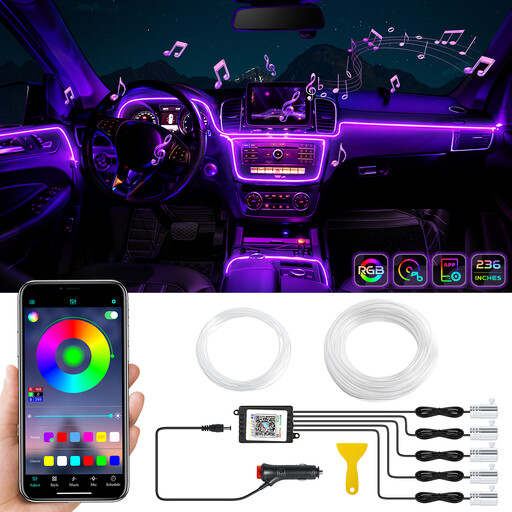
What sets it apart: Note that this is not a headliner kit, but an excellent alternative for complete ambient lighting. It outfits the centre console, all four doors, and the footwell area with acrylic fibre optic strips.
Highlights:
Who is it for? Perfect for those who want to modernise their entire interior with dynamic interior car LED light, without limiting themselves to the ceiling.

What sets it apart: Its “split” architecture is its real strength. The kit uses four mini light sources connected to a central box, which greatly simplifies hiding them and distributing the fibres over large areas. With its 1000 strands, it promises an exceptional star density.
Highlights:
Who is it for? This kit will delight demanding DIYers aiming for an ultra-detailed result, who will appreciate the modularity of the “split” design for a meticulous, custom-fit installation.
The lighting customisation of your cabin doesn't stop at the ceiling. From LED strips for the floorboards to ambient bulbs, the possibilities are endless for creating an atmosphere that reflects you.
To explore a full range of lighting solutions, from LED strips to accessories for your car or home, take a look at our colour lamp category.
The installation requires patience and precision, as you generally need to remove the vehicle's headliner to insert each fibre optic strand one by one. For an amateur DIYer, it's a perfectly achievable weekend project. You can find a multitude of video tutorials online to guide you step-by-step. If the task seems daunting, hiring a professional remains the best guarantee for a flawless result.
The lifespan of a kit primarily depends on its LED light source. Most quality LED engines are designed to run for tens of thousands of hours, which translates to many years of normal use. The PMMA (polymethyl methacrylate) fibre optics, for their part, are extremely durable and do not degrade over time.
No, the power consumption of these kits is truly minimal. They run on the car's 12V circuit and their power rarely exceeds 12 to 32W. This is comparable to other cabin lights: there's no risk of draining a healthy battery, even during prolonged use while parked.