
Livraison le jour même ou le lendemain

Qualité garantie

Débloquez vos offres de bienvenue: Livraison GRATUITE | Jusqu'à -80 % | 30 jours d'essai gratuits à JoyPlus
Téléchargez l'application
Back pain, stiff neck, fatigue... Long hours spent sitting while working from home or studying eventually take their toll. To regain energy and comfort, one solution is becoming increasingly popular:?the standing desk. By allowing you to effortlessly alternate between sitting and standing, it transforms your workspace into a healthier, more flexible environment.
This guide is designed to help you make an informed decision. We'll break down the essential criteria for choosing your height-adjustable desk and present our selection of the best models currently available, whether you're looking to optimise a small space or take advantage of the latest innovations.
Before you take the plunge, let's review a few technical points that will make all the difference in your daily routine.
First step: get out the tape measure!?Assess the available space in your home and list the equipment you plan to place on it. A 120?cm wide desktop is sufficient for a laptop and a monitor. For a dual-monitor setup or if you like to spread out your documents, aim for 160?cm to be comfortable. Don't overlook the depth (often 60 or 70?cm):?it's crucial for maintaining a healthy distance between your eyes and the screen.
The motor is the heart of your electric desk. Its quiet operation is a non-negotiable feature to avoid disturbing your concentration (or the rest of the household). A good motor is barely noticeable, with a noise level below 50?dB. But other features can be a real game-changer:
A good ergonomic desk must be perfectly stable, even at its highest setting. A sturdy steel frame is usually a good indicator of reliability. Check the maximum static load capacity:?70 to 80?kg is standard and more than enough for a typical work-from-home setup. Finally, don't underestimate cable management!?Grommets, trays, or hooks are essential for preventing chaos and keeping your workspace clean and safe.
Here is our selection of models that caught our eye, each with its own strengths to meet specific needs.
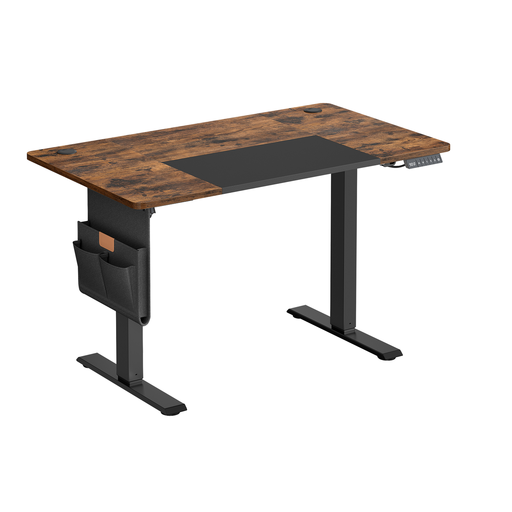
Why it stands out
This is the ideal solution for fitting a standing desk into a small space. With its compact 120?x?60?cm dimensions, it fits anywhere. Yet, it makes no compromises on key features:?its control panel includes a memory function to save your favourite heights, an activity reminder to encourage you to move, and an ever-practical USB-C port.
Pros
Who is it for?
Ideal for students or remote professionals with limited space who don't want to sacrifice the comfort of an adjustable desk and modern features.
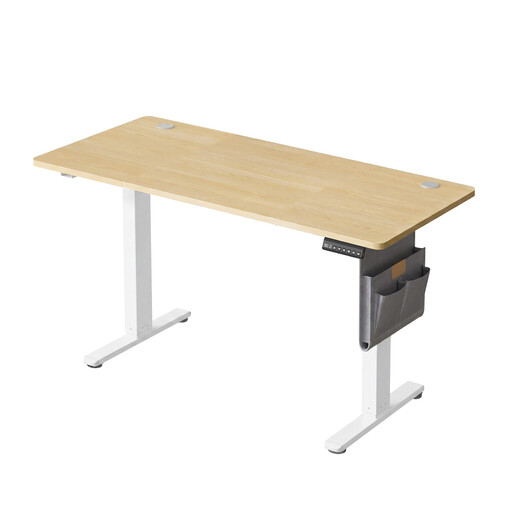
Why it stands out
Need more space??With its generous 160?x?70?cm desktop, this desk offers an XXL work surface, perfect for juggling multiple monitors, peripherals, and documents. Its stability is flawless, thanks to its steel frame and adjustable feet that compensate for minor floor imperfections. The control panel is also impressive, featuring a power-saving mode and a fast-charging USB-C port.
Pros
Who is it for?
This model is aimed at professionals who need a large workspace, such as developers, graphic designers, or anyone using a multi-monitor setup. Its large surface also makes it very versatile for creative hobbies.
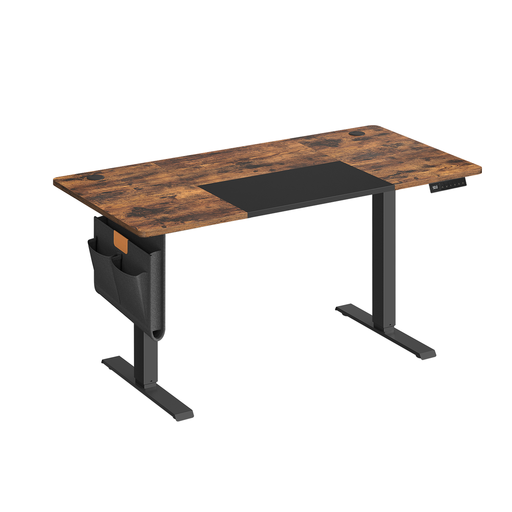
Why it stands out
This is the perfect middle ground. With its 140?x?60?cm dimensions, this desk offers an excellent compromise between a comfortable work surface and a manageable footprint. It checks all the boxes for a modern electric desk:?4 memory presets, a quiet motor, an anti-collision system, and a USB-C port. A significant bonus:?its assembly is designed to be quick and easy.
Pros
Who is it for?
This is the all-rounder option that will suit the majority of remote workers. It offers enough space to be comfortable without taking over the room, all while incorporating the most useful features.
A standing desk isn't the only option. If you prefer a fixed model with integrated storage, other solutions are available. To explore desks that blend design with practicality, take a look at our selection of grey desks with drawers, perfect for a consistently well-organised workspace.
There is no universal ideal height; it all depends on your body type. The golden rule, for both sitting and standing, is simple:?your elbows should form a right angle (90°) when your forearms are resting on the desktop, and your wrists should remain straight. This is where the memory function becomes your best ally:?save your two optimal heights and switch between them with a single press.
Rest assured, modern models are designed to be discreet. A good electric desk generates less than 50 decibels (dB) during adjustment, which is equivalent to a quiet conversation or the hum of a modern refrigerator. That's more than quiet enough not to disturb anyone, whether at the office or working from home.
The goal isn't to break an endurance record, but simply to move!?The secret is to alternate positions to break up a sedentary routine. A good practice is to alternate between 30 to 60-minute periods of sitting and standing. The most important thing is to listen to your body. In fact, some desks include a programmable alert to remind you when it's time to change position. Handy