If you regularly knead bread or brioche dough, start by comparing the amount of yeast dough each model can handle, the dough hook supplied and the bowl size against your usual batch sizes. An attachment-equipped stand mixer or food processor is also worth considering if you often chop, blend or grate ingredients; check its kneading capabilities and which attachments are actually compatible. For occasional baking, making dough by hand may save you from having another appliance taking up space.
Who are these options for?
Households that bake bread regularly
You regularly make bread, brioche, pizza or other stiff doughs, and would like the machine to do the kneading for you. The amount of yeast dough the model can handle and whether it comes with a dough hook matter more to you than extra features.
Families making batches of different sizes
You switch between cakes, pastry and whisked mixtures, sometimes in larger quantities. A bowl that suits your usual batch sizes is more useful than choosing a large capacity without considering smaller preparations.
Home cooks looking to combine several tasks
You also want to blend, chop, grate or slice ingredients regularly. Attachments for a stand mixer or the functions of a food processor can be useful if these tasks are genuinely part of your routine.
What should you look for before buying?
If you often make bread and brioche, look first at the kneading performance and the quantities you prepare. If you also use your appliance for chopping, blending or slicing, compare the functions of models with attachments or food processors too. For occasional use and smaller quantities, preparing everything by hand is still an option.
| Your priority |
What to check |
Who it matters to |
| Regularly making yeasted dough |
Compare the maximum amount of yeast dough stated for the exact model and check that it comes with a dough hook. Look for tests that assess kneading performance. |
When bread and brioche are often on the menu, I want to know whether the mixer can handle my batches without relying on the wattage alone. Around 40% of consumers prioritise this kneading requirement. |
| Batches of different sizes |
Compare the bowl capacity and stated dough quantity with what you usually make; also consider how easy the bowl is to handle. |
If I switch between small cakes and family-sized batches, a bowl that feels cumbersome for everyday use may not suit me. Around 30% of consumers put suitability for different quantities first. |
| Extra functions |
Identify the tasks you regularly do at home, then check which attachments are included and which are compatible with the model you have chosen. |
I also prepare ingredients for chopping, blending or grating and want to use these functions regularly. This versatility is the main priority for around 20% of consumers. |
| Storage space and cleaning |
Check the dimensions, weight, clearance needed to lift the mixer head and the cleaning instructions for the model. |
If I only make modest quantities and need to put the appliance away after use, how easy it is to handle could determine whether I buy it. Around 10% of consumers prioritise storage space and cleaning. |
Mistakes to avoid
-
Assuming wattage tells you how well a mixer kneads
The stated power and number of speed settings alone don’t tell you how much yeast dough a machine can handle or how well it will perform. Que Choisir’s testing protocol includes an assessment of how the machine kneads bread dough.
Compare the stated capacities of the specific models you’re considering and, where possible, look for tests carried out with bread dough.
-
Choosing lots of attachments without a use in mind
A mincer, grater or blender won’t help with your cooking if it stays in the cupboard; these attachments also take up space and need cleaning.
List the tasks you actually do, then check which attachments come with the model and which are optional extras compatible with it.
-
Judging dough capacity by bowl size
Two bowls of a similar capacity won’t necessarily handle the same amount of yeast dough. A large bowl can also be more awkward to move or clean when you’re making a small batch.
Look up the dough limit stated for the exact model and compare it with the quantities you usually make.
-
Assuming an attachment fits every model from a brand
Compatibility can vary by range, bowl size or mixer configuration. KitchenAid, for example, lists different attachments depending on whether a model has a tilt-head or a bowl-lift design.
Before buying an attachment separately, check your mixer’s model number against the manufacturer’s compatibility list.
Brands to know
These ranges show different ways of combining baking with extra functions. Always compare the specifications of the exact model rather than choosing based on the brand name alone.
Moulinex
The range includes the Bake Partner with a 4.6 L bowl and the Masterchef Grande with a 6.7 L bowl, according to Moulinex’s product information.
- Moulinex describes how the whisk, beater and dough hook can be used for different preparations. The brand states that the Masterchef Grande can handle up to 2.2 kg of bread dough.
- The stated capacity for the Masterchef Grande doesn’t apply to other models in the range, so compare it with the size of your batches.
Kenwood
The Chef and Chef XL ranges include stand mixers that can be equipped with extra functions or attachments, depending on the model.
- Kenwood highlights an integrated scale, a heating function and adaptable attachments for the Titanium Chef Patissier XL KWL90.034SI.
- Check which functions you’ll use and which attachments are actually included with the configuration you’re considering.
Bosch
Depending on the model, the MUM range can be fitted with attachments for tasks beyond baking.
- Bosch lists attachments for mincing, slicing, blending and making fresh pasta, among other uses.
- Check compatibility with the exact mixer series and distinguish between attachments included and those sold separately.
KitchenAid
The range includes stand mixers with a tilt-head design and models with a bowl-lift design.
- KitchenAid lists dough hooks, whisks and flat beaters, as well as additional attachments.
- Compatibility varies according to the mixer’s design and size, so check the exact model number before buying an attachment separately.
Stand mixers and models with attachments on Joybuy
These models are mainly suited to kneading and home baking; the Robby also comes with a blender and mincer. If bread or brioche is your priority, compare the amount of dough each model can handle before choosing based on bowl size.
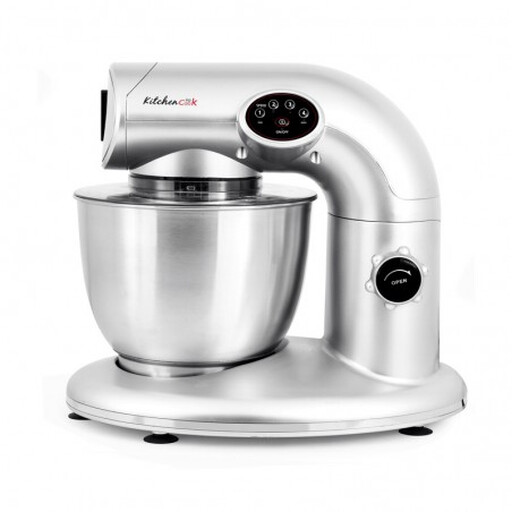 Image unavailable
KITCHENCOOK Model AK80, silver
Worth considering if you’re looking for a mixer mainly for baking and kneading. For bread and brioche, check how much dough it can handle and the kneading instructions for your batch sizes.
View on Joybuy
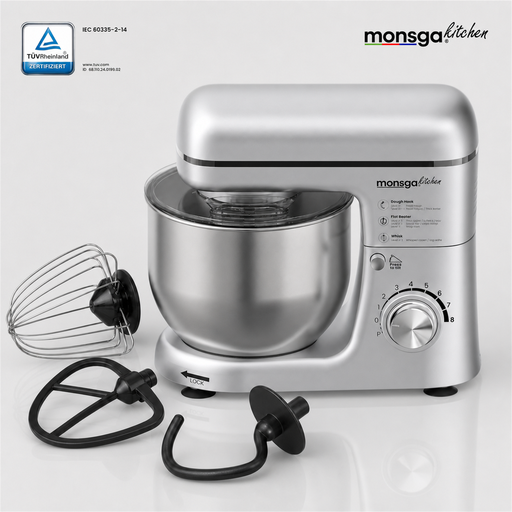 Image unavailable
Monsga SM100, 5.0L bowl, black and silver
For switching between kneading and whisking, this model is listed with a dough hook, whisk and splash guard. Its product title specifies a 5.0L bowl, 1000W rated power and 8 speeds; check separately how much yeast dough it can handle for your batch sizes.
View on Joybuy
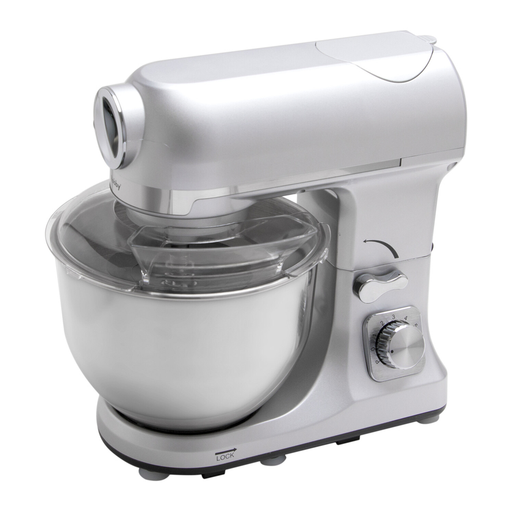 Image unavailable
Robby, 5L mixer with 1.5L blender and mincer
Consider this model if you also use a blender and mincer for your usual preparations. The product title specifies a 5L bowl, a 1.5L blender and 1000W rated power; if you knead regularly, check the maximum amount of yeast dough this model can handle.
View on Joybuy
 Image unavailable
AUCMA ASM1559, 6L bowl, black
For mixing, whisking and kneading, the product title lists a dough hook, beater and whisk. It specifies a 6L SUS304 bowl, a tilt-head design, 6 speeds and 450W rated power; bowl size alone doesn’t tell you how much yeast dough the mixer can handle.
View on Joybuy
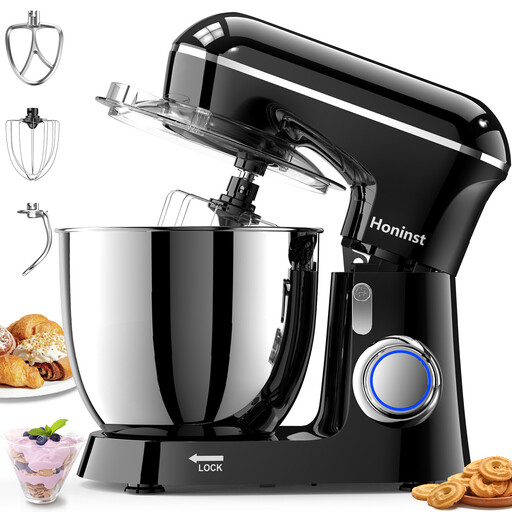 Image unavailable
Honinst, 6.5QT tilt-head stand mixer
For switching between baking and kneading, the product title lists a dough hook, whisk and beater. It specifies a 6.5QT bowl and 10 speeds; before planning large batches of bread, check how much yeast dough this model can handle.
View on Joybuy
Frequently asked questions
Which tools should you check for making bread, brioche and other bakes?
Check whether the mixer comes with a dough hook, beater and whisk. The dough hook is designed for stiff doughs, while the other two tools are used for mixing and whisking; check they’re included with the exact configuration you’re buying.
Will a more powerful mixer necessarily knead better?
No. Wattage alone isn’t enough to compare mixers for bread and brioche. Que Choisir recommends considering kneading tasks and includes bread dough in its testing; compare this information with the amount of dough you prepare.
How do you choose the right bowl size?
Start with the size of your usual batches and check the stated dough capacity for the exact model, rather than comparing litres alone. If you often make small quantities, also consider how easy the bowl is to handle and clean.
Does a new stand mixer bought from a retailer come with a statutory guarantee in France?
Yes. According to the French Ministry of the Economy, the statutory guarantee of conformity applies to new goods sold by a retailer to a private individual in France. Any commercial guarantee offered is in addition to this protection, not a replacement for it.


