
Livraison le jour même ou le lendemain

Qualité garantie

Débloquez vos offres de bienvenue: Livraison GRATUITE | Jusqu'à -80 % | 30 jours d'essai gratuits à JoyPlus
Téléchargez l'application
Fluffy brioches, golden-crusted breads, airy cakes… For many baking enthusiasts, homemade is a true pleasure. But kneading by hand and mixing for long minutes can quickly become a chore. This is where the stand mixer comes in?: the ideal companion for turning these demanding tasks into a breeze.
With a crowded market, finding the right one can be tough. This guide is designed to give you practical, objective advice to help you find the kitchen machine that perfectly fits your needs and budget, without getting lost in marketing jargon.
Before you take the plunge, it's essential to understand a few technical features that will make all the difference in your daily use.
Power, measured in watts?(W), is often the number one selling point. While a powerful motor is essential for handling heavy doughs (bread, pizza), the quality of its design is just as crucial. A pure copper alternating current (AC) motor, for example, often offers better durability and more consistent performance. A good dough mixer must be able to maintain a constant speed without overheating. Look for models with overheat protection for peace of mind.
The bowl size is a key factor. A 5L bowl is a versatile option, ideal for most family-sized batches, whether you're whipping egg whites or kneading bread dough.
The three basic attachments included with most models are?:
A splash guard is also a significant plus for keeping your countertop spotless.
A good cake mixer should be easy to use. A tilt-head design makes it much easier to attach the bowl and change accessories. For stability, suction cup feet are a key safety feature?: they prevent the machine from moving, even at full speed. Finally, the noise level is a comfort factor not to be underestimated, especially if you use it frequently. A quiet stand mixer (usually under 75?dB) will make the experience much more pleasant.
To guide you, here is a selection of models that stand out for their performance and value.

Why It Stands Out
This AUCMA model focuses on efficiency and durability with its 400W pure copper AC motor. It's designed to deliver stable performance with a controlled noise level (under 75?dB). Its 10 speeds and pulse function allow for precise control over a wide variety of recipes. The internal structure, combining metal gears and ball bearings, is a testament to its robustness.
Pros
Who Is It For?? Ideal for home bakers looking for a reliable, versatile, and quiet appliance for their daily creations, from the heaviest bread doughs to the most delicate creams.
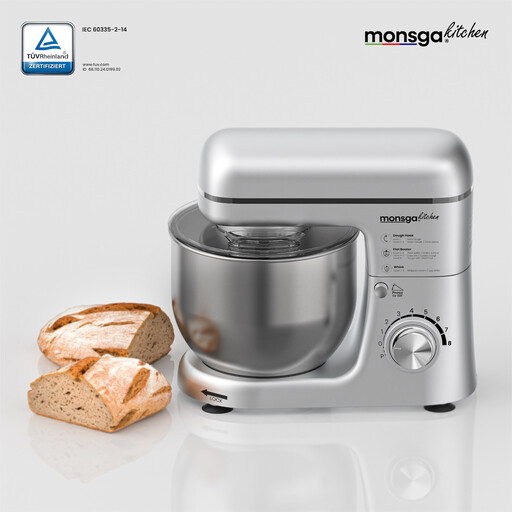
Why It Stands Out
The Monsga SM100 stands out with its powerful 1000W motor and 360° planetary mixing action. This combination ensures a perfectly uniform mix, leaving no ingredients behind. Its large 5L bowl with a handle is very practical for large batches, and its dishwasher-safe attachments make cleanup a breeze.
Pros
Who Is It For?? Perfect for those who frequently make dense doughs (bread, pizza, etc.) and need the power of a high-performance mixer for flawless results every time.

Why It Stands Out
This model shares the excellent technical features of its black and silver counterpart, including its 1000W motor and 5L bowl. It distinguishes itself with a very elegant cream finish and a major advantage?: a dough hook with a Teflon non-stick coating, which makes removing the dough and cleaning up much easier.
Pros
Who Is It For?? For those seeking an appliance that combines high performance with a stylish design for their kitchen. The non-stick hook is a real bonus for anyone tired of spending time cleaning up after making sticky doughs.
An efficient stand mixer will save you precious time. To further optimise your space, a well-organised kitchen is key. If you're looking for solutions to hang your utensils and free up your countertop, take a look at our selection of kitchen hooks.
It all depends on your usage. For light mixtures (creams, cakes), 300 to 500W is sufficient, provided the motor is of good quality. For regularly kneading heavy doughs (bread, brioche), a power of 800W or more is recommended to ensure the appliance's efficiency and longevity.
Absolutely, it's one of its flagship features. Thanks to its dough hook and powerful motor, the kneading machine replicates the baker's work efficiently and effortlessly. It helps develop the dough's gluten network, which is essential for achieving a well-risen loaf with an airy crumb.
The stand mixer is a specialist?: its mission is to mix, whip, and knead using its planetary action and dedicated attachments (whisk, paddle, hook). The food processor, on the other hand, is a Swiss Army knife?: it is equipped with blades to chop, blend, slice, or grate in a bowl with a central spindle. Although some models offer kneading attachments, they are rarely as effective as a true stand mixer when it comes to tackling heavy doughs.