
Livraison le jour même ou le lendemain

Qualité garantie

Débloquez vos offres de bienvenue: Livraison GRATUITE | Jusqu'à -80 % | 30 jours d'essai gratuits à JoyPlus
Téléchargez l'application
A stand mixer makes light work of bread, brioche and pizza dough, as well as cakes, biscuits, creams and whisking egg whites. Yet a spec sheet doesn’t always tell the full story. High power, a large bowl or a dozen speeds aren’t enough to guarantee the appliance will be a pleasure to use day in, day out.
Before you place your order, take the time to spot the most common pitfalls and check a few really practical criteria.
Some manufacturers highlight a “maximum” or “peak” power rating. This figure can be very different from the nominal power – that is, the power actually available during continuous operation. When kneading a dense dough, compare the information provided and don’t rely solely on the first wattage you see.
A motor advertised at 1,000 W peak might, for example, deliver 600 W nominal power. This distinction gives you a more realistic idea of the electric mixer’s capabilities for thick mixtures or prolonged kneading.
A large bowl is handy for families and generous batches, but it can be less effective with small quantities. Conversely, a 5-litre bowl is perfectly adequate for everyday cakes and doughs, yet can reach its limits when you need to prepare several loaves of bread.
Always check the difference between the total capacity and the recommended usable capacity. A bowl advertised as 6 litres may not be able to be filled to the brim with a risen dough.
With a dough hook, a whisk and a flat beater, a stand mixer covers the essentials. However, the shape of the accessories, their material, storage and maintenance all have a direct impact on ease of use.
Also be wary of overly vague cleaning instructions. Some parts are dishwasher-safe, while others must be washed by hand. As for the motor unit, it should never be immersed.
For versatile use, go for an appliance with multiple speeds and a soft start. A 10-speed stand mixer lets you move from a slow mix to a lighter preparation, but an 8-speed model is already sufficient for most everyday recipes.
When present, planetary mixing means the attachment rotates on its own axis while moving around the bowl. This covers a larger area of the bowl and helps incorporate ingredients. It won’t, however, save you from scraping down the sides for some mixtures.
For kneading, stick to a low or medium speed and respect the maximum time stated in the manual. A heavy dough can put the motor under strain, even when the advertised power seems generous.
A stand mixer with a stainless steel bowl is generally easy to clean and robust enough for regular food use. The models in this selection have a capacity between 5 litres and approximately 6.2 litres.
The weight and non-slip feet also deserve your attention. A stand mixer needs to stay firmly in place on your worktop, especially during kneading.
The three essential accessories are:
Also check for a tilting head, a splash guard, overload protection and a cut-out device when the head is raised. For use in the UK, make sure the appliance accepts a 220–240 V, 50–60 Hz supply, where this information is stated.

Why this choice suits this profile: with its 5 L bowl and simple controls, this model is ideal for those starting out in home baking. It lets you make cakes, pizza doughs and whisk egg whites without investing in a larger appliance.
The spec lists a 220–240 V supply, 10 speeds and a pulse function. Concrete information, far more useful than a simple promise of versatility.
5 L stainless steel bowl, dough hook, whisk, beater and suction feet to stop the appliance moving on your worktop.

Why this choice suits this profile: its large stainless steel bowl and 10 speed settings are aimed at households that often prepare a variety of recipes, sometimes in large quantities.
The stated capacity is approximately 6.2 L and the accessories are clearly identified: dough hook, beater and whisk. So you can check they suit your recipes before buying.
Tilting head, splash guard, overheat protection and non-slip feet.
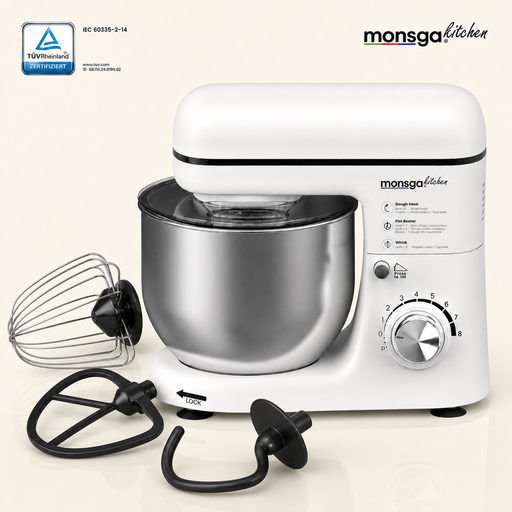
Why this choice suits this profile: this model is designed for regular preparation of bread, pizza, cakes and creams, particularly when bowl capacity and stability matter more than compactness.
The spec distinguishes a peak power of 1,000 W and a nominal power of 600 W, while also stating that the recommended capacity is lower than the total bowl volume.
8 speeds, planetary mixing, 6 L stainless steel bowl and accessories stated as dishwasher-safe.
We’ve put together a comprehensive selection, updated in real time, of products that meet these exacting criteria as well as European safety standards.
Respect the maximum quantities and avoid running a heavily loaded motor for longer than the manual recommends. With a thick dough, start slowly to minimise splashes and jerks.
Always unplug the appliance before changing an attachment. Clean the bowl and utensils following the manufacturer’s instructions, then wipe the motor unit with a slightly damp cloth. Good airflow around the vents and storing the mixer in a dry place will also help preserve it.
A 5-litre bowl is generally suitable for everyday family preparations. For several loaves of bread, large batches of biscuits or recipes for many guests, a stand mixer of around 6 litres will give you more leeway. However, always check the recommended dough quantity from the manufacturer, rather than just the bowl volume.
With its accessories, it can mix, whisk and knead many preparations. However, it doesn’t always replace a blender or stick blender for soups, smooth sauces and liquid mixtures. The right choice therefore depends mainly on the recipes you make most often.
The power consumption depends on the nominal wattage, the duration of use and your electricity tariff. A few minutes to whisk cream generally uses less than prolonged kneading. To compare models, look at the stated power, the recommended usage times and any motor protection features.