
Livraison le jour même ou le lendemain

Qualité garantie

Débloquez vos offres de bienvenue: Livraison GRATUITE | Jusqu'à -80 % | 30 jours d'essai gratuits à JoyPlus
Téléchargez l'application
An essential tool for baking enthusiasts and an invaluable everyday ally for families, the stand mixer has it all. But with a dizzying array of models, power ratings, and attachments, it's easy to get lost.
Our mission is to help you see clearly. This guide cuts through the marketing jargon, offering practical advice and a selection of tried-and-tested models. The goal: to find the mixer that truly fits your needs and your budget.
Before diving into our top picks, let's review the key criteria to ensure you make the right choice.
Power (in watts) is the key factor: it determines the mixer's ability to tackle the densest doughs. For occasional use (cake batters, light creams), a 400 to 600 W motor will suffice. However, if you dream of homemade bread and fluffy brioche, aim higher: a stand mixer with at least 1000 W will guarantee endurance and efficiency.
Planetary mixing action isn't a gimmick; it's an essential technology. The attachment spins on its own axis while also orbiting the bowl. The result is a perfectly uniform mixture that leaves no ingredients behind, either on the sides or at the bottom.
The bowl's capacity, typically ranging from 4 to 7 litres, should match your needs. For a family, a 5-litre bowl is a good sweet spot. It's large enough to prepare dough for two loaves of bread or a dozen cupcakes.
The essential starter kit includes three attachments: the whisk (for egg whites and whipped cream), the flat beater (for cake batters and frostings), and the dough hook (for yeast doughs like bread or brioche). Some models go further, transforming into true multifunction kitchen machines with optional attachments like a blender, meat grinder, or pasta roller. A stand mixer with a blender attachment is an excellent solution for saving counter space.
We've selected three models that stand out for their performance and value for money.
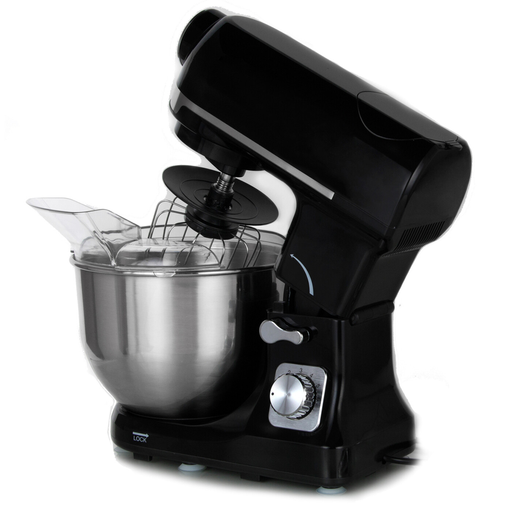
Why it stands out: Much more than a simple pastry mixer, this is a true all-in-one kitchen station. It includes a glass blender and a meat grinder, making it incredibly versatile.
Key features:
Who is it for? This is the ideal choice for those who want one appliance to do it all. If counter space is at a premium and you enjoy making a variety of things (smoothies, minced meat, sauces, etc.), this multifunction kitchen machine is a remarkably effective option.
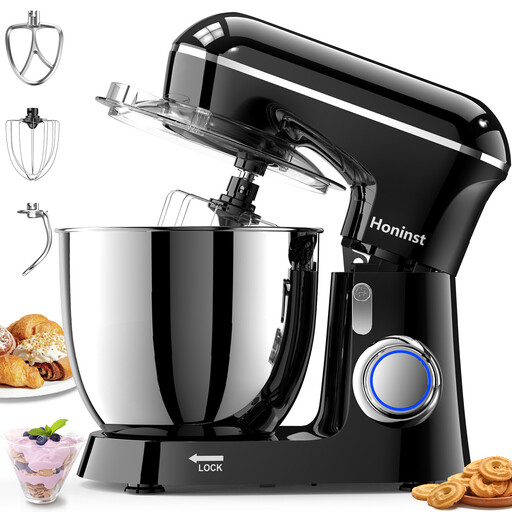
Why it stands out: With its extra-large 6.2-litre (6.5QT) bowl and 10 speeds, this mixer is for those who think big and demand precision.
Key features:
Who is it for? For experienced home bakers and large families who cook in big quantities. Its generous capacity ensures you won't feel limited, even with the most ambitious recipes.

Why it stands out: This model focuses on efficiency and user comfort. Its pure copper AC motor and noise-reducing design make it a quiet yet powerful ally.
Key features:
Who is it for? An excellent choice for daily use. It's suitable for beginners and experienced home bakers alike who are looking for a reliable, high-performing, and quiet machine for their baking and bread-making recipes.
Our selection focuses on versatile models, but personal preference also comes down to design and colour. If you're looking for a specific style, other options are available.
? Discover our complete collection of Black Kitchen Mixers to find other models.
It all depends on your usage. For light batters (pancakes, cakes), 400 to 600 W is more than enough. However, if you plan to regularly knead dense doughs (bread, brioche), a motor of at least 1000 W is essential to avoid overworking it and to ensure a good result.
Yes, and it's one of its greatest strengths! A mixer for bread making is equipped with a dough hook that perfectly mimics a baker's kneading motion, developing the dough's gluten network effortlessly. Just be sure to choose a model with a sufficiently powerful motor and good stability.
A classic electric mixer simply rotates its beaters on their own axis. Planetary action, on the other hand, is much smarter: the attachment (whisk, beater, hook) spins on its axis while also orbiting around the bowl. This dual rotation ensures that the entire bowl is scraped, resulting in a mix that is incomparably faster, more uniform, and leaves nothing stuck to the sides.