
Livraison le jour même ou le lendemain

Qualité garantie

Débloquez vos offres de bienvenue: Livraison GRATUITE | Jusqu'à -80 % | 30 jours d'essai gratuits à JoyPlus
Téléchargez l'application
Homemade brioche, egg whites whipped to perfection, effortlessly kneaded bread dough... A dream? Not quite. A stand mixer, sometimes called a kitchen machine, is the essential partner that makes these tasks feel like child's play. But with an overwhelming number of options on the market, it can be difficult to know where to start.
I'm the Head of Buying Guides at Joybuy, and my role is to do the legwork for you. This guide gives you everything you need to understand the criteria that really matter and presents a selection of models for every need and budget. The goal? To help you make the right choice, plain and simple.
Before diving into our selection, let's review the key points that will help you find the perfect baking mixer for you.
Power, measured in watts (W), is a good indicator, but don't rely on it blindly. A powerful stand mixer is essential for tackling heavy doughs like bread or brioche. But the motor's technology is just as crucial. A direct current (DC) motor is often quieter and more efficient at low speeds than an alternating current (AC) motor of the same wattage.
Also, check that the mixer features planetary action. This means the attachment (whisk, beater, hook) spins on its own axis while also sweeping the sides of the bowl. This guarantees a perfectly homogeneous mixture, with no ingredients left behind on the sides.
The size of the bowl, in litres, depends directly on your usage. For a single person or a couple, a 3 to 4-litre bowl may be sufficient. For a family or if you cook in large quantities, aim for a 5L stand mixer or larger.
Stainless steel is the gold standard: it's durable, hygienic, easy to clean, and doesn't retain odours or tastes. A handle on the bowl isn't a luxury; it's a real plus for everyday convenience.
A good dough mixer must come with the basic trio of attachments:
Finally, don't underestimate the noise. A quiet stand mixer generally operates below 75 decibels (dB). This information is increasingly highlighted by manufacturers and is a real factor for daily comfort.
We've scoured the market to select three models with an unbeatable performance-to-price ratio, each tailored to a specific user profile.

What sets it apart: The Monsga SM100 is the ideal entry point for getting serious about baking. It offers very decent power, a good-sized bowl, and relatively quiet operation, all in a very attractive cream design.
Key Features:
Who is it for? Home bakers looking for a versatile and reliable appliance for regular use, capable of handling everything from cakes to yeast doughs without breaking the bank.

What sets it apart: This Aucma model focuses on durability and precision. Its 400W pure copper AC motor is a guarantee of longevity, while its 10 speeds allow for incredibly fine control.
Key Features:
Who is it for? Cooks looking for a reliable and precise kitchen machine that can adapt to delicate recipes as well as demanding preparations, and who prioritise motor longevity.
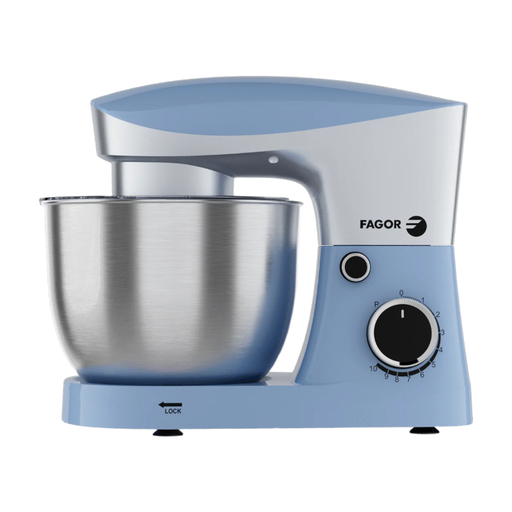
What sets it apart: The FAGOR FG4519 is for those who think big. With its 1500W DC motor and huge 6-litre bowl, it's built for large households and the densest doughs. This borders on professional-grade performance.
Key Features:
Who is it for? Baking enthusiasts who need a mixer for making bread in large quantities, large families, and anyone who wants to make no compromises on power and capacity.
Our selection focuses on specific needs, but the world of kitchen machines is much broader. To discover other models or explore different types of appliances, feel free to browse our full catalogue.
? Discover our complete range of electric mixers to find the appliance that will transform your kitchen.
1. What is a good wattage for a stand mixer? For versatile use, 1000W is a good starting point. For regularly kneading heavy doughs (over 1 kg of flour), a 1200W model or higher, ideally with a direct current (DC) motor, will be more comfortable and durable. But don't just focus on watts: the quality of the mechanics is just as crucial.
2. Can you really make bread with a stand mixer? Absolutely, it's one of its greatest strengths. The dough hook is designed specifically for this: it replicates the baker's kneading motion to develop the dough's gluten network, which is essential for an airy crumb, all without the slightest effort.
3. How do you clean a stand mixer? The golden rule: always unplug the appliance before cleaning it. The body of the mixer can be cleaned with a simple damp cloth. As for the bowl and accessories, most stainless steel or metal parts are dishwasher-safe, which greatly simplifies maintenance. Always check the manufacturer's instructions if in doubt.