
Livraison le jour même ou le lendemain

Qualité garantie

Débloquez vos offres de bienvenue: Livraison GRATUITE | Jusqu'à -80 % | 30 jours d'essai gratuits à JoyPlus
Téléchargez l'application
A stainless steel steamer lets you cook vegetables, fish, dumplings, rice or couscous with little to no fat. But not all models are created equal, depending on how you plan to use them. Whether you opt for a stainless steel steamer pot, a removable steamer basket or an electric appliance, factors like capacity, compatibility with your hob and ease of maintenance can make a real difference to your daily cooking.
Before you place your order, there are three common pitfalls worth checking.
A 3-tier steamer might look particularly spacious. However, the advertised volume doesn't always reflect the actual space available for your food. The baskets can be narrow or too shallow to hold a large piece of fish or certain bulky vegetables.
For two people, one or two tiers are often more than enough. For a family or when cooking several ingredients at once, check the diameter of the baskets, their usable height and whether you can use them separately.
The claim "suitable for all hobs" needs to be backed up by a genuinely compatible base. A steamer pot that works with induction usually needs a sufficiently thick magnetic base. If you cook on gas, also make sure the flame stays centred under the base to minimise discolouration and the risk of overheating.
The product listing should specify compatibility with induction, gas, electric or ceramic hobs. If the information is vague or incomplete, it's best to consult the manual or the manufacturer's instructions before buying.
Stainless steel handles regular use very well, but it can develop white marks from minerals in the water, rainbow-like heat stains or manufacturing residues when new. These marks don't necessarily mean the utensil is damaged, but they do require the right cleaning approach.
A glass lid and dishwasher-safe baskets can make maintenance much easier. On the other hand, some models must be washed by hand only.
304 stainless steel is commonly used for utensils that come into contact with food. It is valued for its resistance to corrosion and the fact it has no coating that could flake off. Some manufacturers refer to it as 18/8 composition, another common term in the world of stainless steel cookware.
However, don't stop at the material stated. Also look at:
A model described as a non-coated stainless steel steamer avoids the need to replace a damaged non-stick coating. However, food may stick more in the lower section if the temperature is too high.
A steamer basket with wide perforations is suitable for vegetables, fish and dim sum. Finer holes are better at holding small grains, semolina and delicate foods.
A 3-tier steamer allows you to separate ingredients and cook several items at once. However, you need to arrange the food so it doesn't block the steam flow. For couscous, choose an appliance with a fine basket or a special attachment for semolina: a stainless steel couscoussier will often be more suitable than a simple stackable pot.
An induction-compatible steamer pot sits directly on your hob and doesn't need plugging in. It's a great choice if you already have a suitable pot and prefer not to clutter your kitchen with extra appliances.
An electric steamer usually comes with a timer, a separate water tank and sometimes a keep-warm function. However, it does need storage space and a nearby power socket. For frequent use or cooking complete meals, these features can save you time.
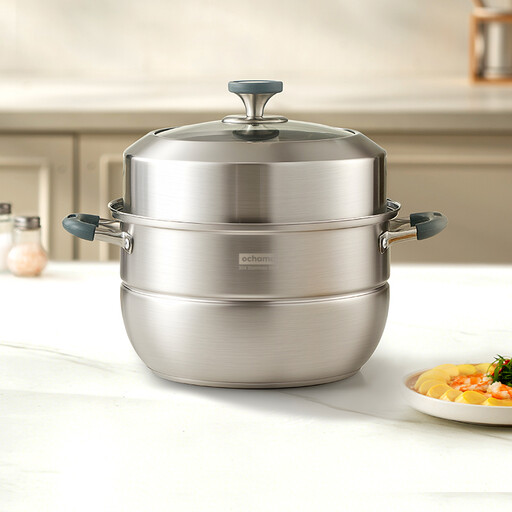
Why this choice suits this profile: with its two tiers, this model is aimed at those who want to discover steam cooking with a simple utensil, no motor or programming required. It is made from 304 stainless steel and is compatible with both induction and gas hobs.
The number of tiers is clearly stated, so you won't confuse the advertised capacity with the actual usable space. The steamer can be used on several types of hob.
Stated 304 stainless steel, stackable baskets and compatibility with induction and gas.
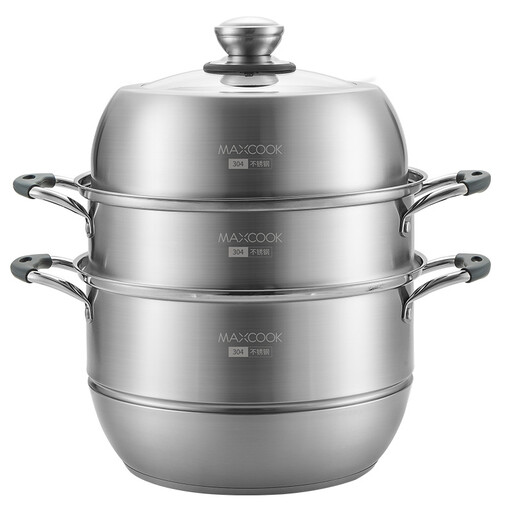
Why this choice suits this profile: its three tiers let you organise several dishes in a 28 cm stainless steel steamer pot. The glass lid means you can keep an eye on the cooking without lifting it repeatedly.
Compatibility is stated for induction, gas, electric and ceramic hobs. The handles have heat-resistant silicone covers.
Three tiers, glass lid and composite base compatible with multiple heat sources.
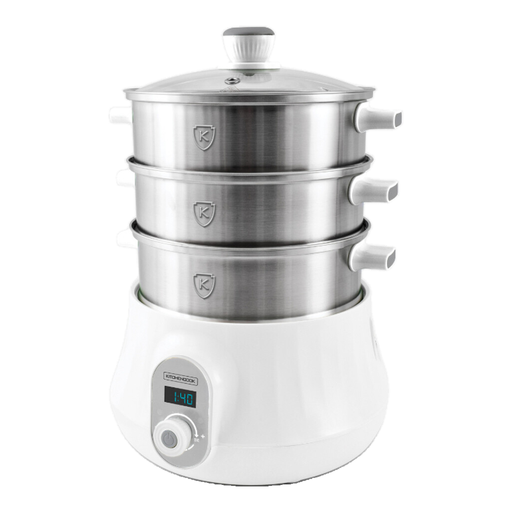
Why this choice suits this profile: with 9 litres split across three 3-litre tiers, this electric appliance is ideal for family meals and preparing couscous. Its timer can be set up to 100 minutes, and the keep-warm function works for up to 120 minutes.
The 2-litre water tank, MIN/MAX markings and overheat protection are designed for longer cooking sessions.
Total capacity of 9 litres, couscoussier function, timer and dishwasher-safe parts.
We've put together a comprehensive, real-time selection of products that meet these demanding criteria as well as European safety standards.
Before using a stainless steel steamer for the first time, wash each part in hot water with washing-up liquid. For some models, boiling water for a few minutes and then wiping everything dry will remove any polishing residues.
During cooking:
With an electric model, never immerse the base in water. Unplug the appliance before cleaning and make sure the water level stays between the minimum and maximum marks.
Yes, provided its base has a compatible magnetic bottom. The listing or manual should state "suitable for all hobs". The diameter of the base must also match your cooking zone.
Its lifespan depends on the thickness of the steel, the quality of the handles, how often you use it and how you care for it. Gentle washing, drying after each use and moderate heating all help preserve the appearance of the stainless steel and the strength of the joins. A cracked or chipped glass lid should be replaced.
It depends on its power rating and how long you use it. A 600 W appliance used for one hour consumes around 0.6 kWh, not including the keep-warm phase. To estimate the actual cost, check the stated power, the typical cycle length and your electricity tariff.