
Livraison le jour même ou le lendemain

Qualité garantie

Débloquez vos offres de bienvenue: Livraison GRATUITE | Jusqu'à -80 % | 30 jours d'essai gratuits à JoyPlus
Téléchargez l'application
Tired of pans that warp at the first sign of high heat, coatings that flake off after a few months, and uncertainty about what your cookware is made of?? Choosing a new pan can quickly become a headache. In this context, the stainless steel pan has established itself as a gold standard for home cooks and professional chefs alike, prized for its unbeatable durability and perfectly non-reactive surface.
This guide is here to help you navigate the options, understand the key criteria before you buy, and discover our selection of models that meet every need—from perfectly searing a steak to preparing slow-simmered dishes.
Before you start shopping, it's crucial to understand what separates an excellent stainless steel pan from a low-end model. Here are three key points to check to make the right choice.
A multi-ply pan is built by bonding together several layers of metal. Most commonly, a core of aluminium or copper (excellent heat conductors) is encapsulated between two layers of stainless steel.
This technology ensures the pan heats up quickly and, most importantly, distributes heat perfectly evenly across the entire surface. The result?? Precise, controlled cooking without the infamous “?hot spots?” that burn food, all while offering greater energy efficiency. This is THE feature that brings your cookware closer to professional-grade equipment.
Is your kitchen equipped with an induction cooktop?? Make sure the pan you want is compatible with all stovetops, including induction. This information is easy to find?: look for the coil-shaped pictogram on the packaging or the bottom of the pan.
Versatility also comes down to having a lid. Far from being a mere accessory, a pan with a lid allows you to simmer, steam, and keep food moist, transforming your pan into a truly versatile piece of cookware.
The main advantage of stainless steel is that it's inert. This perfectly stable material doesn't react with food, not even acidic ingredients like tomatoes or lemon. This ensures healthy cooking, with no risk of particles leaching into your food.
For those wary of traditional non-stick coatings, stainless steel is a safe haven. Plus, manufacturers are innovating with textured surfaces (like a honeycomb pattern) or next-generation ceramic coatings that are guaranteed PFOA-free, PTFE-free, and free of other controversial compounds.
To guide you, our editors have scrutinized several models, evaluating their technical specs, design, and, most importantly, their real-world performance under both daily and intensive use.
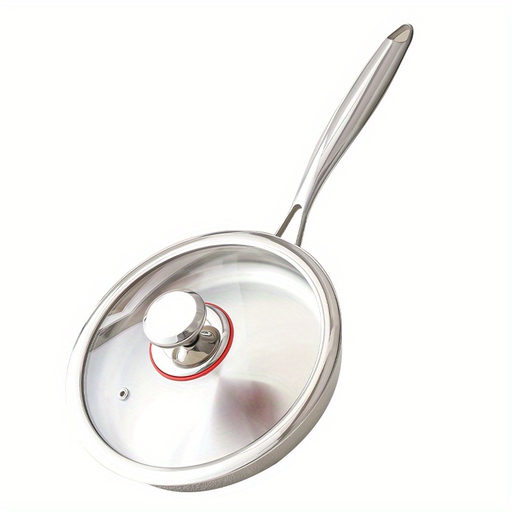
Why it stands out?: This model is an excellent ambassador for multi-ply technology. Its triple-layer base (stainless steel-aluminium-stainless steel) ensures heat diffusion that is both rapid and perfectly uniform—a must for searing meat or creating a delicate sauce. The glass lid, rimmed with insulating silicone, is a clever detail that lets you monitor cooking without getting burned or losing heat.
Pros?:
Who is it for? For everyday cooks who want a reliable, high-performance pan for daily meals. Its excellent thermal conductivity makes it a top choice for those who value precision.
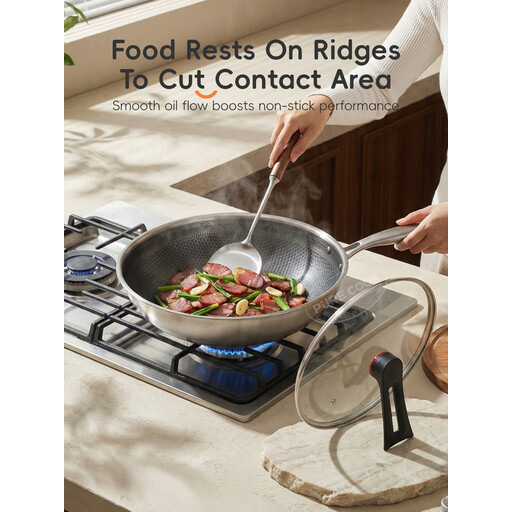
Why it stands out?: This stainless steel wok stands out from the crowd with its textured honeycomb cooking surface. This raised pattern creates a micro-air barrier that limits direct contact between the food and the pan's base, providing a natural non-stick effect without any chemical coatings. It's an ingenious solution for healthier cooking with very little oil.
Pros?:
Who is it for? For wok cooking enthusiasts and anyone looking for a large, do-it-all pan. An excellent choice for large families or for cooking in big batches, all while going easy on the oil.
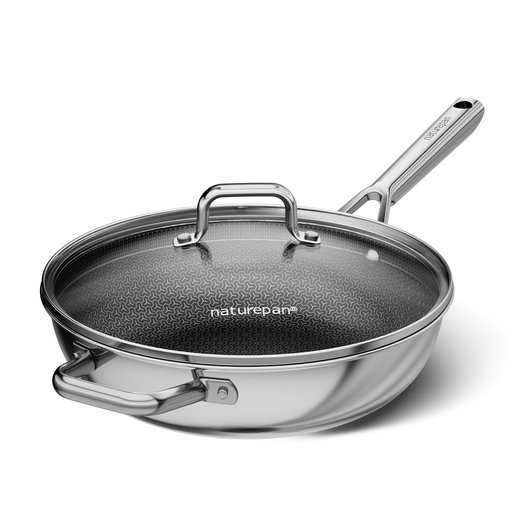
Why it stands out?: This pan successfully combines the robustness of stainless steel with an exclusive ceramic coating, reinforced with diamond and titanium particles. Guaranteed PFOA-free, PFAS-free, and PTFE-free, it offers the convenience of a non-stick surface while promising enhanced longevity. With its high sides and lid, it transforms into a sauté pan or a small casserole dish in an instant.
Pros?:
Who is it for? For those who refuse to compromise between the performance of stainless steel and the convenience of a healthy non-stick surface. Its ability to go from stovetop to oven makes it a powerful ally for more elaborate recipes.
Our selection highlights highly versatile models. To round out your setup, don't forget the accessories that make a difference, like a perfectly fitting lid or other stainless steel utensils to complete your cookware set.
Discover our collection of stainless steel kitchen lids.
This is the number one concern?! Unlike a non-stick pan, stainless steel requires a bit of technique?: always preheat the pan dry over medium heat for one to two minutes. Then, add your fat or oil. As soon as it begins to shimmer slightly, you can add your food. This technique, which relies on the Maillard reaction, creates a natural barrier that prevents food from sticking and ensures perfect caramelisation.
It couldn't be simpler. After use, let the pan cool for a few moments to avoid thermal shock. Washing with hot water, a soft sponge, and dish soap is usually enough. For stubborn residue, a little hot water and baking soda will work wonders. Above all, avoid abrasive sponges and steel wool, which will definitely scratch the surface.
Yes, the vast majority of modern stainless steel pans, especially multi-ply models, are compatible with induction. To be sure, look for the coil-shaped pictogram (the “?induction?” logo) on the bottom of the pan or its packaging. For induction technology to work, it requires a base made of a ferromagnetic material.