
Same-day & Next-day Delivery

Quality Guaranteed

Unlock Your Welcome Offers: FREE Delivery | Up to 80% OFF | Free 30-day JoyPlus trial
Download the APP
The stainless steel mixing bowl is a staple in our kitchens, whether for whisking egg whites, preparing cake batter, or simply tossing a salad. However, its apparent simplicity can hide some very real pitfalls: steel that rusts, a bowl that spins on the countertop, or a set that's as bulky as it is impractical. Before you commit to a purchase, it's crucial to read between the lines of the marketing claims and focus on what truly matters.
As a product selection expert at Joybuy, my mission is to help you see things more clearly. Let's analyse the mistakes to avoid and the criteria to prioritise to find the stainless steel bowl or mixing bowl set that will become your best ally in the kitchen.
An attractive price often conceals flaws that can render a utensil useless after just a few months. Here are the red flags to keep in mind.
To avoid these pitfalls, focus on three technical characteristics that make all the difference in the quality and longevity of your set of stainless steel bowls.
The benchmark for kitchen utensils is 304 stainless steel, also known as 18/8 or 18/10 stainless steel. This designation guarantees a composition (18% chromium, 8-10% nickel) that gives it excellent resistance to corrosion, food acids (lemon, tomato), and oxidation. It's a neutral material that won't transfer any taste or odour, and it stands out for its durability and ease of cleaning.
A good pastry bowl must remain perfectly stable. Two solutions stand out for achieving this:
Beyond the material, daily user comfort comes down to a few thoughtful details:
Rather than searching for a single, perfect model, it's better to choose a set that fits your cooking habits. Here are our recommendations for different profiles.
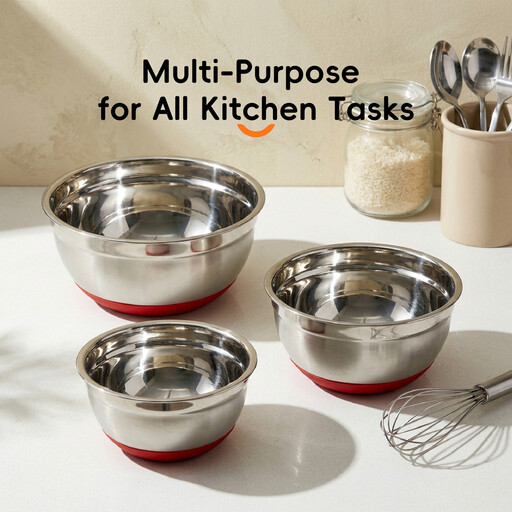
Why we love it: The perfect solution for anyone who demands perfect stability for whisking egg whites or kneading dough. The silicone base grips the countertop, leaving both your hands free.
It directly addresses pitfall #1: instability. No more bowls dancing on the counter when you bring out the electric mixer.
Non-slip stability and countertop protection thanks to its food-grade silicone base.
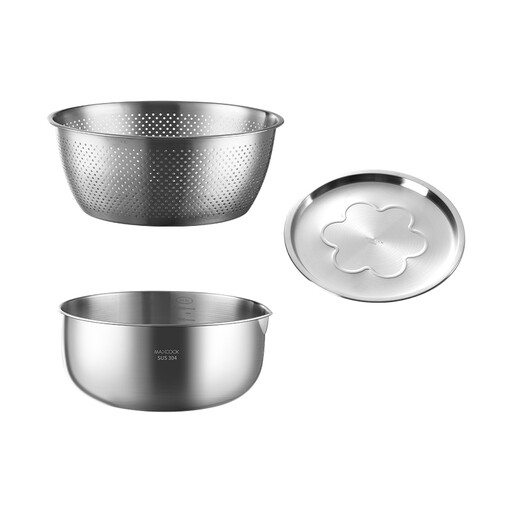
Why we love it: Ideal for meal prep and everyday cooking. This set combines a mixing bowl, a colander for washing vegetables or draining pasta, and a lid for keeping leftovers fresh.
It avoids the trap of a useless "all-in-one" set by offering accessories that are genuinely functional and complementary.
3-in-1 versatility (mix, drain, store) and an ultra-compact stacking design for optimised space-saving.
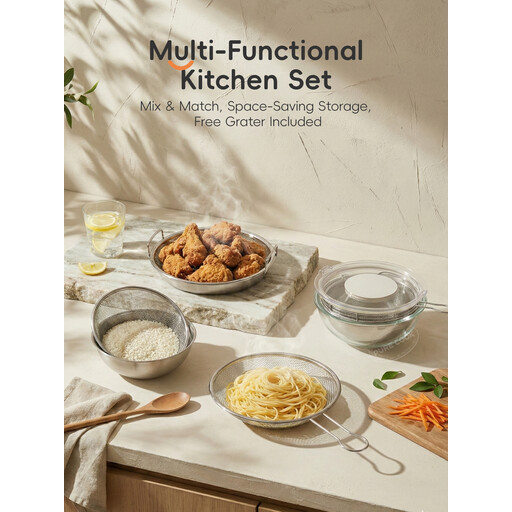
Why we love it: For those who cook a lot and want an all-in-one solution. This comprehensive set includes bowls of various sizes, a colander, a grater, and lids. Everything nests perfectly for ultra-compact storage.
It solves the false space-saving problem with a smart nesting design where every piece fits perfectly, without any wobble.
An ultra-complete all-in-one solution (mix, wash, grate, store) with a nesting design for optimised storage.
Discover our full selection of products that meet our quality criteria and current safety standards.
304 stainless steel is extremely resistant, but not invincible. Wash your bowl with hot, soapy water and a soft sponge. Avoid steel wool scouring pads: they scratch the surface and can deposit iron particles that will eventually rust. The golden rule: always dry the bowl thoroughly after each wash to prevent water spots and any risk of oxidation. Most models are dishwasher-safe, but manually drying them after the cycle is an excellent precaution.
Never in the microwave! Metal causes electrical arcs that can damage your appliance. And on a stovetop? The answer is no, in most cases. A standard mixing bowl is not designed to withstand direct heat and could warp. It can, however, be used in a double boiler (placed over a saucepan of simmering water) to melt chocolate, for example.
304 stainless steel (or 18/8) is the standard for food-grade use. It offers an excellent balance of corrosion resistance, durability, and cost. You might sometimes find 316 stainless steel, which is even more resistant (especially to salt), but it's more expensive and reserved for specific uses. Conversely, lower-quality steels (like 430) are cheaper but much more susceptible to rust and acids, making them ill-advised for kitchen use. For a set of stainless steel mixing bowls, sticking with 304 quality is a true guarantee of peace of mind.