
Livraison le jour même ou le lendemain

Qualité garantie

Débloquez vos offres de bienvenue: Livraison GRATUITE | Jusqu'à -80 % | 30 jours d'essai gratuits à JoyPlus
Téléchargez l'application
Choosing a stainless steel milk pitcher may seem straightforward. However, an unsuitable capacity, an overly wide spout or a finish that is difficult to maintain can quickly make cappuccino or latte preparation more complicated. Whether at home or in a coffee shop, the right model should match the amount of milk you use, the type of foam you want and the precision of your technique.
Here are the key criteria to consider before buying, along with a selection of models suited to different uses.
A 500 ml pitcher is not designed to be filled to the brim. Milk expands as it is heated and textured. Overfilling the container increases the risk of spills and makes temperature control more difficult.
For a single drink, a 300 to 400 ml milk frothing pitcher is usually sufficient. The 450 to 500 ml formats are more practical when preparing several drinks or when you need enough room to create a smooth vortex.
A matte or glossy black surface can give a pitcher more character, but it does not guarantee a better experience. Some coatings require hand washing and do not respond well to abrasive sponges. For everyday use, uncoated stainless steel is often easier to inspect and clean.
Check the manufacturer’s recommendations: hand washing, dishwasher compatibility, immediate drying and restrictions against steel wool are all useful details to know.
A spout marketed as “designed for latte art” will not do the work for you. Its shape does, however, affect the consistency of the flow. A well-designed precision pouring spout makes simple patterns, such as hearts or rosettas, easier, while a very wide spout produces a less refined stream.
The spout geometry, rim thickness and transition between the body and the tip matter more than any marketing claim.
304 stainless steel is widely used in utensils and accessories designed for food contact. In product specifications, this grade is generally associated with good corrosion resistance and a durable surface. It does not, however, eliminate the need to check the model’s compliance information and specific care instructions.
Prioritise a perfectly smooth interior, with as few areas as possible where milk residue could accumulate. A construction without visible welds can also make cleaning easier, but the overall quality of the finish remains the most important consideration.
The height and diameter should also be compatible with your machine’s steam wand. A pitcher that is too tall can restrict movement, while one that is too wide may make precise pouring more difficult.
A comfortable handle improves stability while steaming. Some models feature a polished handle, an angled opening or carefully balanced weight distribution to support different grips.
For a milk frothing pitcher, look for a clean rim and a shape that makes it easy to monitor the texture. In latte art, a consistent flow is essential, but it also depends on temperature, the amount of milk and your technique.
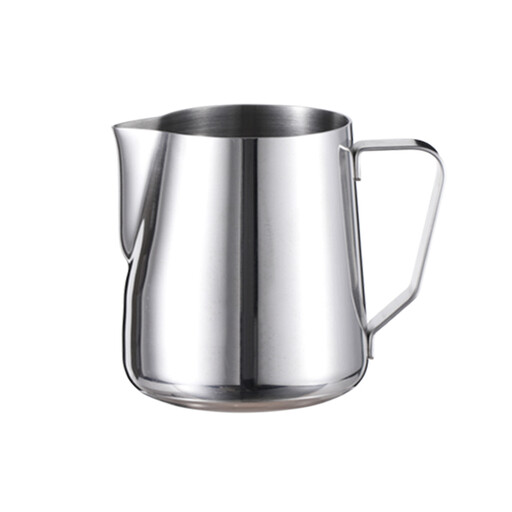
Why this model is a good fit: its compact format suits coffee lovers who prepare one drink at a time and want to keep the area around their machine clear.
With a 350 ml capacity, it reduces the risk of overfilling the pitcher when preparing a single drink. The product listing specifies stainless steel construction and dimensions of 93 × 75 × 65 mm.
A capacity well suited to smaller quantities, with a design made for milk frothing, cappuccinos and latte art.
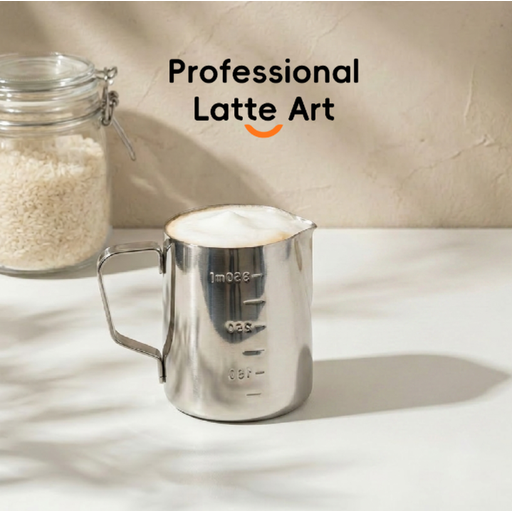
Why this model is a good fit: laser-engraved markings make it easier to measure milk and reproduce recipes more consistently, whether at home or in a small café.
The markings are engraved rather than printed, reducing the risk of them fading over repeated washes. The pointed spout is designed to deliver a consistent flow.
A 350 ml format, 304 stainless steel, a one-piece design and advertised dishwasher compatibility.
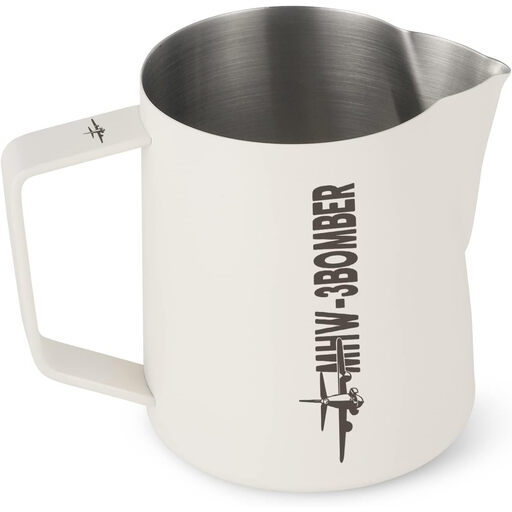
Why this model is a good fit: its capacity suits those preparing several drinks or who need enough milk to texture it properly.
The product listing specifies a curved dual-channel spout and a smooth body without visible welds. Hand washing is recommended to preserve the finish.
304 stainless steel, an ergonomic handle and a spout designed to give you precise control when pouring latte art.
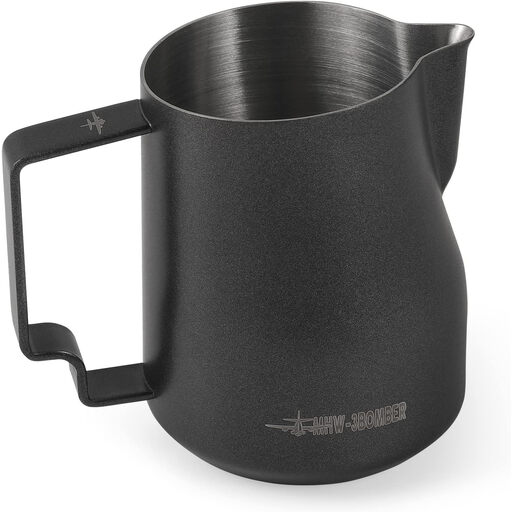
Why this model is a good fit: its mid-size capacity and reinforced construction may suit a barista or coffee shop looking for a manoeuvrable accessory for frequent use.
The listing specifies SUS304 construction, a thickened wall and a matte finish with baked-on coating. The manufacturer recommends hand cleaning without abrasive products.
A curved dual-groove spout, a rounded handle and a 450 ml capacity for espresso, cappuccinos and milk frothing.
Rinse the pitcher immediately after heating the milk to prevent residue from drying onto the walls. Use lukewarm water, a mild detergent and a non-abrasive sponge. Then dry the inside and outside to minimise water marks.
Avoid microwaves, direct flames and heavy impacts. For a matte or coloured finish, hand washing is generally preferable, even when dishwasher use is advertised as possible. The cost of ownership remains low: simply clean the pitcher after every preparation and replace it only if it becomes deformed, cracked or its surface is damaged.
Do not confuse it with a stainless steel insulated bottle: the latter is designed to transport drinks and maintain their temperature, not to texture milk with a steam wand.
Explore our updated selection of products that meet these requirements for capacity, material, pouring precision and care.
For a single drink, a 350 to 400 ml model is generally the easiest to handle. A 450 or 500 ml pitcher makes sense if you prepare several cappuccinos, if your machine has a more powerful steam wand or if you want more room to create a vortex in the milk.
It depends entirely on the manufacturer’s instructions. The PURECOOK 350 ml model is listed as dishwasher-safe, while several MHW-3BOMBER models recommend hand washing, particularly to preserve their finish. Always check the care instructions before the first cycle.
Do not fill the pitcher beyond the recommended level. First position the steam wand near the surface to incorporate a little air, then create a vortex as the milk begins to aerate. The shape of the spout makes pouring easier, but consistency also depends on temperature, the type of milk and practice.