
Same-day & Next-day Delivery

Quality Guaranteed

Unlock Your Welcome Offers: FREE Delivery | Up to 80% OFF | Free 30-day JoyPlus trial
Download the APP
A stainless steel kitchen colander is just as useful for rinsing rice and vegetables as it is for draining pasta or straining hot mixtures. However, some models quickly prove bulky, unstable or difficult to clean. Before comparing prices, it is therefore better to look at a few practical details rather than relying on marketing claims.
The simple mention of ‘stainless steel’ does not always specify the grade used. For a utensil that comes into contact with food, a 304 stainless steel colander is often preferred for its composition and good everyday resistance to corrosion. This does not mean you can ignore care instructions: salt, acidic foods and lingering moisture can leave marks on the metal.
So check the stated material, but also the quality of the finish, welds and edges, as well as the cleaning recommendations. A vague description such as ‘stainless metal’ says considerably less than a product page that specifically mentions 304 stainless steel.
A pasta colander that is too small will force you to work in batches. Conversely, a large model may be difficult to position in a narrow Parisian sink or fit into the dishwasher. For family use, compare the diameter, depth and capacity of the colander with your saucepans and available storage space.
Side handles make handling more comfortable, but can sometimes increase the overall size. In a small kitchen, an extendable sink drainer basket may be more practical, provided its length matches the width of the bowl and the whole unit sits securely.
Large holes drain water quickly, but may allow quinoa, small grains of rice or fine pieces through. A fine mesh retains more particles, but requires more thorough rinsing to prevent residue from becoming trapped.
For straining stock or a plant-based drink, a food strainer made from nylon will often be more suitable than a conventional colander. For removing food from hot oil, a stainless steel skimmer or a frying strainer with a sufficiently long handle serves a different purpose.
Prioritise product pages that clearly state the material and surface treatment. A rolled or polished edge reduces the risk of cuts during handling. Models without an additional coating are generally easy to rinse, but it is still best to use a soft sponge and mild washing-up liquid.
Fine marks, manufacturing lines or weld marks may be visible on a metal utensil. However, they should not be confused with a sharp edge, a deformation or a poorly attached handle.
A raised base prevents food from sitting in the drained water. For a basket intended for washing fruit and vegetables, evenly distributed holes speed up rinsing. Some double-bowl models collect the water in an outer bowl; this design is practical on a worktop, particularly for rice or fruit.
For working directly over the sink, an extendable kitchen drainer keeps the worktop clear. Nevertheless, check its minimum and maximum dimensions, as well as the depth of the bowl.
A colander intended for pasta or blanched vegetables should have handles positioned far enough away from the steam. A skimmer used in oil or boiling water can also become very hot: oven gloves or pan holders are still recommended, even when the handle is described as heat-insulated.
An oil filter or filtering saucepan should be placed on a stable, heat-resistant surface. Never pour a scalding liquid into a container that is not designed for this purpose.
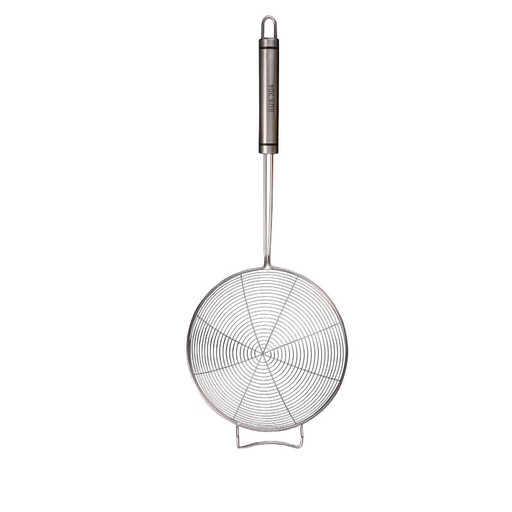
Why this choice suits this profile : With its 15 cm diameter and handheld design, this model is suitable for occasional tasks such as straining a sauce, removing small pieces of food or draining a portion.
The product page clearly states that it is made from 304 stainless steel, so you are not left choosing a utensil with an unspecified material.
Compact design, handheld grip and mesh designed for straining preparations.
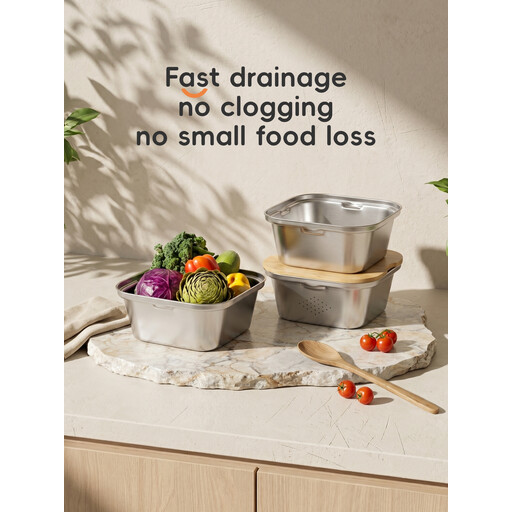
Why this choice suits this profile : This set combines bowls and filtering baskets with capacities of 1.3 and 2.5 litres, helping you organise preparation, washing and storage.
The dimensions and capacities are stated clearly, making it easy to check that they meet your needs.
304 stainless steel, stackable square design, bamboo lids and versatile uses.
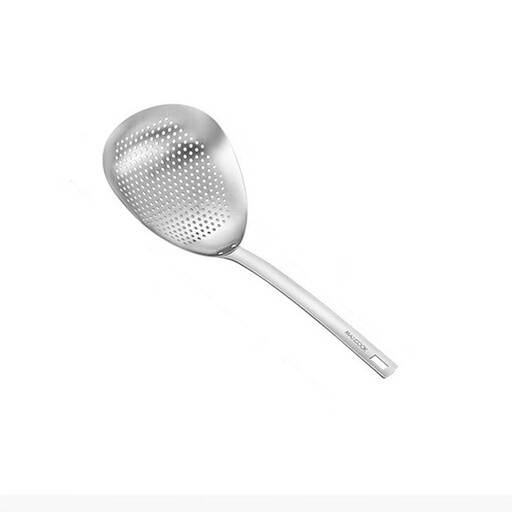
Why this choice suits this profile : This stainless steel skimmer is suitable for frequent cooking, whether you are removing food from oil or draining soups, noodles and dumplings.
Its long handle keeps your hand away from the oil. However, the instructions still remind you to take care around heat.
304 stainless steel, wide head, evenly spaced holes and hand-washing recommended.
We have selected a complete, real-time updated range of products that meet these demanding criteria and European safety standards.
Rinse the colander after each use to prevent starch, salt or acidic residue from drying on the surface. A soft sponge and mild washing-up liquid are generally all you need. Then wipe it with a tea towel or allow it to drain and dry completely.
Avoid wire wool, abrasive powders and prolonged soaking. For a nylon food strainer, check the recommended maximum temperature and remove fine residue immediately after use. The BJ Soy Milk Nylon Strainer, sold in a pack of two with a mesh size of 200, may be suitable for fine straining, but it is not a substitute for a stainless steel colander when handling very hot preparations.
For one or two people, a medium diameter may be sufficient. For a family, choose a model that is wide enough to hold the entire quantity of pasta at once and check that it fits in your sink. Also remember to measure the available height in your cupboards.
It depends on the manufacturer’s instructions and the associated components, such as handles or lids. If the product page recommends hand washing only, use a soft sponge, rinse thoroughly and dry promptly to help preserve the surface.
A sink drainer basket, a vegetable colander with small holes or a model with a collecting bowl will do the job. To save space, an extendable drainer can sit over the bowl. Simply make sure it is completely stable before placing food or dishes in it.