
Livraison le jour même ou le lendemain

Qualité garantie

Débloquez vos offres de bienvenue: Livraison GRATUITE | Jusqu'à -80 % | 30 jours d'essai gratuits à JoyPlus
Téléchargez l'application
Choosing a new stainless steel induction pan can quickly become a headache. Between marketing promises of "scratch-proof" coatings and "all-stovetop" logos, it's easy to end up with a disappointing pan that gets relegated to the back of a cupboard. As a product expert for the editorial team, my mission is to help you see clearly, so you can make a smart, durable choice that's perfectly suited to your kitchen.
Before we get to our top picks, let's break down the 3 most common pitfalls that can cost you dearly (and make you regret your purchase):
To avoid these disappointments, forget the marketing jargon and focus on objective technical specifications. These are the true benchmarks of quality and performance.
A quality stainless steel induction pan is never made from a single piece of metal. The models that stand out rely on a multi-ply construction, often called "Tri-Ply" or "5-Ply."
The choice of cooking surface depends on your cooking habits.
Your kitchen is a living space, not a warehouse. Think practical.
Rather than searching for a one-size-fits-all pan that doesn't exist, it's better to choose one that truly matches your needs. Here are our suggestions.
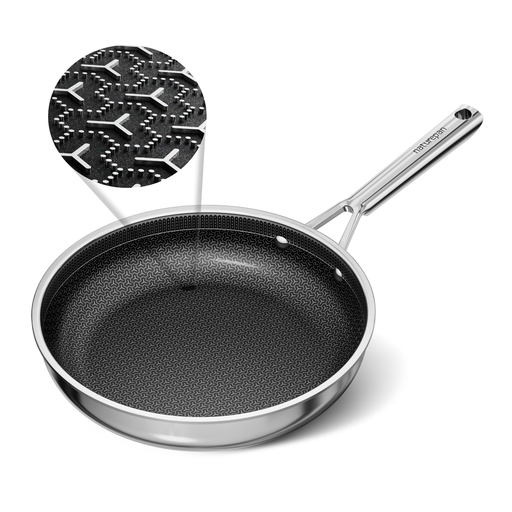
Ideal for: Those who want to sear a steak and then make an omelette without switching pans. Its large 28cm diameter is perfect for family meals, and its versatility makes it the ultimate all-rounder.
Its hexagonal surface combines stainless steel ridges (for durability) with a non-stick ceramic base. This avoids the pitfall of a coating that wears out quickly, as the non-stick part is protected from utensils.
5-ply construction for even heat. Guaranteed PFAS/PFOA-free ceramic coating. Oven-safe up to 260°C.
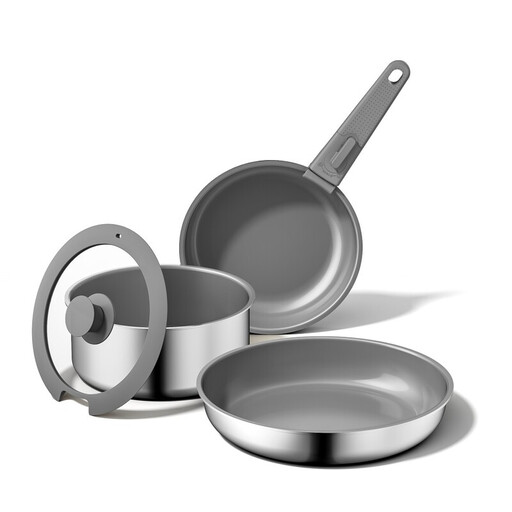
Ideal for: People in studio apartments, small kitchens, or van life enthusiasts. This stackable pan set with its unique removable handle offers maximum space-saving for a complete induction cookware set.
It solves the storage puzzle without sacrificing quality. The Tri-Ply stainless steel construction ensures excellent performance on induction, avoiding the trap of "compatible" but inefficient cookware.
Patented and secure removable handle. Ultra-compact storage. Reinforced ceramic coating (PFOA-free). Compatible with all stovetops and ovens.
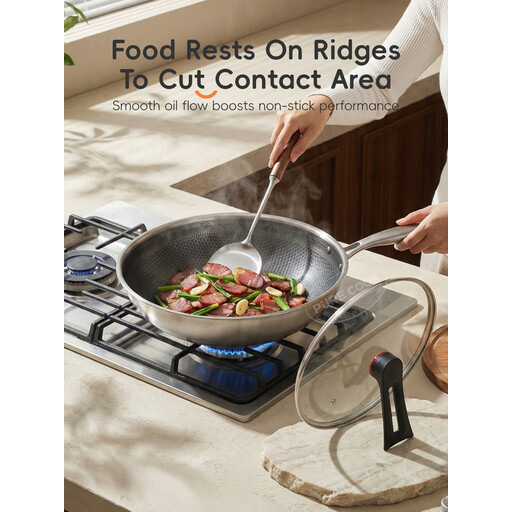
Ideal for: Fans of Asian cuisine and stir-fries that demand intense heat and a large cooking surface. This induction wok is designed to sear ingredients in a flash while making the cooking process effortless.
Its honeycomb texture creates physical (not chemical) non-stick properties that don't degrade at high temperatures. The result: it resists scratches, even from metal utensils.
Tri-Ply 304 stainless steel construction for lightning-fast heating. Ultra-durable physical non-stick surface. Large 32cm diameter with a glass lid.
Explore our full selection of pans that meet our quality criteria and the strictest European safety standards.
Maintenance is simple but essential. The golden rule: always let the pan cool down before cleaning to avoid thermal shock, which could warp it. For raw stainless steel, hot water and a standard sponge are sufficient. If food is stuck on, a quick soak with white vinegar or baking soda will work wonders. For non-stick coatings, only use the soft side of the sponge. Finally, dry your pan thoroughly to prevent water spots.
Labels like PFOA-free, PFAS-free, or PTFE-free guarantee that the pan is free from the controversial substances used in the past. Modern alternatives (ceramic coatings, hybrid structures) are designed to be perfectly stable and release no harmful compounds under normal use. The basic precaution remains the same: never heat an empty pan and always adhere to the maximum temperatures recommended by the manufacturer.
This is the number one pitfall, and the most frustrating one. The mere presence of the "induction" logo is no guarantee of performance. Poor heat distribution almost always indicates a low-quality base. A base that is too thin or made of a weakly ferromagnetic alloy will not transfer energy from the cooktop correctly. This is why a multi-ply structure with an aluminium core is the decisive factor for truly even cooking.