
Livraison le jour même ou le lendemain

Qualité garantie

Débloquez vos offres de bienvenue: Livraison GRATUITE | Jusqu'à -80 % | 30 jours d'essai gratuits à JoyPlus
Téléchargez l'application
A stainless steel frying pan compatible with induction can be used to sear meat, sauté vegetables, prepare a sauce or cook a family meal. However, not all stainless steel frying pans perform in the same way on an induction hob, gas hob or ceramic hob.
Price alone is not enough to help you make the right choice. A pan that is too thin may heat unevenly, while an unsuitable diameter can limit the quantities you can prepare. Here are the main pitfalls to avoid and the features to examine before you buy.
The term ‘stainless steel’ mainly refers to the outer material or cooking surface. It may be a simple stainless steel pan, a multi-layer frying pan with an aluminium core, or a stainless steel pan with a non-stick coating.
An uncoated frying pan generally offers better resistance to metal utensils and high temperatures. In return, it requires controlled preheating and a little fat to reduce sticking. A non-stick frying pan makes cooking eggs or fish easier, but its coating requires greater care, particularly the use of wooden, silicone or nylon utensils.
A frying pan marked ‘all hobs’ should be suitable for the heat source you use. For induction, its base must be ferromagnetic and sufficiently flat to transmit the magnetic field effectively. Compatibility with gas or ceramic hobs therefore does not automatically guarantee satisfactory performance on an induction hob.
Before buying, check the product description and look specifically for the terms induction, gas, electric and ceramic. If you use a halogen or infrared hob, confirmation from the manufacturer may be necessary.
A thick, multi-layer frying pan often offers better stability, but it may also be heavier to handle. A long handle can take up space in a small dishwasher or on an already busy hob. A lid is useful for simmering and reducing splashes, but it adds weight to the set and will generally increase the price.
304 stainless steel is commonly used for utensils intended to come into contact with food. It is valued for its resistance to corrosion and relatively easy care. That said, the sole mention of ‘304’ is not enough to assess the pan’s overall quality : thickness, base design and handle attachment are equally important.
Some products specify 316 stainless steel. In this case, check the full technical details to find out about the pan’s construction, usable diameter and actual compatibility with different types of hob.
A multi-layer frying pan generally combines several layers of stainless steel with an aluminium core. Aluminium promotes even heat distribution, while stainless steel provides rigidity and corrosion resistance. Compared with a single-layer stainless steel pan, this design can help minimise areas of overheating.
For everyday use, check the following :
Good heat distribution does not replace good cooking habits : bring the pan up to temperature gradually, avoid leaving it empty over high heat and wait for it to cool before washing it.
A 28 cm stainless steel frying pan is suitable for family portions, stir-fried vegetables and fairly large cuts of meat. However, it requires a sufficiently large hob and suitable storage space.
Also remember to check the base diameter, which is often smaller than the diameter of the outer rim. On an induction hob, a base that is too small for the active zone may slow down heating.
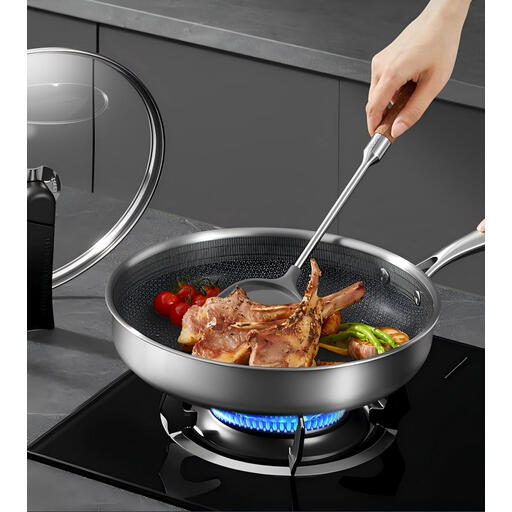
Why this choice suits this profile : Its 28 cm size and glass lid make it suitable for family meals. You can monitor cooking without lifting the lid.
The product details mention 304 stainless steel construction and compatibility with all hobs, which should be checked against your setup.
28 cm diameter, glass lid and 304 stainless steel specified by the manufacturer.
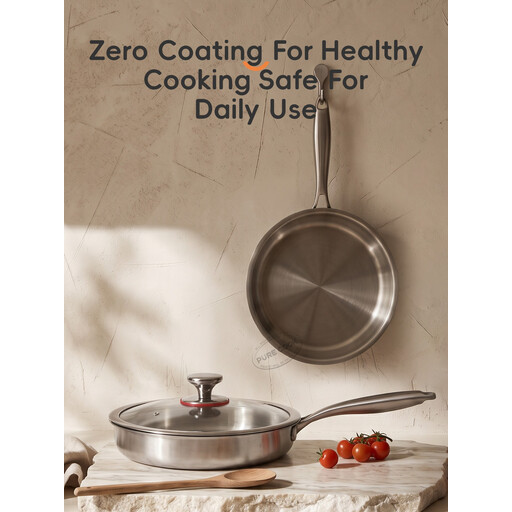
Why this choice suits this profile : Its three-layer construction, with an aluminium core, is designed to heat more evenly when searing food, sautéing vegetables or simmering dishes.
The product details specify the stainless steel–aluminium–stainless steel construction, rather than simply stating ‘multi-layer’.
304 stainless steel, three-layer construction, glass lid and stated compatibility with several types of hob.
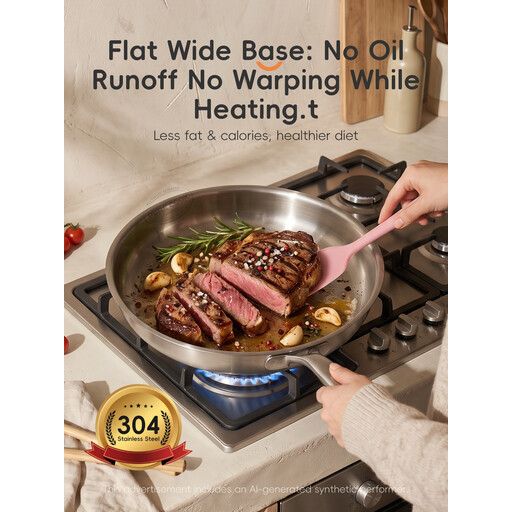
Why this choice suits this profile : The lack of a lid suits cooks who prioritise searing, deglazing and quickly cooking large quantities.
The product details specify the three-layer construction, compatibility with induction, gas and ceramic hobs, as well as the fact that it comes without a lid.
304 stainless steel construction with an aluminium core, 28 cm size and design suitable for different types of hob.
We have put together a complete, real-time updated selection of products that meet these exacting criteria and European safety standards.
Even a frying pan designed to last can become less convenient if it is used incorrectly. For an uncoated stainless steel frying pan :
With a pan fitted with a ceramic coating, use a low to medium heat and non-metal utensils. Hand washing is generally preferable to help preserve the surface, even when the product details state that it is dishwasher-safe.
Yes, provided the manufacturer’s product details explicitly state that it is induction-compatible and the base is ferromagnetic. A stainless steel body alone is not always enough. You can also check for the induction symbol on the packaging or in the instructions.
A 28 cm frying pan provides a comfortable cooking surface for preparing four portions, but it can be cumbersome on a small hob. For two people, a diameter of 24 to 26 cm is often easier to handle. The usable base diameter should also match the heating zone.
Uncoated stainless steel generally withstands metal utensils and high temperatures better. A non-stick frying pan focuses more on ease of cooking, releasing food and cleaning. Its lifespan nevertheless depends on many factors : thickness, build quality, heating temperature and care.