
Same-day & Next-day Delivery

Quality Guaranteed

Unlock Your Welcome Offers: FREE Delivery | Up to 80% OFF | Free 30-day JoyPlus trial
Download the APP
Between the promises of leak-proof seals, mentions of “food-grade quality” and the sheer range of sizes available, choosing a stainless steel food storage box can quickly become a headache. A container that’s handy for the fridge won’t necessarily be suitable for transport, the freezer or a lunch at the office.
To avoid any nasty surprises, focus on four key points: the material, the lid, the capacity and the actual use you have in mind for the box. Here are the criteria to run through before picking a stainless steel lunch box, a bento box or a storage set.
A stainless steel box can be incredibly robust yet still let a sauce escape if its lid is poorly designed. Leak-proofing relies mainly on the quality of the seal, the closure system and how well the different parts fit together.
Before ordering a hermetic food container, check for a removable seal, clips or a reliable locking mechanism. For a work bag or a rucksack, it’s still best to carry the container upright, unless the manufacturer clearly states it can be placed in any position.
A 1.5 or 1.6-litre box can work well for a family portion, several meals prepped in advance or storing leftovers. For an individual lunch, however, it might take up too much space. On the flip side, a small container can prove too tight for a full meal.
So the capacity needs to match how you’ll use it:
Stainless steel must never go in the microwave. Some polypropylene lids can’t handle high temperatures or direct contact with a flame either. As for the sealing components, they may need hand washing.
Take the time to read the manufacturer’s instructions regarding the dishwasher, freezer, oven and microwave. A food storage box may be freezer-safe without its lid being able to withstand all temperatures or reheating methods.
304 stainless steel is commonly used for food containers. It offers good corrosion resistance for typical household use. 316L is also found on some models and is generally presented as more corrosion-resistant, particularly in more demanding environments.
These indications don’t replace compliance information. For a product sold in the UK, look for mentions relating to food contact, usage instructions and, where stated, the identity of the responsible party established in the European Union.
A good lid should close easily, come off without a struggle and stay firmly in place during transport. Clip systems generally improve security, while a flexible lid with a removable seal can make cleaning easier.
For a compartmentalised lunch box, also check whether the dividers are genuinely leak-proof between sections. Compartments help stop food from mixing, but that doesn’t necessarily mean each section can hold a liquid preparation without risk of leakage.
Stackable boxes save space in both the fridge and the cupboards. Rectangular shapes often optimise storage, while a wide opening makes filling and washing easier.
After each clean, dry the box and its lid thoroughly. Remove the seal regularly to prevent deposits building up in the grooves. If the lid isn’t dishwasher-safe, stick to warm water and washing-up liquid.
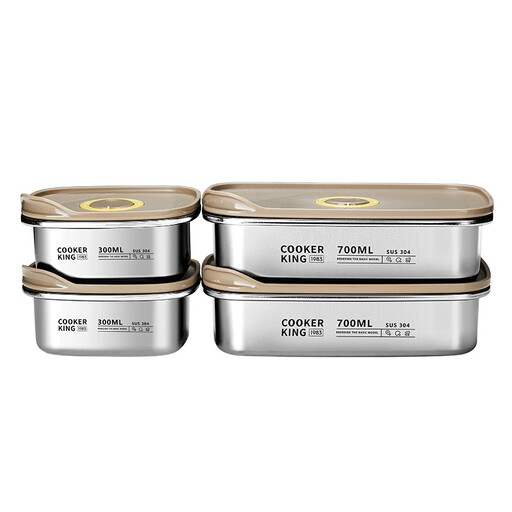
Why this choice suits this profile: This set of four boxes is ideal for anyone wanting to start meal prepping with several reusable containers, whether at home, for lunch or a picnic.
The four-piece set saves you from buying items separately, while the stackable design helps keep the fridge well organised.
Food-grade stainless steel, four containers, stackable design and stated dishwasher compatibility.

Why this choice suits this profile: These four large-capacity containers are built for meal prep, family leftovers and regular food storage in the fridge or freezer.
With a stated capacity of 1,600 ml per box, the risk of running out of space for larger batches is minimised.
316L stainless steel, snug-fitting lids, uniform four-piece set, stated freezer and dishwasher compatibility.

Why this choice suits this profile: Its wide opening and vacuum insulation make it ideal for meals taken to the office, school or on outings where you need to keep food at the right temperature.
Its capacity and leak-proof lid are suited to transport. However, avoid turning the jar upside down in your bag.
Vacuum insulation, wide opening, 1.5 L capacity and stated hot or cold retention for 4 to 6 hours.

Why this choice suits this profile: This compartmentalised lunch box is ideal for lunches made up of several different foods, picnics and separate portions, for both children and adults.
The five compartments limit food mixing, while the four fasteners keep the lid securely in place.
316L stainless steel construction, five separate compartments, PP lid and closure fasteners.
We’ve put together a comprehensive, real-time updated selection of products that meet these exacting criteria as well as European safety requirements.
It depends on the model. Some containers are stated as freezer- and dishwasher-safe, while vacuum-insulated jars or lids with seals may need to be hand washed. Always check the instructions and leave a little space if the contents might expand.
Its lifespan depends on the build quality, how often it’s washed and how well the seal is maintained. Dry all parts thoroughly after cleaning, avoid abrasive sponges and replace any cracked lid or deformed seal. A stainless steel box is tough, but it isn’t indestructible.
Stainless steel is lightweight, impact-resistant and practical to carry. Borosilicate glass lets you see the contents and is well suited to home storage, but it’s generally heavier and more prone to breaking if dropped. For the office, school or a picnic, compare weight, lid design, leak-proofing and compatibility with your appliances.