
Livraison le jour même ou le lendemain

Qualité garantie

Débloquez vos offres de bienvenue: Livraison GRATUITE | Jusqu'à -80 % | 30 jours d'essai gratuits à JoyPlus
Téléchargez l'application
Preparing a packed lunch seems simple enough… until the sauce mixes with the rice, the lid leaks in your bag, or the box becomes a chore to clean. Whether for a child at school, a desk lunch, a picnic or a camping trip, a stainless steel divided lunch box must first and foremost suit the purpose it’s intended for.
Product descriptions often highlight durability or leak resistance, without always spelling out the model’s limitations. Here are the criteria to examine before you order, along with a selection tailored to different needs.
Separate compartments stop solid foods from mingling, but that doesn’t mean each section is airtight. A box can be perfectly fine for rice, vegetables, fruit or biscuits, yet be unsuitable for transporting soup or a liquid sauce.
If you plan to pop the box into a bag, check for a lid with a seal, sufficiently secure clasps and, where available, genuine leak tests. A simple compartment tray without a lid is really designed for serving at the table, in a canteen or for reheating outside a microwave.
Not all stainless steels offer exactly the same properties. A food-grade 304 stainless steel container is generally valued for its corrosion resistance and ease of cleaning. 316 steel is often chosen for its enhanced resistance in more demanding environments. The result, however, also depends on the overall design, the thickness of the steel and the quality of the lid.
Simply stating “stainless steel” doesn’t specify the grade used or the manufacturing quality. Look for the exact material reference and any food-contact information provided by the seller.
A box that’s too small won’t hold a full lunch. Conversely, an overly large model may take up too much room in a school bag or work bag. Angles, grooves and removable seals also play a big part in everyday cleaning.
A one-piece design, with no visible welds, reduces the number of places where residue can build up. For models with a plastic lid and clasps, check whether the different parts can be taken apart and whether the manufacturer allows dishwasher cleaning.
A divided lunch box with three sections often works well for separating a carbohydrate, a side and a fruit. Five compartments allow you to isolate portions better, but can sometimes reduce the space available in each area.
For a child, choose compartments that are easy to reach and of a sensible depth. For an adult who wants to organise their meals more effectively, this separation can help with portion visualisation, without replacing professional health advice.
The 304 stainless steel used on some PURECOOK trays is presented as suitable for food contact, with a satin-brushed finish. This matt surface tends to show fewer fingerprints and is easy to clean with a soft sponge. The five-section model is also said to be resistant to knocks and repeated washing.
The Maxcook model, meanwhile, uses 316L stainless steel, a polypropylene lid and four clasps. However, its care recommendations should be followed: hand washing is advised and dishwasher cleaning is not recommended, to preserve the lid and its closure system.
Stainless steel must never be placed in a microwave. This precaution applies particularly to the PURECOOK trays and the Maxcook box. To transport a hot meal, serve the food into the box after cooking, then let it cool before closing it if the manufacturer recommends this.
A box intended for transport should also be placed on a stable surface. With children, be especially careful with very hot food and any small parts on certain lids.
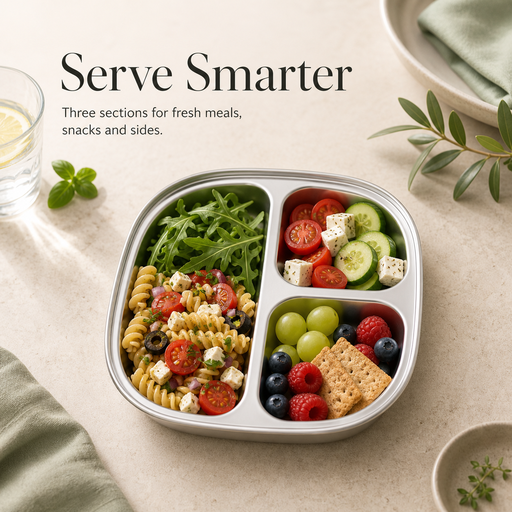
Why this choice suits this profile: With its three sections and dimensions of 19.5 × 19.5 × 3.9 cm, this tray is ideal for family meals, children and first experiences with compartment containers.
Its one-piece design limits the crevices where food can get stuck. However, it should not be considered leak-proof for liquids.
304 stainless steel, three compartments, satin finish and dishwasher-safe as stated by the manufacturer.
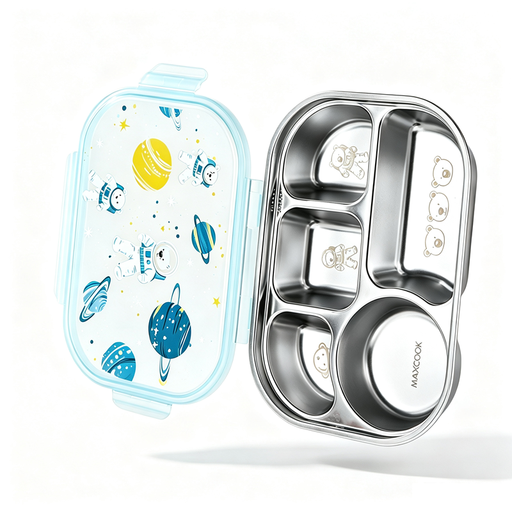
Why this choice suits this profile: Its five compartments and four-clasp lid meet the needs of those who enjoy preparing well-organised meals, whether at the office, school or on a picnic.
The multiple clasps hold the lid firmly in place. Hand washing is still recommended to preserve the seal and the condition of the lid.
316L stainless steel, five sections, removable PP lid and a design said to be leak-resistant.
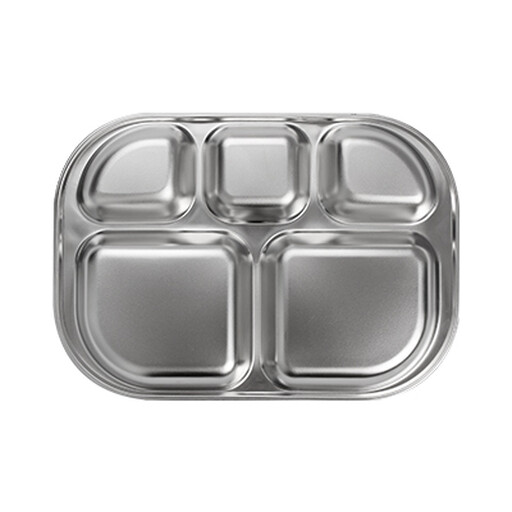
Why this choice suits this profile: Its five compartments are designed for meals where each food needs to stay well separated, for catering, large families and camping trips.
The separation into five zones limits flavour mixing. The stainless steel construction also avoids the breakage risks associated with glass or ceramic.
304 stainless steel, five independent compartments, said to be dishwasher-safe and a format suitable for both serving and outdoor activities.
To keep your stainless steel bento box in good condition, rinse it after each meal and avoid leaving very salty or acidic foods in it for too long. Use a non-abrasive sponge and dry all surfaces thoroughly. Overly harsh cleaning products can cause superficial scratches, while a poorly cleaned seal may retain odours.
Before each trip, check the condition of the lid, clasps and any seals. A stainless steel box is not automatically leak-proof: this property depends entirely on its closure system.
No. Metal must not be placed in a microwave. Transfer the food to a suitable container before reheating.
Yes, particularly because of its impact resistance and ease of cleaning. However, choose a size that’s easy to handle, keep an eye on food temperature and adapt your choice to the child’s age. Lids with small parts should be used with care.
It all depends on the thickness of the steel, the knocks it takes, how often it’s used and how it’s cared for. Gentle washing, thorough drying and promptly replacing a damaged seal all help to extend its lifespan.