
Livraison le jour même ou le lendemain

Qualité garantie

Débloquez vos offres de bienvenue: Livraison GRATUITE | Jusqu'à -80 % | 30 jours d'essai gratuits à JoyPlus
Téléchargez l'application
A cluttered countertop, a sponge soaking in a puddle of water… it's an all-too-familiar scene in our kitchens, especially smaller ones. Yet, a good dish rack can change everything, transforming this minor chaos into a clean, organised space. The problem? The market is flooded with models that promise the world but often end up in the bin after just a few months. Our mission is to arm you with the right information to make a smart, long-lasting choice.
Before you take the plunge, here are the 3 absolute pitfalls to avoid so you don't regret your purchase:
To avoid these traps, a few technical points need to be inspected closely. It's these details, often overlooked at the time of purchase, that guarantee the longevity and user-friendliness of your future dish rack.
The word "stainless" is often used as a catch-all term. For the kitchen, where contact with water is constant, only one standard matters: 304 stainless steel. This is a specific alloy of chromium and nickel that provides near-perfect resistance to corrosion and rust. Low-end models often use lower-quality steels or a simple coating that doesn't hold up for long. A genuine stainless steel kitchen dish rack is a long-term investment.
For a two-tier model, stability is not optional. The structure must be robust, with non-slip feet that anchor the rack to the countertop. Modularity is also a real plus. A foldable dish drying rack is an ideal solution for small kitchens: it offers ample drying capacity and can then be tucked away when not in use. Just make sure its folding mechanism feels reliable and is built to last.
A good dish rack should drain water, not store it. The simplest and most effective solution remains a dish rack with a removable tray. Ensure it's easy to remove and clean to say goodbye to limescale and residue. Some higher-end models feature a swivel spout that drains water directly into the sink. This is the premium option for keeping your countertop permanently dry.
Because every kitchen is different, we've selected several profiles that meet the quality and practicality criteria we've just outlined.
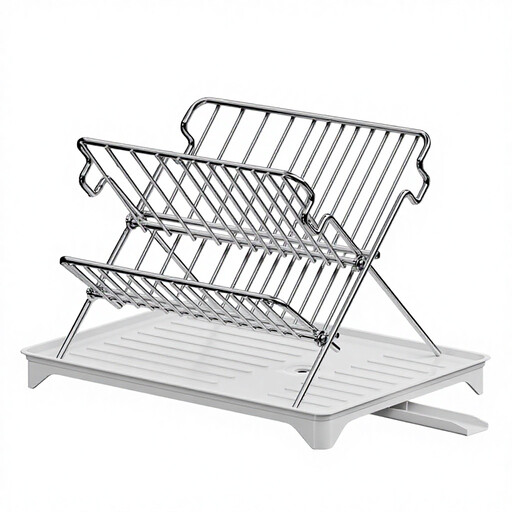
Its standout feature: Perfect for studio apartments and kitchens where every square inch is precious. It uses vertical space for drying, then folds away to completely free up the countertop.
Its structure, combining stainless steel and polypropylene (PP), is designed to be both lightweight and stable. The folding mechanism is built for daily use without sacrificing sturdiness.
Its foldable function makes it the ultimate space-saver. Its integrated drainage tray ensures clean water runoff.
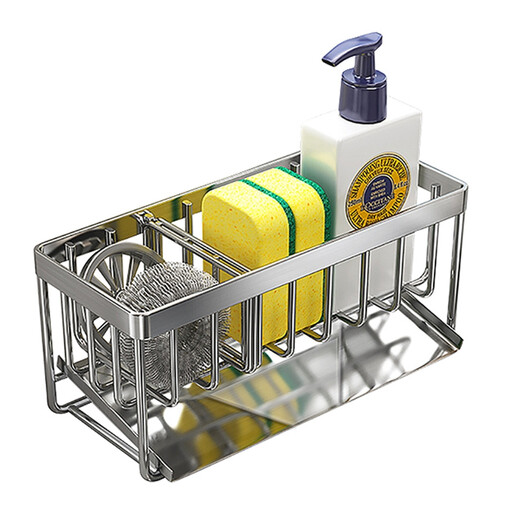
Its standout feature: For those aiming for a zero-clutter countertop, organisation goes beyond just dishes. This caddy is the perfect complement to a dish rack, providing a dedicated spot for sponges, brushes, and washing-up liquid, and putting an end to the clutter around the sink.
It tackles the problem of poor drainage at its source. By keeping sponges and brushes elevated and well-aerated, it prevents water from stagnating and stops mould from forming.
Its rust-proof 304 stainless steel construction and compact design create a perfectly optimised washing-up area.
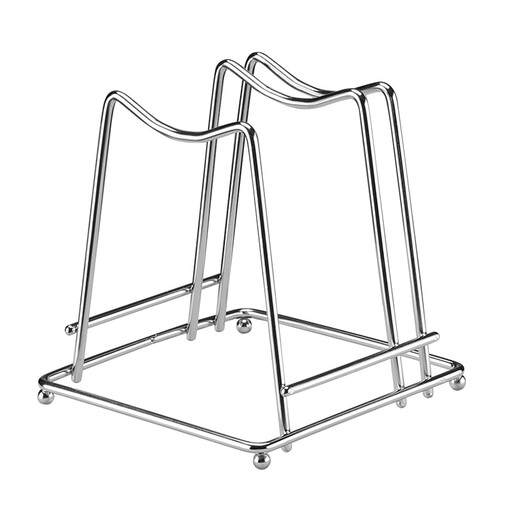
Its standout feature: For anyone tired of flimsy gadgets and who prefers to invest once in a quality product. This type of item exemplifies the importance of a high-quality material and a design made to withstand the test of daily use.
It counters the risks of rust and instability with its food-grade 304 stainless steel and its thick 4 mm structure, capable of supporting the weight of heavy lids without ever bending.
An ultra-sturdy design and a corrosion-resistant material, guaranteeing unbeatable durability, even in the constant humidity of the kitchen.
Explore our full selection of storage solutions that meet our standards for quality and durability.
It's all in the material! Insist on 304 stainless steel. For maintenance, a regular rinse and dry, especially for the tray, is sufficient. Absolutely avoid abrasive products and steel wool sponges, which could scratch its protective layer and expose it to corrosion.
Yes, if the model is well-designed. Look for a wide base, non-slip silicone or rubber feet, and a structure that feels sturdy at first glance. Also, remember to distribute the weight evenly and not overload one side.
The secret is consistency. Empty the tray of your dish rack with a removable tray daily to prevent water from stagnating. Once a week, a good clean with hot, soapy water will tackle any limescale and residue. Dry it well before putting it back, and you're all set.