
Livraison le jour même ou le lendemain

Qualité garantie

Débloquez vos offres de bienvenue: Livraison GRATUITE | Jusqu'à -80 % | 30 jours d'essai gratuits à JoyPlus
Téléchargez l'application
Wooden boards that crack and stain, plastic ones that become breeding grounds for bacteria with their deep scratches… If this sounds familiar, it's time for an upgrade. For a durable, hygienic, and modern kitchen, the stainless steel cutting board is the premier solution.
This comprehensive guide breaks down the advantages of stainless steel. We'll review the essential criteria to check before you buy and present our selection of the best models, designed for cooks who demand quality and food safety.
To make the best choice, focus on a few key technical features that make all the difference in daily use.
Not all stainless steel boards are created equal. Insist on 304 stainless steel, the gold standard in the food industry. Its reputation is well-established: it resists corrosion, rust, and food acids (from citrus, tomatoes, etc.). As it's completely non-porous, it prevents juices and bacteria from seeping in, making it an inherently hygienic cutting board. Choosing 304 stainless steel is an investment in a utensil that's built to last and guarantees 100% food-safe contact.
Cross-contamination is every cook's nightmare. A double-sided cutting board is the simplest and most effective solution. The principle? Dedicate a surface to each type of food: one side for raw meat and fish, the other for vegetables, fruit, or bread. Some models take this a step further with different textures on each side: a smooth one for precision cuts, and another with grooves to catch juices.
A good cutting board must be practical above all. Look for non-slip feet or a silicone border for perfect stability while cutting. An integrated handle is also a real bonus for handling and storage. Finally, the key advantage of stainless steel remains its ease of cleaning. Most models are dishwasher-safe or can be cleaned in a flash with soapy water—an essential convenience for daily use.
Enough theory—let's get practical. Here are the models that caught our eye, selected for their smart design and kitchen efficiency.
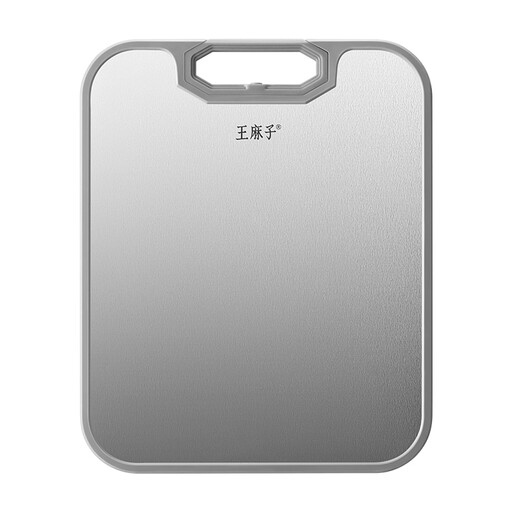
Why it stands out: This model cleverly combines two surfaces in one. Made from food-grade 304 stainless steel, its surface is naturally antibacterial. But its real strength is its double-sided design: a smooth side for everyday tasks (slicing bread, chopping vegetables) and a side with non-slip grooves, perfect for cutting meat and fish while containing juices.
Advantages:
Who it's for: Those who often juggle raw meat and vegetables and want an all-in-one solution to prevent cross-contamination and simplify their kitchen routine.
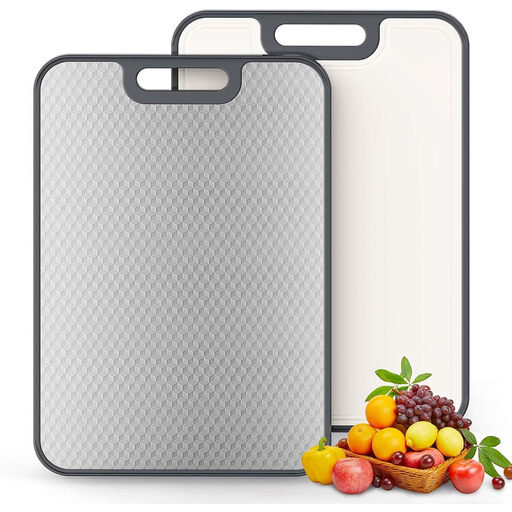
Why it stands out: This model takes a hybrid approach, combining a stainless steel side with a wheat straw and PP (polypropylene) side. It's a smart design that offers the best of both worlds: the hygiene and durability of stainless steel for high-risk foods (meat, fish), and a PP surface that's gentler on your knife edges, ideal for fruits and vegetables.
Advantages:
Who it's for: The perfect choice for the undecided—those who want the rigour of stainless steel without sacrificing their knives. A versatile board that adapts to all cutting tasks.

Why it stands out: A great cutting board is good. Knowing where to store it is even better. This multi-functional 304 stainless steel rack is the ideal solution. Designed to hold lids, spatulas, and cutting boards, it keeps your countertop clean and organised thanks to its clever removable water-drip tray.
Advantages:
Who it's for: Essential for anyone looking to optimise their space and keep their board (and lids) clean, organised, and within easy reach.
Our selection is just a glimpse of the possibilities that stainless steel offers. To discover other board formats, racks, or stainless steel kitchen accessories, explore our dedicated category.
Discover Our Range of Steel Products
1. Does a stainless steel cutting board damage knives? This is a valid concern. Since stainless steel is harder than wood or plastic, it can dull a knife's edge slightly faster. In practice, this effect is moderate and easily offset by regular blade maintenance (a quick touch-up with a honing steel now and then). It's a trade-off many cooks are willing to make for the huge gains in hygiene and durability. For the more cautious, hybrid models like the VVM board are an excellent alternative.
2. How do you clean a stainless steel cutting board? This is its greatest strength! A simple hand wash with hot water and dish soap is more than enough, as nothing gets embedded in its non-porous surface. Most models are also dishwasher-safe for maximum convenience. The only tip: avoid abrasive sponges that could create micro-scratches.
3. Is a stainless steel cutting board really more hygienic? Absolutely, and this is a decisive advantage. Unlike wood, which absorbs juices, or plastic, where cuts become havens for germs, stainless steel offers a perfectly smooth and impermeable surface. As a result, bacterial growth is virtually impossible, and cleaning is incredibly effective. It is the very definition of an antibacterial cutting board.