
Livraison le jour même ou le lendemain

Qualité garantie

Débloquez vos offres de bienvenue: Livraison GRATUITE | Jusqu'à -80 % | 30 jours d'essai gratuits à JoyPlus
Téléchargez l'application
A cookware set can look flawless on paper, yet disappoint after just a few weeks of use. To avoid ill-suited purchases, it’s best not to stop at claims like “durable”, “suitable for all hobs” or “professional quality”. The material, the base construction, the diameter and the maintenance all have a direct impact on everyday comfort.
Stainless steel cookware works just as well for everyday meals as it does for large gatherings and serving. Frying pans, woks, saucepans, steamers, stockpots, stainless steel cutlery or barbecue accessories: the possibilities are endless. Here are the criteria to consider before making your choice.
A stainless steel frying pan can be made from a single sheet of metal or built with a multi-layer structure. Stainless steel resists corrosion well, but it conducts heat less quickly than aluminium. A tri-ply construction, with an aluminium core sandwiched between two layers of stainless steel, distributes heat more evenly across the entire surface.
However, the number of layers alone doesn’t guarantee performance. Check the stated composition, the thickness of the base and the types of hobs it’s compatible with.
To work on an induction hob, cookware must have a base that is compatible with the magnetic field. The product description should clearly state compatibility with gas, electric, ceramic and induction hobs. In a kitchen fitted with an induction hob, this point is non-negotiable.
The diameter also deserves your attention. A large frying pan of 28 or 32 cm can extend beyond the heating zone of a small hob, resulting in less even cooking.
Stainless steel does not necessarily have a non-stick coating. Food can therefore stick if the pan is cold, if the oil is added too late, or if the temperature is too high. A non-stick pan generally requires less fat, whereas stainless steel is used differently – particularly for searing food, deglazing pan juices or preparing sauces.
Technique matters just as much as the material: preheat the pan gradually, add the oil when the surface is hot, then adjust the heat.
Grade 304 is commonly used for utensils intended for food contact. It offers good corrosion resistance for normal domestic use. Simply stating “304 steel” does not replace checking the information provided by the manufacturer: the full composition, usage instructions and contact details of the person responsible for placing it on the market should all be accessible.
The products featured here are made from 304 stainless steel. The compliance information on the product pages should not be interpreted as a general European certification: always consult the data specific to the product.
For a 304 stainless steel frying pan or saucepan, choose a thick base or a multi-layer structure. This design helps to limit hot spots and temperature variations. A composite base is particularly useful for cooking that requires even heat: vegetables, fish, sauces, rice or stewed dishes.
A stainless steel wok of 28 to 32 cm should also have a stable base. Very rounded models can be less practical on a flat hob if their base isn’t specifically designed for induction or ceramic hobs.
Before ordering, compare the diameter of the utensil with the size of your household and the number of people you cook for. A 28 cm frying pan suits many family meals, while a 32 cm wok offers more volume for stir-fries and sharing dishes.
Also examine the handles, the lid, the weight and the cleaning method. Dishwasher compatibility is convenient, but hand washing with a soft sponge often helps preserve the appearance of stainless steel. White or iridescent stains caused by water, minerals or starch can usually be removed with a little white vinegar, followed by a thorough rinse.
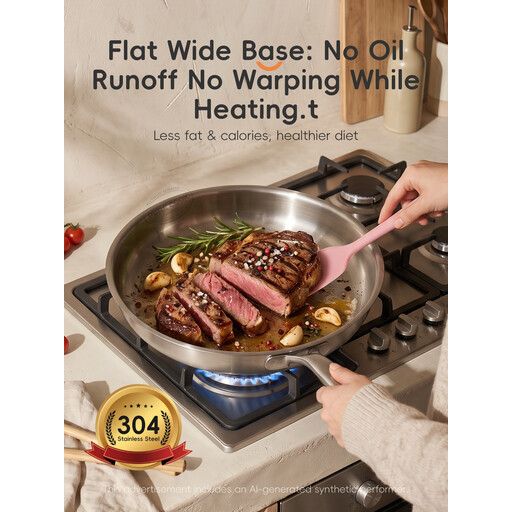
Why this choice suits this profile: Its 28 cm format is ideal for everyday cooking, while its three-layer construction and compatibility with all hob types make it a versatile foundation for your kitchen.
The product page specifies the 304 steel and aluminium composition, as well as compatibility with gas, induction, electric, ceramic and halogen hobs. The buyer can therefore check the essential criteria before ordering.
Tri-ply construction, pouring rim, satin finish and dishwasher-safe cleaning.
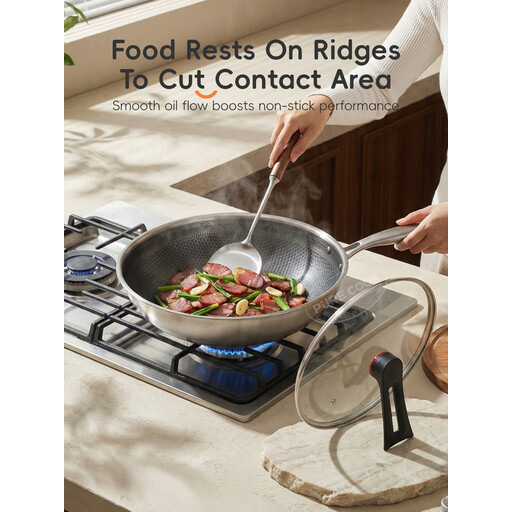
Why this choice suits this profile: With its large diameter, this wok is aimed at cooks who want to prepare stir-fries, stewed dishes and family recipes, and it comes with a glass lid.
The product page details the tri-ply construction, the 32 cm diameter and compatibility with induction, gas and ceramic hobs. The manufacturer also mentions a PTFE coating: follow the care instructions and check which utensils can be used.
Large format, transparent lid and insulated handle. Hand washing is recommended to preserve the surface.
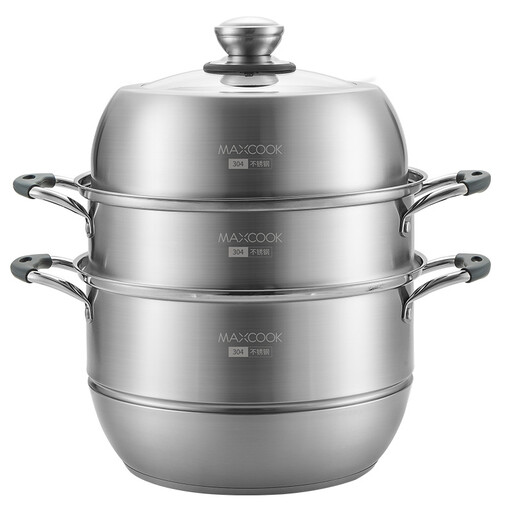
Why this choice suits this profile: Its three tiers allow you to cook several foods at the same time – a practical setup for family meals and batch cooking.
The product page states a composite base compatible with induction, gas, electric and ceramic hobs. Hand washing is recommended – something to consider before buying.
Three cooking tiers, glass lid and side handles with heat-resistant silicone protection.
We’ve put together a comprehensive list, updated in real time, of products that fully meet these strict selection criteria and European safety regulations.
Yes, provided the product page explicitly states this compatibility. A magnetic base or a suitable composite base is essential. Also check that the diameter of the utensil matches the heating zone of your hob.
Preheat the pan over a moderate heat, then add a small amount of oil, and finally place the food in the pan. Avoid moving it straight away: a crust can form, allowing the food to release more easily. To remove any residue, let the pan cool, soak it, then use a non-abrasive sponge.
It depends on the quality of manufacture, how often you use it and how you care for it. An uncoated utensil can remain perfectly functional despite a few superficial marks, whereas a coated model must be used according to the manufacturer’s recommendations. Dry the pieces after washing, avoid thermal shock and do not heat an empty pan on a high setting.