
Livraison le jour même ou le lendemain

Qualité garantie

Débloquez vos offres de bienvenue: Livraison GRATUITE | Jusqu'à -80 % | 30 jours d'essai gratuits à JoyPlus
Téléchargez l'application
A pan that sticks, a frying pan that heats unevenly, or a stockpot that won't work on an induction hob can quickly turn a promising purchase into a waste of money. Stainless steel cookware has a reputation for being robust, but not all models are built the same or offer the same versatility.
Before you choose a set of stainless steel saucepans or a stainless steel frying pan, make sure you check three things: the material composition, the structure of the base, and compatibility with your hob.
Simply seeing the word "stainless steel" doesn't guarantee a pan will work on an induction hob. Induction requires a magnetic, perfectly flat base. A single-ply stainless steel model may not be detected by the hob at all, or it may heat unevenly.
Look for specific details such as magnetic base, encapsulated base, or multi-layer base compatible with induction. The product description should also state compatibility with other heat sources: gas, electric, ceramic, or halogen.
If a piece of cookware is described as "reinforced" or "durable" without any information about its construction, take a closer look. A composite base or a "tri-ply" structure — stainless steel, aluminium, stainless steel — generally distributes heat more evenly than a single sheet of stainless steel.
That doesn't mean a multi-layer model will suit every recipe, but this information gives you a solid basis for comparing products.
A large stainless steel stockpot might seem practical, but it takes up more space and becomes heavy once filled. On the other hand, a small saucepan won't be much use for family meals. Check the diameter, capacity in litres, whether a lid is included, and the length and shape of the handles.
For a stainless steel deep fryer or a stockpot with a lid, also check the stability, the height of the sides, and any recommendations about oil quantity.
304 stainless steel is commonly used for cookware. You'll find it on many saucepans, frying pans, and stainless steel cookware sets. Some product descriptions also mention 316 or 316L stainless steel, as seen on certain Maxcook or Cooker King models. This tells you the composition stated by the manufacturer, but it isn't enough to judge overall quality — the base, handles, and finish all play an important role too.
For products intended for food contact, check the compliance information on the product page as well as the care instructions. References to standards or regulations should be distinguished from simple marketing claims.
A tri-ply frying pan or a saucepan with a composite base combines several materials to improve heat transfer. Among the products featured here, some descriptions mention an aluminium core surrounded by stainless steel, while others refer to a magnetic base made up of several layers.
For everyday cooking, choose a flat base that is wide enough to cover the heating zone and stable enough to stay put on the hob. On a gas hob, the flame should not extend beyond the base to avoid overheating the handles and sides.
For daily use, a saucepan that works on all hobs and has a comfortable handle can prove more useful than a very large set where several pieces end up at the back of the cupboard.
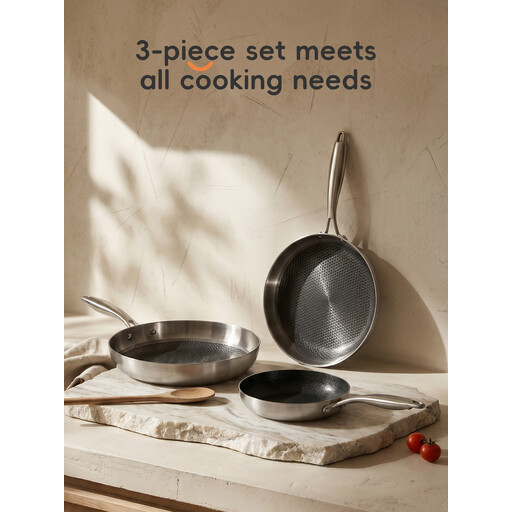
Why this suits this profile: With three diameters — 20, 26, and 30 cm — this set covers everything from individual portions to family meals, without needing to buy several pans separately.
The dimensions and compatibility with induction, gas, and ceramic hobs are clearly stated on the product page, making it easy to compare before you buy.
304 stainless steel, multi-layer magnetic base, and three sizes stated as compatible with all hob types.
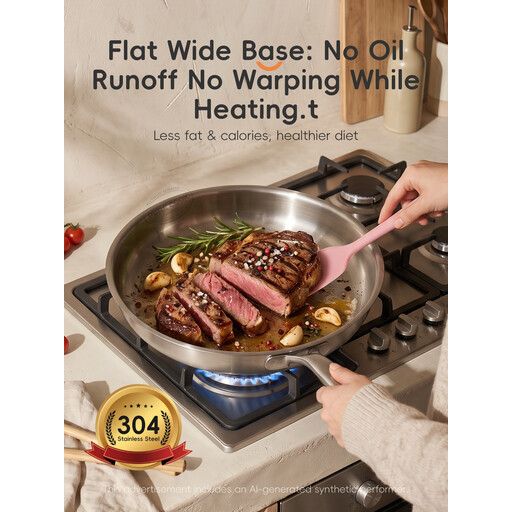
Why this suits this profile: Its three-layer construction and 28 cm diameter make it ideal for cooks looking for a versatile stainless steel pan that can sear, simmer, and prepare sauces.
The stated construction — 304 stainless steel around an aluminium core — offers far more detail than a simple promise of rapid heating.
Satin finish, pouring rim, and stated compatibility with gas, induction, electric, and halogen hobs.
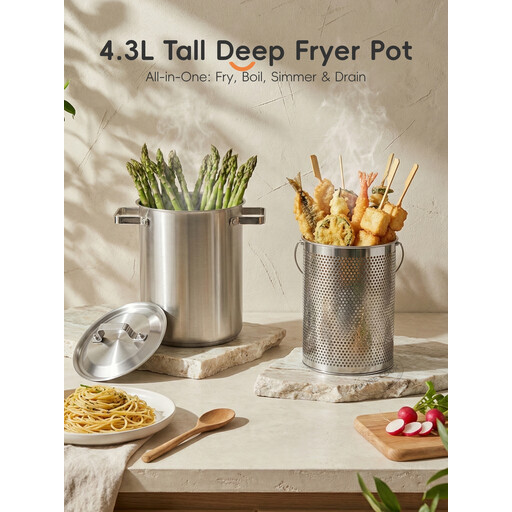
Why this suits this profile: Its high sides and removable basket meet the needs of occasional deep frying, but it's also great for cooking pasta, soups, or blanching vegetables.
The 4.3-litre capacity, draining basket, and composite base are all detailed on the product page, unlike models where the "deep fryer" use remains vague.
304 stainless steel, three-layer magnetic base, and stated compatibility with gas, induction, and ceramic hobs.
We've put together a full, real-time updated list of products that fully meet these demanding criteria as well as European safety regulations.
Stainless steel is generally cleaned with a soft sponge and a mild detergent. To reduce white or iridescent marks, dry the item after washing and avoid adding salt to water before it boils. White vinegar can help remove certain deposits, as long as you rinse thoroughly afterwards.
Avoid steel wool and abrasive products, especially on satin finishes or external coatings. With a stainless steel frying pan, increase the temperature gradually and use an appropriate amount of fat to reduce sticking. Handles, lids, and seals should be maintained according to the recommendations on the product page.
Yes, provided the cookware has a compatible magnetic base. Check for the induction symbol or an explicit description. A magnet can give you a first clue, but the manufacturer's information is essential.
It depends on how often you use it, the thickness of the material, the quality of the base, and how well you look after it. A saucepan that is properly dried, never overheated when empty, and cleaned without abrasive products can remain functional for many years. Regularly inspect the handles, base, and any signs of warping.
Energy consumption depends mainly on the power of your hob, the diameter of the base, whether you use a lid, and the temperature setting. A multi-layer base that distributes heat evenly, a size that matches the burner, and cooking with a lid all help to reduce heat loss and unnecessary temperature increases.