
Livraison le jour même ou le lendemain

Qualité garantie

Débloquez vos offres de bienvenue: Livraison GRATUITE | Jusqu'à -80 % | 30 jours d'essai gratuits à JoyPlus
Téléchargez l'application
Tired of plastic utensils that stain and warp?? Switching to stainless steel is an essential step towards building a long-lasting kitchen. A stainless steel colander isn't just a gadget?: it's an investment in durability, hygiene, and versatility. But with the jungle of available models, navigating the options can be tough. This guide is here to help?: we've outlined the key criteria and selected the best options to simplify your daily kitchen routine, from rinsing vegetables to draining pasta.
Before you decide, let's review the few technical points that make all the difference. Here are the three criteria to consider to find the perfect utensil for your needs.
Not all stainless steels are created equal. For food-safe contact and unbeatable longevity, 304 stainless steel (sometimes called 18/8) is the gold standard. This alloy is renowned for its excellent resistance to corrosion and rust. It ensures that no metallic taste will transfer to your food. This is a non-negotiable criterion for 304 steel kitchen utensils designed for heavy-duty use and built to last.
The model you choose will primarily depend on how you plan to use it.
In daily use, it's the details that make all the difference. Fine, evenly spaced perforations ensure rapid drainage without letting small foods like rice or quinoa escape. Sturdy, well-attached handles provide a secure grip, especially when the contents are hot and heavy. Finally, a stable base or non-slip feet prevent the colander from tipping over in the sink.
Based on these criteria, we have selected three products that meet different needs and uses in the kitchen.
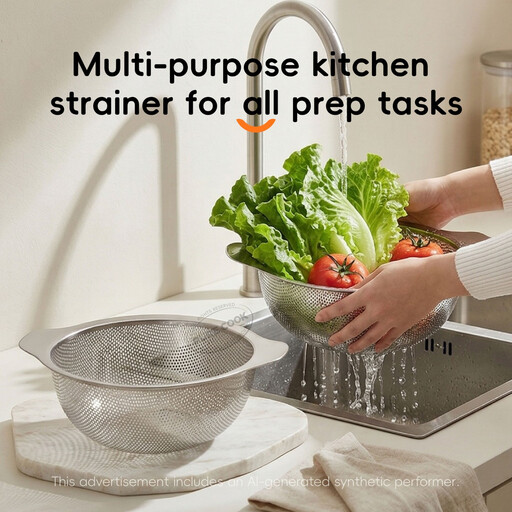
Key Feature
This stainless steel drainer basket shines with its versatility. Its robust design and integrated handles make it a do-it-all tool?: perfect for washing and draining, of course, but also for storing fresh produce in the fridge or even serving as a stylish fruit basket on the table.
Advantages
Who is it for??
This model is for families and cooking enthusiasts who appreciate versatile utensils. Its large capacity and sturdy construction make it a trusted daily ally.

Key Feature
This model's star feature is its telescopic function. Designed as an extendable over-the-sink colander, it adjusts to fit most sinks, freeing up your hands and your countertop. When its job is done, it retracts for ultra-compact storage.
Advantages
Who is it for??
The ideal solution for those living in small spaces or who simply want to optimise their countertop. An ultra-practical accessory for washing fruits and vegetables or draining dishes directly over the sink.

Key Feature
This isn't a classic colander, but a set of three stainless steel skimmers in different sizes. These tools, also known as kitchen spiders, are specialists for frying, poaching, and cooking in large pots of liquid.
Advantages
Who is it for??
This set is for amateur or seasoned cooks who master frying (fries, doughnuts), cooking stuffed pasta (ravioli, gnocchi), or blanching vegetables. An essential technical addition to more traditional colanders.
Our selection highlights versatile and specialised models to cover the most common needs. However, the world of colanders and drainers is much larger. If you're looking for a different size, a finer mesh, or a specific shape, many other solutions are available.
? Discover our complete collection of kitchen strainers to explore a wider range of products.
Stainless steel outperforms plastic on several key points. First, durability?: it doesn't warp under heat. Second, hygiene?: its non-porous surface doesn't absorb odours or food colours (no more tomato sauce or beetroot stains?!). Finally, stainless steel is a perfectly neutral material that won't leach unwanted substances like BPA.
Maintenance is a breeze. Most models are dishwasher-safe (but always check the manufacturer's recommendations). For hand washing, a soft sponge and dish soap are all you need. Absolutely avoid scouring pads, which could scratch the stainless steel. Our tip to prevent limescale spots?: dry it with a soft cloth right after washing.
304 stainless steel is the star of food-grade stainless steels. It's an alloy primarily composed of iron, chromium (about 18?%), and nickel (about 8?%). This composition gives it excellent resistance to rust and corrosion, making it the material of choice for kitchen utensils that come into direct contact with our food.