
Livraison le jour même ou le lendemain

Qualité garantie

Débloquez vos offres de bienvenue: Livraison GRATUITE | Jusqu'à -80 % | 30 jours d'essai gratuits à JoyPlus
Téléchargez l'application
Is clutter piling up and living space shrinking? A stackable plastic storage box seems like the go-to solution. Yet, impulse buys often lead to disappointment: boxes that crack, lids that no longer clip shut, or stacks that threaten to topple at the slightest nudge. To avoid throwing your money away, you need to know how to sidestep the common traps and invest in a solution that will stand the test of time.
As a Product Expert at Joybuy, I'm here to help you make an informed decision. Let's cut through the marketing jargon and get straight to the facts. Here are the objective checkpoints and criteria for choosing the storage container that's right for you.
A tempting price tag often hides design flaws that make a product unusable in the long run. Here are the three most common problems:
To avoid these pitfalls, you just need to check a few technical details. They are what make all the difference between a purchase you'll regret and a smart investment.
The type of plastic is the primary indicator of sturdiness. Polypropylene (PP) is an excellent choice for its impact resistance, flexibility, and ability to withstand temperature changes. For unbeatable durability, look for models with a reinforced structure: a thicker wall (for example, 2.5 mm) or reinforcing ribs on the sides and bottom. This guarantees the box won't deform under a heavy load.
A storage crate with a lid worthy of the name must offer a reliable closure and secure stacking. Look closely at the lid's design: it should have rims or grooves that fit into corresponding notches on the base of the box above it. This interlocking system prevents any sliding. Strong, well-integrated closing clips are also a sign of longevity.
Opting for a transparent stackable box saves you precious time: no more unpacking everything to find what you're looking for. Also, think in terms of a system: buying a set of plastic storage boxes from the same range ensures perfect modularity. The boxes will stack seamlessly, allowing you to optimise the vertical space in your closet organiser, garage, or office.
Every storage project is unique. Here are a few options that suit different needs, all selected according to the quality criteria we've just discussed.
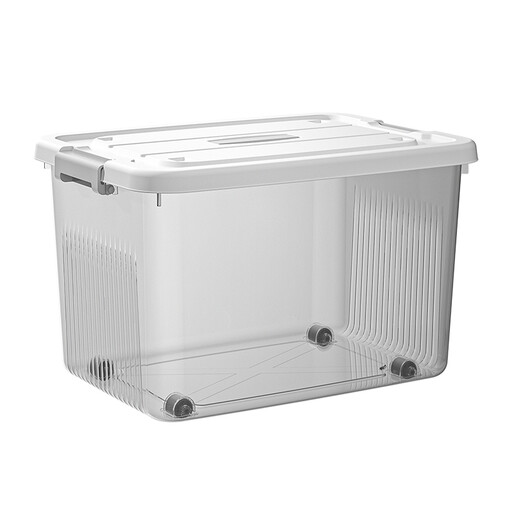
Why we chose it: Ideal for everyday general storage (clothes, papers, toys). This set offers excellent value for money to get everything in order, uniformly and efficiently.
Advertised with a 2.5 mm thickness and reinforcing ribs, its PP plastic prevents the risk of breakage. The clip-on lid and non-slip base ensure stable stacking.
Its transparency allows you to identify the contents at a glance. The integrated handles make it easy to carry, even when the box is packed to the brim.
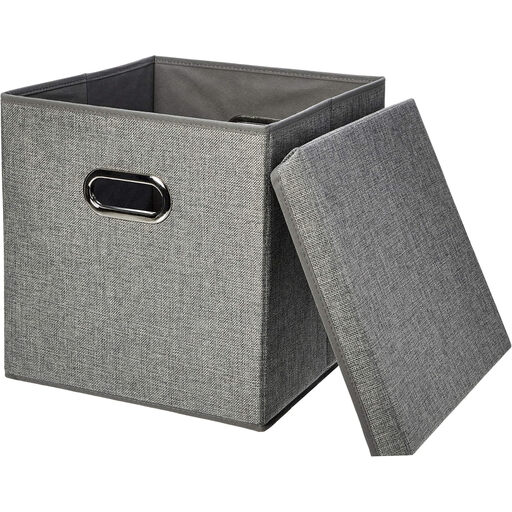
Why we chose it: Perfect for optimising space inside cupboards or on shelves. Its main advantage? It's foldable and stores flat when not in use. A real space-saver in an apartment.
Its fabric construction immediately eliminates the risk of breakage associated with low-grade plastic. The removable lid provides effective protection from dust, a must-have for closet storage.
Its lightweight, foldable design offers maximum flexibility. Its square format is compatible with most modular storage units (like Kallax, etc.).
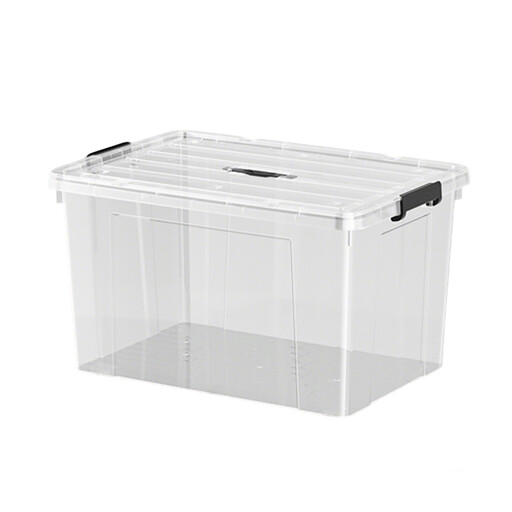
Why we chose it: For those who need to store heavy and bulky items (tools, seasonal equipment, archives) in challenging conditions. Large capacity and robustness are its key features.
Its thick, reinforced PP structure is built to withstand heavy loads and resist the conditions of a cellar or garage. The lid design ensures secure stacking, even with full boxes.
Its generous volume (51 x 39 x 35 cm) can accommodate duvets, tools, or large archives. The set of 4 is a complete solution for a major decluttering project.
These golden rules—durability and smart design—apply to any type of storage. We've compiled a complete selection of products that tick all the boxes.
It all depends on its material and how it's used. A good box made of polypropylene (PP), used indoors and away from direct sunlight, can last for years. However, prolonged exposure to UV rays and extreme temperatures (frost, heatwaves) will weaken the plastic and reduce its lifespan.
For stable stacking, follow these simple rules:
Absolutely not! You should not store food in standard storage boxes unless the manufacturer explicitly states that they are food-grade. Plastics intended for food contact comply with strict health standards to ensure they do not release harmful substances. Look for the official logo (a glass and fork) or check the product sheet.