
Livraison le jour même ou le lendemain

Qualité garantie

Débloquez vos offres de bienvenue: Livraison GRATUITE | Jusqu'à -80 % | 30 jours d'essai gratuits à JoyPlus
Téléchargez l'application
Shoes piling up in the hallway, trainers spilling out of the wardrobe, or boxes you can’t open in the garage – shoe storage can quickly become a headache. Stackable boxes help you save space, protect your pairs from dust, and spot the style you’re looking for in an instant. But you need to check a few details before you place your order.
A box described as compatible with most shoes can turn out to be too short for bulky trainers, high-top styles, or models with thick soles. Always check the internal dimensions, or at least the external dimensions of each compartment.
A length of 33.3 cm alone doesn’t guarantee that all UK shoe sizes will fit. The shape of the shoe also matters: a wide pair of trainers naturally takes up more room than a pair of loafers.
Transparent boxes let you spot a pair at a glance. However, a lid on the top quickly becomes impractical when several boxes are stacked. For everyday use, models with a front-opening door are often more convenient: you simply open the box without having to move the whole column.
A stackable storage system needs to stay stable, even when you remove a box from the middle. Plastic that’s too flimsy, an uneven base, or a poorly fitted lid can cause the whole stack to slide. Also avoid overloading the boxes or placing a column that’s too tall in a walkway.
Measure the largest pair in your collection, taking into account its length, width and height. If you’re installing shoe storage in a cupboard, also remember to measure:
Sizes around 33.3 × 23.1 × 14.3 cm suit many low-profile styles, but may lack height for high-top shoes. Boxes measuring 35 × 25.2 × 19 cm offer more volume per compartment, at the cost of a deeper column.
Polypropylene (PP) is very common in the manufacture of plastic storage boxes. It’s lightweight and easy to clean with a damp cloth. However, rigidity depends on the thickness of the panels, the presence of reinforcements, and the design of the corners. For storing heavier items or using the boxes for other purposes, a reinforced structure with ribs and a non-slip base will keep the stack more stable.
Avoid placing these products near a heat source or flame, or behind glass that’s exposed to direct sunlight for long periods. Also follow the manufacturer’s recommended maximum load to reduce the risk of warping.
Ventilation openings encourage air circulation, but they don’t replace the need to dry your shoes first. Leave damp pairs to dry completely before storing them, and remove the insoles if necessary.
For assembly, choose panels that click together clearly and a door that stays properly aligned. An organiser that’s easy to put together will also be simpler to move or rearrange when the seasons change.
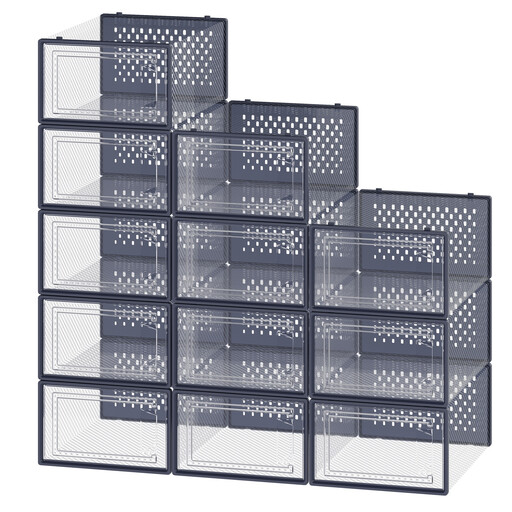
Why this choice suits this profile: This pack of 12 boxes is enough to organise a first shelf, a hallway, or a small wardrobe. Each box measures 33.3 × 23.2 × 14.3 cm.
The transparent panels and front openings reduce repeated handling. It’s still essential to compare the dimensions with those of your shoes before buying.
Pack of 12 boxes, PP structure, snap-together assembly and integrated ventilation openings.
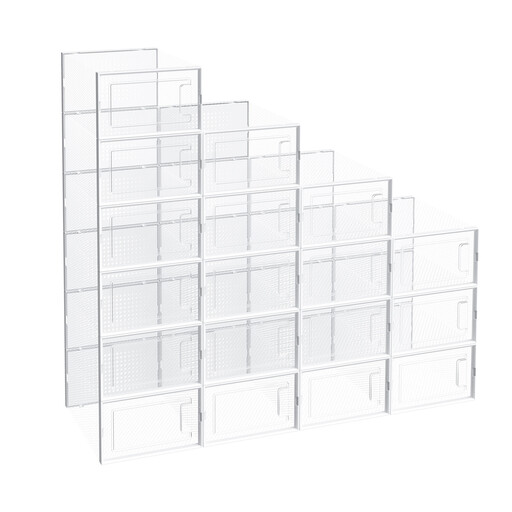
Why this choice suits this profile: With its 18 compartments, this pack lets you display a collection uniformly in a wardrobe or dedicated room. The 35 × 25.2 × 19 cm size offers more height for certain styles.
The front door means you don’t have to move the boxes to access a pair. However, the dimensions should still be checked for particularly wide shoes.
18 boxes, transparent doors, ventilation and a size stated to fit trainers up to UK size 11.

Why this choice suits this profile: These boxes, measuring 50.4 × 37.6 × 28.8 cm, offer a volume suitable for the garage, cellar, balcony, or car boot for storing bulkier items.
The 2.5 mm reinforced body, ribs and non-slip base correct the main flaws of overly flimsy boxes. The maximum load must still be respected.
Clip-on lid, integrated handles, reinforced structure and stacking designed for versatile home storage.
We’ve put together a comprehensive, real-time updated list of products that fully meet these strict selection criteria and European safety regulations.
To keep your shoe storage clean and stable:
A compact shoe storage system works best when the column’s dimensions match the room. In a narrow hallway, choose a shallow depth and a reasonable height. In a garage, larger boxes with a lid can also hold accessories, seasonal clothing, or travel gear.
No. Their compatibility depends on the actual dimensions and volume of the pair. Measure your largest shoes, especially thick trainers and high-top styles, then compare these measurements with those listed on the product page.
Yes, as long as the floor or shelf is stable and the column follows the manufacturer’s recommendations. For frequent access, shoe boxes with a front door save you from having to dismantle the whole stack.
It all depends on the quality of the plastic, the weight stored, how often it’s handled, and exposure to heat or sunlight. Correct assembly, moderate loading, and cleaning without abrasive products all help to preserve the panels and fastening systems.