
Livraison le jour même ou le lendemain

Qualité garantie

Débloquez vos offres de bienvenue: Livraison GRATUITE | Jusqu'à -80 % | 30 jours d'essai gratuits à JoyPlus
Téléchargez l'application
A cluttered hallway, trainers piled up at the back of a cupboard, or heels that have gone missing can quickly eat into your available space. Stackable shoe storage boxes offer a simple solution – provided you choose a model that suits the size of your shoes and the layout of your home.
However, product photos and descriptions don’t always tell the full story. Actual available dimensions, type of opening, stability, and ventilation are all points to check before you order. Below, we’ve outlined what to look for, followed by a selection tailored to different needs.
A box advertised as suitable for trainers may turn out to be too short for high-tops, thick soles, or larger sizes. Hinges, door frames, and the thickness of the plastic can all significantly reduce the internal volume.
Before you buy, measure the largest pair in your collection, taking into account its length, width and height. Then compare these figures with the internal dimensions listed for each box – where these are provided.
Clear shoe boxes make it easy to spot the pair you’re looking for. However, a lid on the top quickly becomes impractical when several boxes are stacked. Shoe storage with a front-opening door generally makes it easier to access the pairs in the middle or at the bottom of the stack.
This format is particularly well suited to a hallway, dressing room, or cupboard where height is better utilised than depth.
A ventilated shoe box may have openings designed to improve air circulation. However, this does not mean you can skip letting your shoes dry out before storing them. In particular, avoid immediately sealing away a damp pair after a walk in the rain or a workout.
Ventilation is therefore a design advantage, not a guarantee against odours. The material, how you care for your shoes, and the storage conditions all matter just as much.
To create a reliable vertical storage system, check the total height of the stack as well as the stability of the floor. Stackable storage bins should be placed on a flat surface, away from a radiator or any other heat source.
For a collection of trainers and sneakers, the dimensions of each compartment are the priority. The JOYFURNOS model measuring 35 × 25.2 × 19 cm is advertised as compatible with sneakers up to UK size 11. It is still essential to check the shape and volume of your own shoes before buying.
Plastic shoe boxes are easy to clean and practical for keeping the contents visible. Polypropylene (PP) is commonly used for flexible or semi-rigid models. A reinforced frame, rounded corners, and a non-slip base can improve stability, but these features should be confirmed on the product page.
Do not place overly heavy objects on the boxes, and always follow the manufacturer’s recommendations. For clothes, accessories, or seasonal items, a model with a lid may be more suitable than a compartment that is open at the front.
A front door allows you to remove a pair without having to dismantle the entire stack. A top lid is better suited to storing clothes, linen, or accessories that are only used occasionally.
For cleaning, a slightly damp cloth is usually sufficient. Avoid sharp objects, abrasive products, and prolonged exposure to direct sunlight. In a cellar, garage, or enclosed balcony, make sure there is adequate ventilation and check the condition of your shoes regularly.
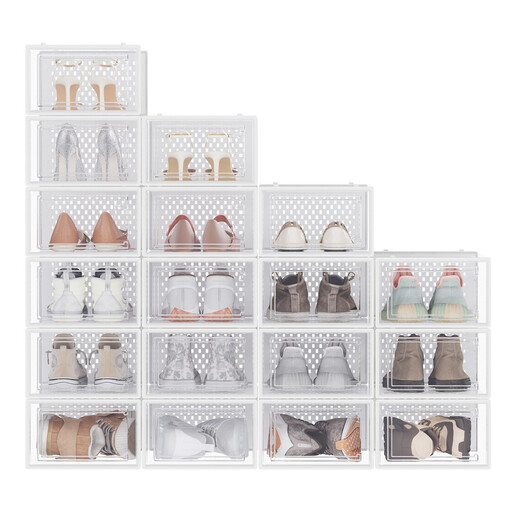
Why this choice suits this profile: This 18-box pack makes it easy to reorganise a cupboard, hallway, or dressing room, while keeping a uniform look for your trainers, heels, and flats.
With its dimensions of 33.3 × 23.1 × 14.3 cm and transparent front, each box lets you assess the space before building a stack.
An 18-unit pack, front opening, PP construction, and ventilation openings as stated on the product page.
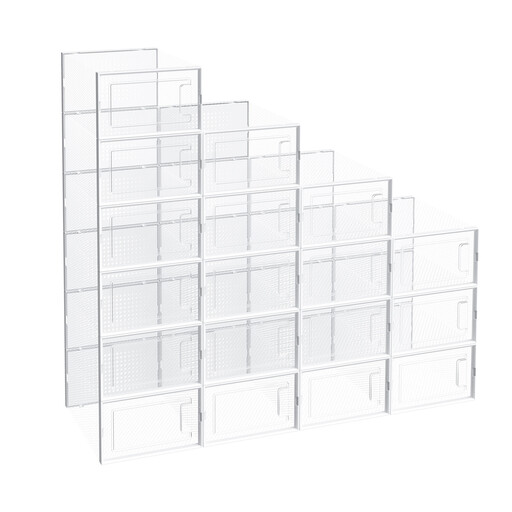
Why this choice suits this profile: Their white and transparent finish blends naturally into a well-kept dressing room or hallway where your shoes are part of the décor.
The front door means you don’t have to move the whole column, while the dimensions of 35 × 25.2 × 19 cm give you a precise reference to check compatibility.
18 boxes, PP construction, transparent doors, and ventilation holes as mentioned in the description.

Why this choice suits this profile: With dimensions of 50.4 × 37.6 × 28.8 cm, these boxes meet larger needs: bulky shoes, seasonal clothing, accessories, or storage in the garage or car boot.
The clip-on lid, reinforcing ribs, and non-slip base are suitable for heavier storage, provided you respect the recommended weight limit.
PP stated as 2.5 mm thick, integrated handles, lids, and a transparent format to see the contents.
We’ve selected products that meet these criteria and European safety standards, in a list updated in real time.
Start with a flat, stable base. Place the heaviest boxes at the bottom, align each element carefully, and avoid building a column that is too tall if it isn’t secured. In a hallway, also make sure there is enough clear space to avoid knocks.
It all depends on the quality of the plastic, the weight stored, how often they are used, and exposure to heat or UV light. To preserve their structure, stick to the stated weight limit, avoid high temperatures, and clean the boxes with non-abrasive products.
No. High-tops, boots, thick soles, and some heels require more height. Always measure your largest pair and check the actual internal space available. For classic trainers, a pack of front-opening compartments generally offers compact, easy-access storage.