
Livraison le jour même ou le lendemain

Qualité garantie

Débloquez vos offres de bienvenue: Livraison GRATUITE | Jusqu'à -80 % | 30 jours d'essai gratuits à JoyPlus
Téléchargez l'application
Shoes piling up in the entryway, collector's sneakers gathering dust on a shelf, the daily search for the right pair turning into an obstacle course... Does this scenario sound all too familiar? You're dreaming of a space-saving shoe storage solution that is both practical and stylish. The stackable shoe storage box seems like the obvious answer, but be warned: not all models on the market are created equal.
Before you commit, it's crucial to know the pitfalls that can turn a good idea into a purchase you'll instantly regret. As the Head of Product Recommendations at Joybuy, my mission is to help you see through the marketing hype and focus on what really matters.
The market is flooded with solutions promising flawless organization. However, a few design flaws are all it takes to turn your purchase into a headache. Here are the critical points you should never overlook.
To avoid these traps, the secret is to stick to a few objective technical specifications. These are the details that make all the difference between a short-lived gadget and a true shoe organizer built to last.
The durability of a plastic shoe box depends on its composition. The most reliable models combine two types of plastic:
Also, check for reinforcing ribs on the walls and a sturdy interlocking system between the boxes. This is what guarantees the perfect stability of your storage wall.
Before any purchase, there's one non-negotiable step: measure your largest pairs of shoes (length, width, and height). Then, compare these measurements to the internal dimensions of the box.
A good system must be modular. The ability to buy a set of shoe boxes and assemble them according to your needs allows you to create a custom closet organizer or optimize an unused corner of your entryway. Modularity ensures that your storage solution will evolve with your collection and your space.
For frequent use, opt for a stackable transparent box with a front-opening door. Unlike boxes with a lid on top, this system allows you to access any pair without having to unstack the entire pile. It's a huge time-saver, especially for sneaker storage collectors who like to rotate their pairs. Finally, make sure there are ventilation holes, usually at the back of the box, to let your shoes breathe.
To help you see how these criteria apply in practice, here is our selection for different types of users.
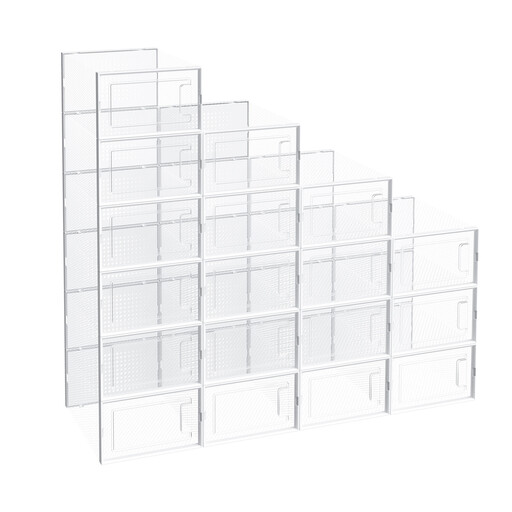
The ideal choice for this user: This model offers generous dimensions (35 x 25.2 x 19 cm) capable of holding high-top sneakers and sizes up to EU 46 (UK 11). The transparent door and rigid ABS frame are perfect for displaying and quickly accessing a rotating collection.
Its internal dimensions are clearly specified and suited for bulky footwear, avoiding the "one-size-fits-all" trap. The presence of ventilation holes preserves sneaker materials.
Large capacity per box, ideal for high-top models. Solid ABS frame for stable and secure stacking.
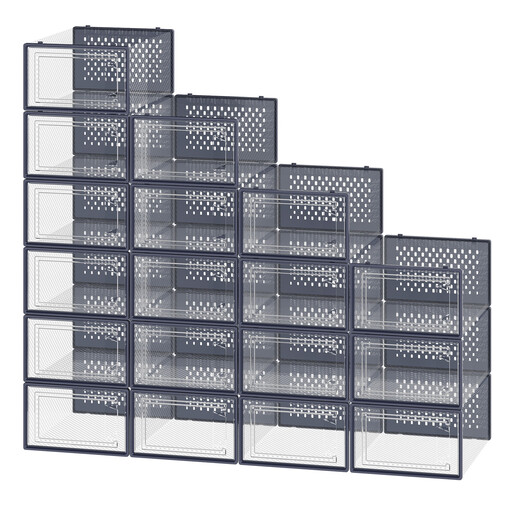
The ideal choice for this user: Sold in a set of 18, this pack offers an excellent starting point for organizing the whole family's shoes. The simple and quick assembly allows you to tidy up an entryway or closet effortlessly. The standard size fits most everyday shoes.
The interlocking system is designed to ensure the stability of the stack, countering the risk of collapse. The simple, proven design avoids fragile mechanisms.
Excellent value for large-scale organization. Tool-free assembly.

The ideal choice for this user: This is more than just a shoe box. With its 2.5mm thickened body and reinforcing ribs, it's designed to support heavier loads. Ideal for storing boots, but also clothes, toys, or tools in a garage or laundry room.
Its reinforced construction and thick PP plastic directly combat the fragility trap. The non-slip bottom ensures stable stacking, even with heavier contents.
Heavy-duty sturdiness and great versatility, far beyond just shoe storage. Integrated handles for easy transport.
We have compiled a complete selection of products that meet our quality criteria and current safety standards.
The longevity depends on the quality of the plastic and how it's used. A model made of good-quality, thick polypropylene (PP), used indoors and away from direct sunlight, can last for many years. Direct exposure to UV rays can make the plastic more brittle over time.
The vast majority of models are designed for simple, tool-free assembly. The different parts (walls, door, frame) snap or click together. It is advisable to follow the instructions or assembly video carefully to avoid forcing the fastening tabs and risking breakage.
Quality plastics like the PP and PS used today offer good resistance to yellowing. However, prolonged and direct exposure to sunlight can eventually affect their transparency. To maintain their clarity, it's best to place them in a closet, dressing room, or an area of the room with little direct light.