
Livraison le jour même ou le lendemain

Qualité garantie

Débloquez vos offres de bienvenue: Livraison GRATUITE | Jusqu'à -80 % | 30 jours d'essai gratuits à JoyPlus
Téléchargez l'application
Buying a Spring Valley tropical juice 330 ml, pack of 24 meets a very specific need: having individual fruity drinks on hand for home, the office, an event, or takeaway sales. But commercial labels don't always make comparison easy. Between juice from concentrate, nectar, fizzy drinks and fruit blends, the differences aren't always obvious.
Before ordering a pack of 24 cans of 330 ml, be sure to check the ingredients, the actual volume delivered and the storage conditions. This will help you avoid a drink that's too sweet for your taste, an unsuitable format, or stock that's difficult to shift.
Fruit juice, nectar and exotic fruit drinks don't necessarily have the same fruit content. The term 'tropical' primarily refers to a combination of flavours; it doesn't guarantee a specific recipe or a high fruit proportion.
The Spring Valley product page mentions a blend of fruit juices from concentrate, comprising 42% apple, 23% pineapple and 18% orange, along with banana, mango, mandarin, passion fruit and guava. So you're looking at a fruity blend, to be compared with the category you're after, rather than a simple pineapple or mango juice.
A drink can taste light while still containing a significant amount of sugar. For the Spring Valley product, available information indicates around 9.5 g of sugar per 100 ml, which is nearly 31.4 g per 330 ml can. That's a figure to keep in mind if the cans are consumed regularly or offered to a varied audience.
The ingredient list and nutritional values printed on the packaging remain the reference points at the time of purchase, as they can change.
A pack of 24 cans represents 7.92 litres of drink. That's a sensible volume for regular consumption or an event, but probably excessive for a single person who simply wants to try the product. Conversely, smaller batches mean more orders and can sometimes complicate the management of a professional service.
The slim 330 ml cans are easy to distribute and require neither a glass nor measuring. They naturally fit in during office breaks, in lunchboxes, on a buffet or for takeaway sales. For a party or community event, base your quantity on the number of participants and allow a small margin, without overstocking.
The individual format also reduces handling: everyone opens their drink when they're ready. Once opened, however, the can should be consumed quickly, in line with the storage instructions.
For an apple-pineapple-mango-passion fruit juice, look at the full fruit list rather than relying solely on the packaging design. The Spring Valley recipe also mentions orange, banana, mandarin and guava. The expected result is therefore a complex fruity profile, dominated by the flavours corresponding to the stated proportions.
If you're looking for a refreshing fruity drink without bubbles, go for a juice blend. For a livelier, fizzier sensation, a pineapple fizzy drink might be more suitable, but it shouldn't be presented as the equivalent of a juice.
The Spring Valley product is stated as being made in France and can be stored at room temperature, in a cool, dry place away from sunlight and heat sources. Serve it chilled for a more enjoyable taste. Before buying, always check the best-before date and the information on the delivered batch.
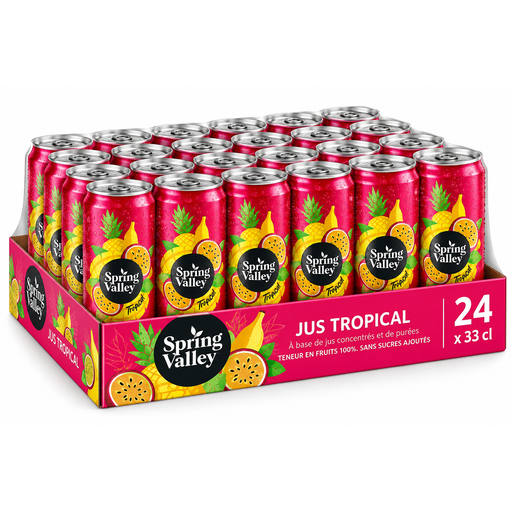
Why this choice suits this profile: The 24-can format lets you build up a usable stock straight away. The blend of apple, pineapple, orange, mango, passion fruit and guava offers a change from single flavours.
The product page specifies the total volume, the fruit breakdown, nutritional values and storage conditions, allowing you to compare the product objectively before buying.
24 slim 330 ml cans, a blend of several fruit juices and storage stated at room temperature.
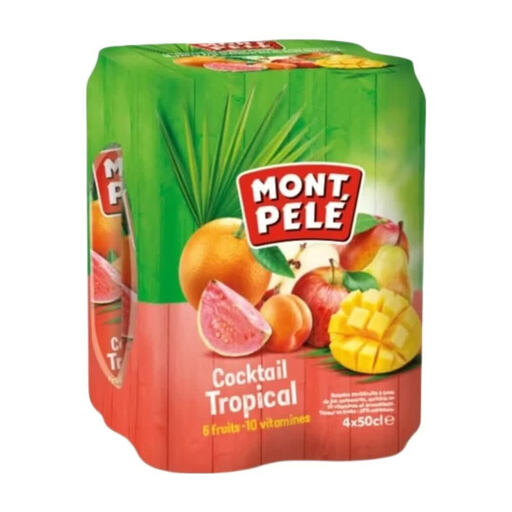
Why this choice suits this profile: The 50 cl bottles and the texture of an exotic fruit nectar will suit those who prefer a larger container and a drinking experience less associated with the can format.
The product page clearly distinguishes the nectar from the canned juice and states a total volume of 2 litres. So there's no risk of inadvertently comparing containers of different sizes.
Pack of 4 bottles of 50 cl, a blend of six fruits according to the product page and refrigeration required after opening.
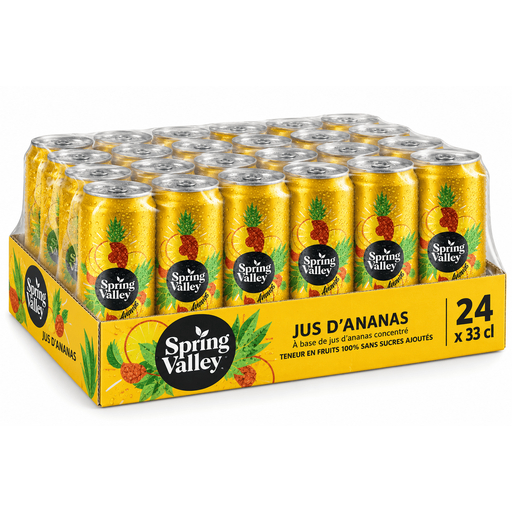
Why this choice suits this profile: The 24 individual cans are suitable for catering, events and takeaway sales when customers are looking for a pineapple fizzy drink.
The product page states that it is a pineapple-flavoured fizzy drink, not a still tropical blend. The product therefore better matches the customer's expectations.
24 cans of 330 ml, no refrigeration needed before opening and can be drunk on its own or used as a mixer.
Yes, if several people drink it regularly or if you want to have stock for meals and guests. The total volume is 7.92 litres. For occasional consumption, a smaller batch will reduce storage space and the risk of exceeding the date on the packaging.
The product page recommends storing them in a cool, dry place away from light and heat. So the fridge isn't essential before opening, although the drink will generally taste better served chilled. After opening, consume it immediately.
The Spring Valley tropical juice is presented as a blend of several fruit juices from concentrate. The Spring Valley pineapple drink, on the other hand, contains carbonated water, sugar, pineapple juice from concentrate and natural pineapple flavouring. The first satisfies a craving for tropical fruit juice, while the second belongs more to the family of fruity sodas.