Parents who want set portions
When preparing several breakfasts or snacks, a 15 g single-serve tub or a 25 g mini jar saves you having to measure out a portion each time. St Mamet and METRO France offer these two individual formats respectively.


To serve a set amount to each person, choose individual 15 g or 25 g portions. If your family enjoys spread regularly at home, a large jar may be more suitable, but you’ll need to portion it out when serving. Mini-jar sets are better for trying different recipes. Whichever format you choose, compare the sugars per 100 g and check the allergens.
When preparing several breakfasts or snacks, a 15 g single-serve tub or a 25 g mini jar saves you having to measure out a portion each time. St Mamet and METRO France offer these two individual formats respectively.
A set of small jars lets you try several recipes without opening multiple large jars. The weekly sets from Carrefour and Le Comptoir de Mathilde each contain seven 30 g jars. Check the ingredients for each recipe.
The size of the jar tells you nothing about what’s in it. The nutrition declaration lets you compare sugars per 100 g, while you should check the ingredients list and allergen information for the product you’re considering.
When shopping for a large family, first decide whether you want pre-portioned servings, a selection of recipes to try or one shared jar for regular use. Then check the ingredients and nutritional information for each product.
| Criterion | What to check | Who it suits |
|---|---|---|
| Set portions | The weight of each portion and the number of units in the pack. | When I’m preparing several snacks, I want to give everyone a portion that’s already separated, without measuring it out of a shared jar. Around 37% of consumers would make portioning their main priority. |
| Regular family use | The jar size and how much the household actually uses. | If the jar stays at home and is used often, I’d choose a size suited to how frequently we use it, while planning how to portion it out. This would be the priority for around 27% of consumers. |
| Variety of recipes | The number of jars, the flavours on offer and the ingredients in each recipe. | When family members have different tastes, I’d rather try several recipes in small quantities than open several large jars. Around 18% of consumers would put variety first. |
| Ingredients and allergens | Sugars per 100 g, the ingredients list and allergen information. | Before choosing a format, I need to check the sugars or ingredients that matter to my household. A small portion doesn’t answer that question on its own. This check would be a priority for around 18% of consumers. |
Article 1613 ter of the General Tax Code, published by Légifrance, applies to drinks and liquid preparations for drinks. It doesn’t tell you anything about the ingredients in a spread.
To compare two spreads, check the ‘sugars’ line per 100 g and the ingredients lists instead.
In France, the DGCCRF states that displaying the Nutri-Score is voluntary. If it isn’t shown, you should still check the nutrition information for prepacked foods, subject to the applicable exceptions.
Compare the values per 100 g, particularly sugars, saturated fatty acids and salt, then check the ingredients and allergens.
Individual 15 g and 25 g formats make it easier to serve separate portions. A large jar is better suited to a different need: regular use by the family at home.
Estimate how many portions you’ll need and choose the pack size to suit the meals you have planned. Don’t assume one format will suit every situation.
The Nutella mini jar featured by METRO France contains milk, hazelnuts and soya. Ingredients can vary from one jar to another in a set of assorted recipes. Nutella also states that its Plant-Based version isn’t suitable for people allergic to milk proteins.
Check the ingredients and allergen information for the product you’re considering and, for a set, for every flavour.
St Mamet offers hazelnut spread in individual 15 g tubs, supplied in a pack of 120.
METRO France offers a 25 g Nutella mini jar. Larger jars are also available in France.
Carrefour stocks a 100 % Natu weekly set containing seven 30 g mini jars of spread.
Le Comptoir de Mathilde offers a set of seven spreads in 30 g jars.
These products let you choose between a 25 g Nutella portion to serve individually and 1 kg or 3 kg Nutella jars for sharing at home. A larger format doesn’t set the amount served to each person.
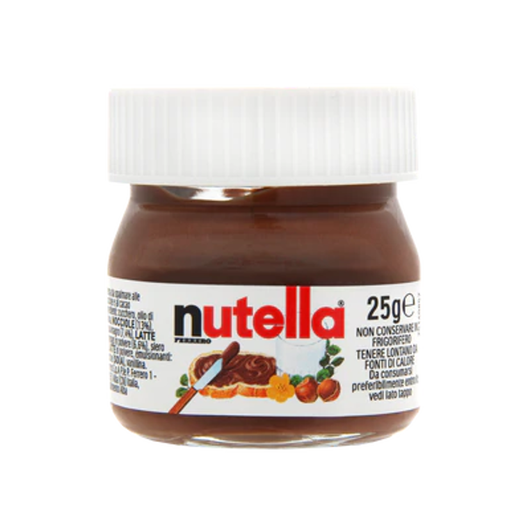 Image unavailable
For serving an individual portion at snack time or when you’re out and about. Portion: 25 g. Check the number of units in the pack and the allergen information on the packaging.
 Image unavailable
For regular family use at home. Size: 1 kg. The jar doesn’t come in pre-portioned servings, so plan how you’ll serve it if you want to divide it into portions.
 Image unavailable
For a household that uses a large amount of spread regularly. Size: 3 kg. Consider how much you’ll use and plan to portion it out when serving.
Compare the amount per portion, the number of units and the nutritional information per 100 g, rather than assuming the container size tells you what’s in it. Also check the ingredients and allergens for each product.
No. As the DGCCRF states, displaying it is voluntary. To compare prepacked foods, check their nutrition declarations, subject to the applicable exceptions, and particularly the ‘sugars’ line per 100 g.
No. The levy set out in Article 1613 ter of the General Tax Code applies to drinks and liquid preparations for drinks. It doesn’t tell you how much sugar a spread contains. Check the product’s nutrition declaration instead.
No. Nutella states that its Plant-Based recipe isn’t suitable for people allergic to milk proteins. Check the allergen information for the product you’re considering: the term ‘plant-based’ isn’t enough to answer this question.