People who regularly prepare snacks
If you’re planning several snacks, choose a pack size that suits the quantity you’ll use and the manufacturer’s storage instructions.


For frequent snacks, choose a pack size you can use within the jar’s storage instructions. If snacks are occasional, a smaller pack may be more suitable. Before taking a spread into a nursery, check the ingredients and allergens for the specific product you’ve bought, the setting’s rules and, if there is one, the child’s individualised welcome plan (PAI).
If you’re planning several snacks, choose a pack size that suits the quantity you’ll use and the manufacturer’s storage instructions.
Always check the exact recipe before taking food into a group setting. The French Ministry of National Education explains that a PAI can set out any necessary dietary adjustments, including in settings for young children.
The nutrition table lets you compare spreads on a like-for-like basis, per 100 g. According to the DGCCRF, nutrition information is mandatory on pre-packed foods, while the Nutri-Score is voluntary.
First check the nursery’s rules and the allergens, then choose the pack size and read the nutrition information for the product you’re considering.
| Criteria | What to check | Who is it for? |
|---|---|---|
| Pack size | How many snacks you’re planning and the jar’s storage instructions. | If I regularly prepare snacks, I want a quantity I can realistically use. Around 50% of consumers prioritise choosing the right pack size. |
| Allergens and nursery arrangements | Ingredients, ‘may contain’ warnings, the setting’s rules and any restrictions in a PAI. | If a child has dietary restrictions, I need to confirm that the product can be brought into the setting and eaten there. This is the main concern for around 33% of consumers. |
| Nutrition label | Nutrition information per 100 g; check for a Nutri-Score only if it appears on the packaging. | When I compare recipes, I want to check the sugar and fat content on the same basis rather than rely on a single logo. This is a priority for around 17% of consumers. |
According to the DGCCRF, the Nutri-Score is voluntary. If it isn’t shown, check the nutrition information provided on pre-packed foods instead.
To compare two spreads, look in particular at the sugar and fat content per 100 g. Use the Nutri-Score as additional information when it’s available.
Ingredients vary from one product to another. Carrefour SIMPL and Auchan POUCE product information, for example, lists milk and hazelnuts, while SIMPL also lists soya. Don’t assume that every product in the category does or doesn’t contain gluten.
Read the label on the jar you’ve bought and check the nursery’s rules, as well as any restrictions in the child’s PAI.
Nutella cocoa and hazelnut spread comes in several sizes, including 220 g and 1 kg.
The retailer offers several spread ranges, including SIMPL, Carrefour Classic’ and Carrefour Bio.
E.Leclerc offers the NUSTIKAO range in 400 g, 600 g and 1 kg jars.
The POUCE range includes a 750 g jar of cocoa and hazelnut spread.
ALDI describes TARTICHOC® as a hazelnut spread in a 750 g jar.
Lidl’s spread selection includes different products, so check the specific product and store.
These two jars are options for snacks where you’ll need to consider the pack size, ingredients and nursery rules before choosing.
 Image unavailable
The 1 kg jar is worth considering if you’re planning several snacks and the pack size suits your needs. According to Nutella France, the recipe contains hazelnuts, milk and soya. Check the jar’s label and the nursery’s rules before taking it in.
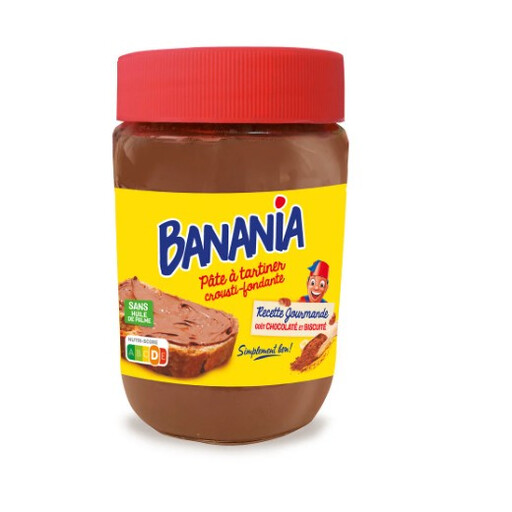 Image unavailable
The 750 g jar is another size to consider for several snacks. Product information lists milk and possible traces of nuts and gluten. Check the packaging and the nursery’s rules, especially if the child has dietary restrictions.
No. The DGCCRF says that the Nutri-Score is voluntary, whereas nutrition information is mandatory on pre-packed foods. You can therefore check the values per 100 g even if the jar doesn’t carry this logo.
No. You can’t assume that every recipe contains the same ingredients. Check the ingredients list and any ‘may contain’ warnings on the jar you’ve bought. You can’t tell whether a product contains gluten from the general category ‘spread’ alone.
Ask whether food brought in from outside is allowed, and what rules apply to sharing, allergens and storage. If the child has a PAI, check the dietary restrictions it sets out. The French Ministry of National Education explains that this plan can apply to settings for young children.
Choose a jar whose contents you can use within its storage instructions, rather than opting for a larger size simply because it holds more. Instructions can vary by product: Auchan, for example, advises keeping its POUCE spread away from heat and moisture.