Who is a jar suitable for?

People who prepare a snack before setting off

A resealable jar lets you prepare portions in advance or share the spread when you arrive. Bonne Maman offers a 250 g jar, while Carrefour France lists glass jars weighing 300 g. If you want to eat straight away during a break, you’ll need something to serve the spread with or a different format.

People comparing recipes

Nutritional values per 100 g let you compare sugar and fat on a like-for-like basis, even when the jars are different sizes. Nutri-Score can provide an extra point of reference if it appears on the packaging: the European Commission says front-of-pack nutrition labelling is not compulsory.

People who pay close attention to ingredients

Check the ingredients list and allergen information for the exact product you’re buying. Hazelnuts, milk, soya or cereals containing gluten may be present, depending on the recipe and format. Other versions from the same brand may have different information.

What should you check?

First decide whether you’ll prepare the snack in advance, serve it when you arrive or eat it during a break. Then check the label of the product that suits your plans.

What to consider What to check Who is it for?
Format and serving Check the container, net weight and what you’ll need to serve the spread. A format with breadsticks doesn’t meet the requirement for a glass jar. If I want to serve a snack when I arrive, I can take a protected jar; for a break without utensils, I’m looking for a ready-to-eat format. Around 37% of consumers prioritise this convenience.
Ingredients and nutrition Compare the sugar and fat content per 100 g of the recipes you’re considering. Check the Nutri-Score only if it’s shown. To choose between recipes, I need to compare their nutritional values on the same basis, rather than judging a product by its format alone. This is a priority for around 36% of consumers.
Allergens and storage Read the ingredients, any warnings about traces and the storage instructions for the exact jar, particularly after opening. If certain ingredients are a concern, I need to check the exact recipe. I also check whether its storage requirements are suitable for the journey. Ingredient suitability and storage are priorities for around 27% of consumers.

Mistakes to avoid

  • Applying the sugary drinks tax to a spread

    The French tax authority’s official guidance describes the contribution that applies to non-alcoholic drinks containing added sugar. Spread isn’t a drink, so this tax isn’t a factor when choosing between jars.

    Instead, compare the sugar content per 100 g shown on the labels.

  • Assuming a missing Nutri-Score is a mistake

    According to the European Commission, front-of-pack nutrition labelling is voluntary. Its absence doesn’t, on its own, tell you anything about a product’s nutritional values.

    Check the nutrition declaration and ingredients list. Use Nutri-Score as an additional guide if it’s shown.

  • Choosing a jar when you want to eat without any preparation

    A jar can be resealed, but it won’t necessarily come with anything to spread the contents with or an utensil. Nutella sells a separate & Go format with breadsticks, but that isn’t a glass jar.

    Before buying, decide whether you’ll prepare portions, serve the snack when you arrive or eat during a break.

  • Assuming recipe claims or storage instructions apply to every product

    Allergen declarations, possible traces and instructions for use after opening vary from one product to another. A version labelled lactose-free or gluten-free may still carry warnings about traces of other ingredients.

    Check the label of the product you’ve chosen, including its allergen information and storage instructions, rather than relying on the details for a different format.

Brands to compare

Nutella

Nutella sells its spread in a glass jar and also offers Nutella & Go with breadsticks.

  • The glass jar is suitable for a snack prepared in advance or served later. Nutella says recycling depends on local facilities.
  • The & Go format is designed to be eaten with its breadsticks, but it isn’t a glass jar. Check the allergen information on the packaging.

Bonne Maman

Bonne Maman offers a 250 g tasting-size jar of hazelnut and cocoa spread, with glass and metal listed as the packaging materials.

  • This format could suit you if you want to take a jar and serve a snack when you reach your destination.
  • Bonne Maman lists 51 g of sugar per 100 g, as well as milk and hazelnuts. The brand recommends keeping this product away from heat and light, without refrigerating it.

Jardin Bio étic

Carrefour France lists a 300 g jar of organic Jardin Bio étic hazelnut and chocolate spread, in a glass jar with a metal lid.

  • This product contains 20% hazelnuts and is made without palm oil or soya lecithin.
  • It also contains 50 g of sugar per 100 g and includes milk and hazelnuts. It may contain traces of other allergens. Claims about a lactose-free and gluten-free version shouldn’t be applied to this product.

Natur Attitud

Carrefour France lists organic Natur Attitud dark chocolate and hazelnut spread in a 300 g glass jar.

  • The product listing gives 40% hazelnuts and 27 g of sugar per 100 g — useful figures when comparing recipes.
  • The same listing gives 630 kcal and 52 g of fat per 100 g, and confirms that the spread contains hazelnuts. Sugar content alone doesn’t tell you everything about a product.

A handy format on Joybuy

This product is designed for eating spread with breadsticks during a break. It isn’t a substitute for a glass jar intended for preparing or serving a snack.
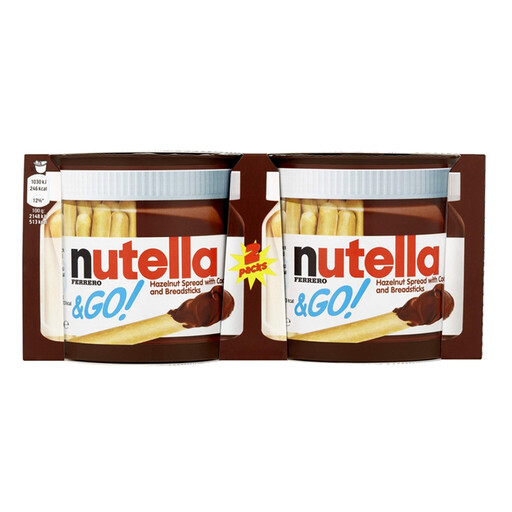
Nutella & Go, 78 g format with breadsticks

Nutella & Go, 78 g

Worth considering if you want something to eat during a break without bringing bread or a knife: this format pairs spread with breadsticks.

This isn’t a glass jar. Check the allergen information on the packaging before buying.

View on Joybuy

Frequently asked questions

Does the sugary drinks tax apply to spread in France?

No. The contribution described in the French tax authority’s official guidance applies to non-alcoholic drinks containing added sugar, not spread. To choose between two jars, compare their sugar content in the nutrition information.

Does the jar have to display Nutri-Score?

No. According to the European Commission, front-of-pack nutrition labelling is voluntary. If Nutri-Score is shown, you can use it to compare products, but it doesn’t replace checking the nutritional values per 100 g and the ingredients.

Can you take an already-opened jar with you?

You could take it with you if the lid is firmly closed, the glass is protected and you follow the instructions for that product. Bonne Maman says to keep its 250 g tasting-size jar away from heat and light. For the 300 g Jardin Bio étic product, Auchan France recommends eating it within a month of opening and says not to store it in the fridge. These instructions don’t automatically apply to other recipes.

Which allergens should you check before buying?

Check the ingredients and any trace warnings on the exact product. The products mentioned include hazelnuts or milk, and some also list soya or cereals containing gluten. A ‘lactose-free’ or ‘gluten-free’ claim on one version doesn’t mean you can skip checking all its allergen information.