For a portion you can serve with no leftovers
You want to put a small amount on the table without opening a large jar. A tub means you’ll need something to spread it on; a snack with breadsticks already comes with something to eat it with.


For a sweet option that’s different from salami, choose a tub of spread if you already have bread or something else to spread it on. A mini jar is a better choice if you’d like to try several recipes or keep some spread for after the evening; if you don’t have anything to serve it with, opt for a ready-to-eat snack instead, checking that it’s the type of product you’re looking for.
You want to put a small amount on the table without opening a large jar. A tub means you’ll need something to spread it on; a snack with breadsticks already comes with something to eat it with.
You check the sugars and fat per 100 g, as well as the pack size. Nutri-Score can be a useful extra guide if it’s shown on the packaging.
You want to check the recipe or allergens before serving several people. Check the label on each product, as ingredients and ‘may contain’ warnings can vary.
First, decide whether you want a spread to put on something or a snack you can eat as it is. For a sweet treat alongside salami, your next considerations are the format, nutritional information and recipe.
| Criteria | What to check | Who is it for? |
|---|---|---|
| Portion and serving style | Check the amount in each unit, how many units are in the pack and whether it comes with anything to eat it with. | If I’m putting together a sweet option alongside salami, I want to serve a separate portion without opening a large jar. Around 45% of consumers put having a ready-to-serve portion first. |
| Nutritional information | Compare the nutritional values per 100 g, especially sugars and fat; check the Nutri-Score if one is shown. | If I’m choosing between several recipes, I’d rather compare their values per 100 g than rely on the front of the pack alone. Nutritional comparison is the main consideration for around 33% of consumers. |
| Ingredients and allergens | Read the ingredients list, highlighted allergens and any ‘may contain’ warnings for each product. | When several people might help themselves, I want to know what each recipe contains before serving it. For around 22% of consumers, ingredients and dietary requirements come before other considerations. |
In France, the DGCCRF describes Nutri-Score as a voluntary labelling scheme. So if it’s missing from a pack, you’ll still need to check the other information.
Compare the nutritional values per 100 g, the ingredients list and the allergens. Nutritional declarations are compulsory for most pre-packed foods, although some exemptions apply.
A tub contains spread, while Nutella & Go is described by Nutella France as a snack with cereal breadsticks. These formats serve different needs.
Choose the tub if you have bread, brioche or pancakes ready; check the product details if you want something you can eat as it is.
If you choose a tub of spread on its own, you’ll need to provide something to spread it on.
This claim doesn’t mean the product contains no sugars. For its no-added-sugar recipe, Lucien Georgelin lists 8.5 g of sugars per 100 g.
Check the ‘of which sugars’ line in the nutritional information for the recipe you choose.
The products mentioned here don’t all have the same ingredients. The product details for Nutella tubs published by CoffeeChoc list hazelnuts, milk and soya, among other ingredients.
If you’re sharing, keep the packaging nearby and check the ingredients, allergens and any ‘may contain’ warnings for each product you serve.
The range featured by Nutella France includes Nutella & Go, a snack with cereal breadsticks. Retailer CoffeeChoc also sells 15 g tubs of Nutella spread.
Lucien Georgelin offers an assortment of six 45 g mini jars of spread, as well as jars of different recipes, including one described as containing 40% French hazelnuts.
For a sweet treat that’s different from salami, the product below is a ready-to-eat option. It’s a filled wafer, not a spread served in a tub or jar.
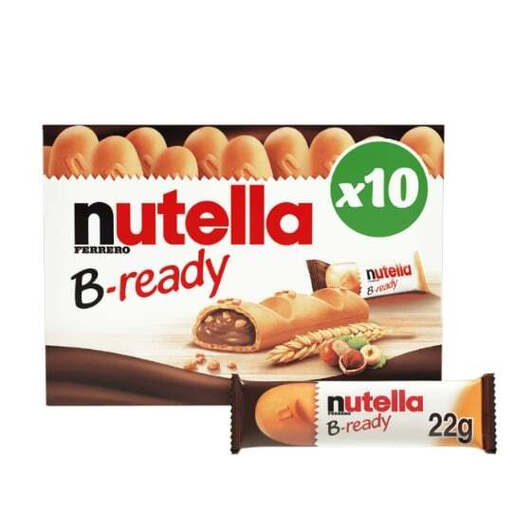 Image unavailable
Consider this if you want a sweet snack you can eat without bread or pancakes. It’s a wafer filled with hazelnut and cocoa spread, not spread to put on something; the product title lists a 220 g pack.
The product details list hazelnuts, milk, soya and cereals containing gluten. Check the allergens on the packaging of the product you receive.
No. The DGCCRF says that Nutri-Score is voluntary in France. Nutritional declarations are compulsory for most pre-packed foods, subject to applicable exemptions.
Compare their nutritional values on the same basis, per 100 g, then check the ingredients and how much you plan to serve. The DGCCRF explains that nutritional declarations include energy, fat, sugars, protein and salt, among other information.
Read the ingredients and highlighted allergens on the packaging of each product, rather than assuming one product has the same ingredients as another. The product details for Nutella tubs published by CoffeeChoc list hazelnuts, milk and soya, among other ingredients; keep the label for the product you serve within easy reach.
No. A mini jar is a small container, not necessarily an amount intended to be eaten in one sitting. If you don’t finish it, close it again and follow the storage instructions on the packaging.