Adults supervising a baking activity
You need to measure out spread for a recipe and divide it between several children, rather than serve a ready-to-eat snack.


When measuring, spreading or mixing spread into a recipe with children, a resealable jar gives you more freedom to measure out the amount you need than a portion pack with breadsticks. An individual portion is more suitable if you want to hand out the spread separately. Either way, check the ingredients, allergens and sugar content on the label of the exact product.
You need to measure out spread for a recipe and divide it between several children, rather than serve a ready-to-eat snack.
You compare the amount served and the sugar content on the label, without assuming that a small pack or a Nutri-Score alone meets your needs.
You need to check the ingredients of each specific product before the activity: a jar and a portion pack with breadsticks may not contain the same ingredients. In a school or other setting, you should also follow the guidance in place for the child concerned.
First, choose a format that works for your recipe. Then check the allergens in the specific product and compare the nutritional information for the amount you plan to use.
Choose this if: you need to measure out, spread or mix the spread into your recipe during the activity.
Bear in mind: an adult will need to measure the amounts before dividing them up.
Consider this if: handing out individual portions matters more than mixing the spread into a recipe.
Check: the breadsticks are part of the product; those in the Nustikao product featured by E.Leclerc contain wheat and barley.
Compare this if: sugar content is your main consideration among spreads suitable for your recipe.
Keep in mind: this claim alone tells you nothing about allergens or texture.
| Criteria | What to check | Consumers concerned |
|---|---|---|
| Portion size and format | Amount of spread per unit; whether it comes with anything else. | When making a filling to share, I want to be able to measure out the amount specified in the recipe without counting the breadsticks as spread. Around 40% of consumers would prioritise being able to measure portions. |
| Allergens and group guidance | Ingredients and precautionary allergen statements for the specific product; the setting’s guidance for the child concerned. | Before cooking as a group, I need to know whether each item can be served to the children concerned. Around 30% of consumers would make this their priority. |
| Sugars and nutritional information | Sugars per 100 g and per amount used; Nutri-Score, if displayed. | If several spreads work for my recipe, I want to compare their declared sugar content without relying only on a claim on the front of the jar. Around 30% of consumers would put this comparison first. |
The Nustikao format featured by E.Leclerc contains 40 g of spread and 20 g of breadsticks per unit. That means you cannot use the full 60 g as cake filling.
When working out quantities for your recipe, check the weight of the spread and the accompaniment separately.
Ingredients vary by product: Nustikao breadsticks contain wheat and barley, while the Nutella recipe featured by the brand contains hazelnuts, milk and soya, among other ingredients. So a chocolate and hazelnut spread does not necessarily contain gluten.
Read the label and precautionary allergen statements on the product you buy. If the activity is taking place in a school or other setting, also follow the guidance in place for each child concerned.
This claim compares sugar content against a benchmark stated by the brand; it does not tell you about allergens or how the spread will work in your recipe. A Nutri-Score, if displayed, does not replace these checks either.
Compare sugars per 100 g and for the amount you plan to use, then check the ingredients and format separately.
The brand offers a chocolate and hazelnut spread in a jar, which you can measure out when you need spread for a recipe.
E.Leclerc features, among other products, a pack of three units containing spread and breadsticks. It is designed for individual portions rather than for measuring out the spread on its own.
This E.Leclerc range includes a spread with a stated hazelnut content that may be useful to know if this ingredient matters for your recipe choice.
The range includes a chocolate and hazelnut spread as well as a product described as reduced in sugar.
These Nutella formats let you compare jars to measure out for a recipe with an individual portion to hand out. Choose the amount to suit your preparation, then check the label on your chosen format before doing an activity with children.
 Image unavailable
A jar you can measure out from to fill or mix into a recipe. Nutella gives a reference serving size of 15 g; adjust the amount to suit your preparation and check the jar label for allergens.
 Image unavailable
A 750 g jar for measuring out spread before using it in baking. Before a group activity, check the ingredients and precautionary allergen statements on the label for this format.
 Image unavailable
A 3 kg jar to consider if your recipe calls for a large amount of spread or you run baking activities regularly. For a one-off session, work out how much you need before choosing this format, and read the allergen information.
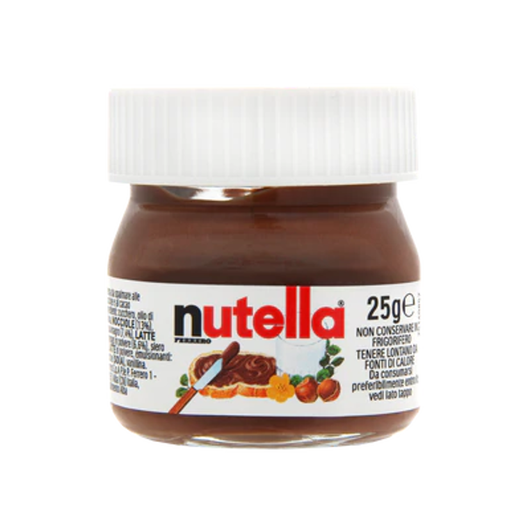 Image unavailable
This 25 g individual portion lets you hand out the spread separately. If you want to mix it into a recipe, check that this pack size works for your needs; also check the label for allergens.
Not necessarily: a jar makes it easy to measure out the amount a recipe calls for, while an individual portion is mainly for handing out the spread separately. Check what each unit contains: the Nustikao product featured by E.Leclerc combines 40 g of spread with 20 g of breadsticks.
No, it depends on the specific product. Nutella’s recipe featured on its website does not list any gluten-containing cereals, whereas the breadsticks in the Nustikao format contain wheat and barley. Also check the precautionary allergen statements on the pack you buy.
Check the ingredients and precautionary allergen statements for every product you use, then follow the school’s guidance for that child. The French Ministry of National Education explains that an individual care plan (PAI) can include dietary adjustments for a pupil with specific needs.
No, it is not a general requirement under the INCO Regulation. The French Ministry of Health presents Nutri-Score as nutritional information, and a French order dated 31 October 2017 recommended its use. If it appears on a product, compare it with similar products, without overlooking the ingredients and allergens.
No, solid spread does not fall within the scope of the drinks covered by this levy. Under Article 1613 ter of the French General Tax Code, published by Légifrance, the levy applies, subject to its conditions, to drinks and liquid preparations for drinks.