For your first shop, choose a squeeze bottle if you mainly want to serve the spread straight from the container, without a utensil. L’Amandaie offers this format in a 270 g bottle, although it doesn’t guarantee there’ll be no waste. If the recipe or size matters more, consider jars too and compare their ingredients, allergens and nutritional values per 100 g. Nutri-Score can help you make your choice if it’s shown, but it isn’t mandatory in France.
Who are these formats for?
Anyone who wants to serve it without a utensil
If you want to spread it straight from the container onto toast, crêpes or waffles, a squeeze bottle may suit the way you like to serve it. L’Amandaie offers a 270 g bottle; choosing its recipe is a separate decision.
Anyone who compares recipes first
If ingredients, allergens or nutritional values matter more to you than a dispensing nozzle, a jar is also worth considering. Compare the information on the packaging of the products you’re interested in.
Anyone trying a product for the first time
If you haven’t tried the recipe before, a smaller size may be more suitable than a large jar. Check the net weight: bottles and jars don’t necessarily come in the same sizes.
What should you look for first?
To choose between a squeeze bottle and a jar, start with the way you want to serve the spread, then check the size and recipe of the specific product.
| Criteria |
What to check |
Who is it for? |
| Serve straight from the container |
Check that it’s a squeeze bottle and look at the net weight; the container alone doesn’t tell you about the recipe. |
If I want to top toast without reaching for a knife, I’m mainly looking for a container I can use directly. Around 36% of consumers put this way of serving it at the top of their list. |
| Recipe and nutritional values |
Compare the ingredients, as well as the sugars and saturated fat per 100 g. Check the Nutri-Score if it’s shown on the packaging. |
If I’m happy to use a jar, I want to compare the recipes before choosing a format. This is the top priority for around 29% of consumers. |
| Size |
Check the net weight of the product you’re planning to buy and make sure that format is available from your chosen retailer. |
When trying a spread, I prefer to decide how much to buy before choosing a product. Around 21% of consumers put size first. |
| Allergens and ingredients |
Read the highlighted allergens and any ‘may contain’ information on the specific packaging. |
If I need to avoid certain ingredients, I check the recipe before considering the bottle or jar. Ingredient suitability is the top criterion for around 14% of consumers. |
Things to watch out for
-
Assuming every pack must display a Nutri-Score
In France, the DGCCRF distinguishes between Nutri-Score, which is voluntary, and the nutrition declaration required for prepacked foods, subject to applicable exemptions. The absence of a logo doesn’t tell you what the spread’s score would be.
Compare the nutrition information and ingredients list whether or not the logo is shown.
-
Assuming a squeeze bottle means no waste
L’Amandaie describes its 270 g bottle as practical to use. That doesn’t tell you how much spread will be left in the bottle when you’ve finished using it.
Choose this format if you like serving it straight from the bottle, but don’t assume you’ll be able to get every last bit out.
-
Relying on just one claim about the recipe
A claim such as ‘organic’ or ‘palm oil-free’ describes one aspect of a product, not its overall nutritional values. For example, Auchan’s Nocciolata product listing states that it contains 51 g of sugars per 100 g.
Read the ingredients list and compare the nutritional information on the same 100 g basis.
-
Choosing the format before checking allergens
The cocoa and hazelnut products described by L’Amandaie, Carrefour and Auchan include ingredients such as hazelnuts, milk or soya, depending on the recipe. A positive claim on the front of the pack is no substitute for checking.
Check the highlighted allergens and any ‘may contain’ information on the product you’re buying.
Brands to consider
L’Amandaie
Its La Classique – Squeezer spread comes in a 270 g bottle, making it worth considering if serving it straight from the container is a priority for you.
- The brand describes the bottle as practical and easy to use.
- The listed recipe contains milk and hazelnuts; the format alone doesn’t guarantee there’ll be no waste.
Rigoni di Asiago / Nocciolata
Organic Nocciolata cocoa and hazelnut spread is a jar option to compare if recipe claims matter more to you than a squeeze bottle.
- Carrefour and Auchan product listings describe it as palm oil-free.
- Auchan’s listing states that it contains 51 g of sugars per 100 g; also check the ingredients and allergens for the product you choose.
Nutella
The products described by Carrefour and Joybuy come in jars, so they’re worth considering if you don’t need a dispensing bottle.
- The retailers describe several jar sizes.
- For the jar listed by Carrefour, the brand owner doesn’t provide a Nutri-Score. Check the other information on the label, but don’t infer a score from it.
A spread in a jar on Joybuy
This jar is worth considering for a first purchase if a squeeze bottle isn’t your main priority. Check the recipe on the packaging before comparing it with a bottle option.
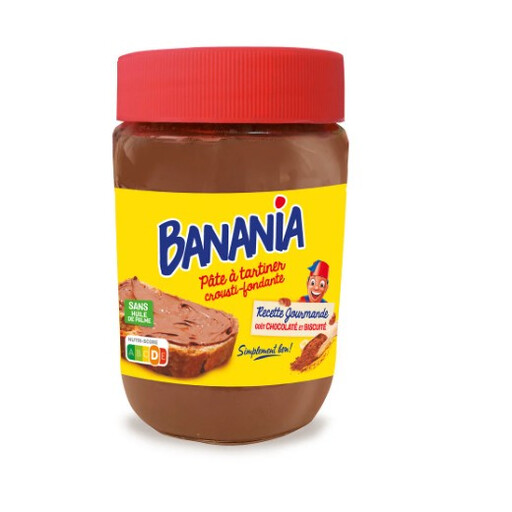 Image unavailable
Banania, 400 g spread, palm oil-free
This 400 g jar could be a good way to try a recipe if you don’t want to choose a squeeze bottle, but it won’t meet the need for serving the spread straight from the container. The product name states that it’s ‘palm oil-free’. To compare its ingredients and check whether it meets any dietary requirements, read the ingredients list and allergens on the exact packaging. Check the Nutri-Score there too, if that’s useful to you.
View on Joybuy
Frequently asked questions
Is Nutri-Score mandatory on spreads in France?
No. According to the DGCCRF, displaying it is voluntary, while a nutrition declaration is required for prepacked foods, subject to applicable exemptions. You can’t work out a product’s score just because it doesn’t display a logo: check its nutrition information and ingredients instead.
What should you read on the label of a jar or prepacked bottle?
In particular, check the ingredients list, highlighted allergens, net quantity and nutrition information. The DGCCRF sets out the labelling rules for prepacked foods; when you’re buying, check the information on the exact packaging.
Does ‘palm oil-free’ mean ‘lower in sugar’?
No. This claim doesn’t mean the product contains less sugar. Auchan’s listing for palm oil-free Nocciolata states that it contains 51 g of sugars per 100 g. To compare two products, check their nutritional values on the same basis.
How should you store spread after buying it?
Follow the instructions for the product you’ve bought, as storage guidance may differ between recipes. For its 3 kg Nutella jar, Joybuy advises storing it in a cool, dry place, without refrigeration.


