People taking a snack with them before exercise
If you can’t make toast when you get there, an individually wrapped snack is easier to carry. It’s still important to consider the ingredients and how well you digest it before exercising.


Choose a jar if you’re making toast to share or packing lunchboxes. For a snack you can take with you without any preparation, individually wrapped portions are more convenient – but a filled wafer isn’t the same as a jar of spread. Before exercise, consider the portion, when you eat it and how well you digest it. Compare the ingredients of products in the same category, but don’t automatically rule out those without a Nutri-Score: according to Santé publique France, displaying it is voluntary.
If you can’t make toast when you get there, an individually wrapped snack is easier to carry. It’s still important to consider the ingredients and how well you digest it before exercising.
One jar is enough to make several slices of toast or snacks at home, with each portion measured out separately.
Ingredients, allergens and nutritional values can help you choose between products in the same category. Nutri-Score can help with your comparison when it’s displayed, but its absence doesn’t tell you whether a product is nutritionally good or bad.
For a snack before exercise, first decide whether you’ll prepare a portion or need something ready to eat on the go. Then compare the recipe and the amount you plan to eat. INSEP highlights the importance of digestive tolerance as a competition approaches.
| Consideration | What to check | Who is it for? |
|---|---|---|
| Portion and timing | Check the amount you actually plan to eat and the nutritional values per portion, if provided. | If I eat very little before exercise, I want to choose a portion and recipe I can tolerate. Around 31% of consumers put this need first. |
| Portability | Look for individually wrapped portions rather than a jar that needs to be portioned and eaten with something else. | If I want to pop a snack in my bag without making toast, I choose a pre-portioned format. This is the priority for around 25% of consumers. |
| Ingredients | Compare the ingredients and nutritional values per 100 g of products in the same category, as well as the allergens in the product you choose. | When I’m choosing between several recipes, I want to know what each one contains, whether or not it displays a Nutri-Score. This comes first for around 25% of consumers. |
| Sharing | Check the jar’s net weight and its storage instructions after opening. | If I’m preparing several lunchboxes, I want a size we can use in line with the instructions on the packaging. Around 19% of consumers prioritise sharing. |
According to Santé publique France, displaying the Nutri-Score is voluntary. So, the absence of the logo alone doesn’t tell you what a spread contains.
If it appears on the packaging, compare it with products in the same category. Also read the ingredients list and nutritional information per 100 g.
A jar is for preparing portions, whereas Nutella B-ready wafers are individually wrapped. B-ready is a filled wafer, not a small jar of spread.
For a snack to take with you, check the number and weight of the individual portions. If you choose a jar for lunchboxes, remember you’ll need something to spread it on and will have to prepare the portions.
The almond and hazelnut praline paste presented by E.Leclerc as an ingredient for baking and fillings isn’t intended for the same use as a spread for toast.
Check the product name and the suggested use on the packaging before choosing something for a lunchbox.
Ingredients vary by product. Carrefour’s product information for Nocciolata La Bianca lists hazelnuts, milk and soya, while Nutella France also lists wheat and barley for B-ready.
If you have an allergy, check the label on the specific product and format you’re buying, even if you already know the brand.
These examples show how formats and recipes can differ. Their inclusion here doesn’t mean all their products are suitable for the same use.
Nutella B-ready is designed as an individually wrapped snack, rather than as a jar of spread.
This 400 g jar of organic spread is suitable for making toast to share.
Funkie’s 200 g jar of organic praline spread offers another recipe to consider when preparing portions at home.
The Eco+ product listed by E.Leclerc comes in a 750 g jar, which may be worth considering if you’re preparing several portions.
Aldi presents Tartichoc as a hazelnut spread in a 750 g jar. It’s a size for sharing rather than a ready-to-eat portion to take with you.
This selection includes jars for making toast or packing lunchboxes, as well as a pack of filled wafers to take with you individually. First decide which of these uses you need: the wafer isn’t a jar of spread.
 Image unavailable
This jar is a good fit if you’re preparing several slices of toast or portions to share, rather than taking a ready-to-eat snack with you.
You’ll need something to spread it on, and to measure out each portion. If you’re having it before exercise, consider how well you digest it too.
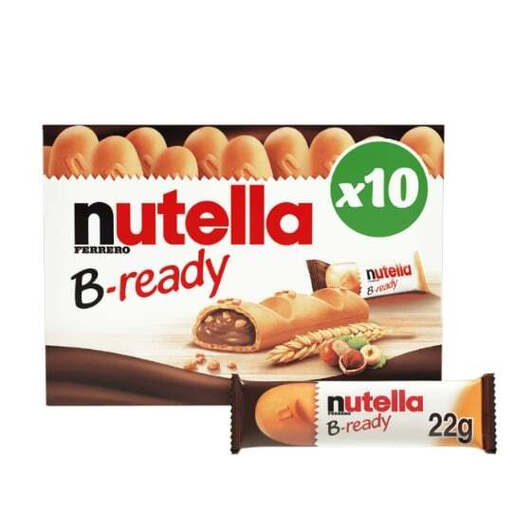 Image unavailable
This pack is ideal if you want to take an individually wrapped snack with you without having to make toast.
Nutella France gives the weight of each wafer as 22 g. B-ready is a filled wafer, not a jar of spread. Check its ingredients, particularly if hazelnuts, milk, soya, wheat or barley are a concern for you.
 Image unavailable
This 250 g jar is an option for making toast at home to take with you.
You’ll need to measure out how much you eat. Don’t assume this product has the same ingredients or nutritional values as Nocciolata La Bianca.
 Image unavailable
This jar is for preparing a portion at home, rather than taking an individually wrapped snack with you.
Carrefour’s product information gives Funkie’s nutritional values per 100 g as 252 kcal and 13 g of fat. Consider these figures in relation to the amount you plan to use, but don’t rely on them alone to decide whether it’s suitable before exercise.
 Image unavailable
The 400 g jar is suitable for making several slices of toast or portions to share.
It doesn’t contain individually wrapped portions ready to take with you. Measure out the amount you want and check the storage instructions on the packaging.
No. According to Santé publique France, producers can choose whether to display Nutri-Score. The DGCCRF distinguishes this label from the information required on pre-packed foods, including the ingredients list and nutrition declaration. If the logo is shown, use it to compare products in the same category, and check their labels too.
No. The recipe, portion and timing you choose depend partly on how well you digest it. INSEP highlights the importance of digestive tolerance on competition day, so it’s better to try your planned snack during a normal training session rather than for the first time on the day.
Read the ingredients list for the exact product you’re buying, as a jar and a filled wafer may contain different ingredients. Carrefour lists hazelnuts, milk and soya in Nocciolata La Bianca; Nutella France lists hazelnuts, milk, soya, wheat and barley among the ingredients in B-ready. If you have an allergy, check the packaging of the product you buy.
Follow the instructions for the specific product you’ve bought rather than those for another spread. For example, Auchan recommends storing Nocciolata La Bianca in a cool, dry place between 15 and 25 °C.