
Livraison le jour même ou le lendemain

Qualité garantie

Débloquez vos offres de bienvenue: Livraison GRATUITE | Jusqu'à -80 % | 30 jours d'essai gratuits à JoyPlus
Téléchargez l'application
A coffee stain on the brand-new sofa, muddy paw prints on the carpet, or car seats that have seen better days... It's an all-too-familiar scenario. A spot cleaner, also called an upholstery shampooer, seems like the perfect solution to bring your fabrics back to life. The problem? The market is flooded with models making sometimes misleading promises, and it's easy to make the wrong purchase. Before you pull out your credit card, here’s how to avoid the most common marketing traps and prevent buyer's remorse.
Falling for an impressive-looking spec sheet without understanding what really matters is a classic mistake. Here are the key points to watch out for to avoid throwing your money away.
Suction Power Sacrificed for Gimmicks Many devices highlight a myriad of accessories or a steam function, but hide weak suction power. The primary mission of a spot cleaner is to extract the dirty water after washing. Insufficient suction (often below 10?kPa) will leave your fabrics soaking wet, promoting the growth of mould and bad odours.
Poorly Designed Tanks That Turn Cleaning into a Chore Water management is the heart of the matter. A model with a single tank where clean and dirty water mix is unhygienic and completely ineffective. Likewise, a capacity that is too small (less than 1?litre) will force you to make constant trips to empty and fill the tanks, turning a quick job into a real chore.
Compromised Ergonomics, or How to Make a Device Unusable A hose that's too short, a power cord under 3?metres, or a heavy, clumsy device can make cleaning a staircase or car seats an impossible mission. Portability and manoeuvrability are essential criteria, yet they are too often overlooked in marketing.
To make an informed choice, focus on a few non-negotiable technical features. They are the true measure of your future upholstery cleaner's effectiveness and versatility.
This is THE criterion that outweighs all others. Expressed in kilopascals (kPa), it defines the force with which the device will literally pull water and dirt from the fibres.
The water temperature is a game-changer depending on the type of stain.
Insist on a dual-tank system. One tank for clean water (and the cleaning solution) and a second, completely separate one to collect the dirty water. This is the only way to guarantee a truly hygienic clean. Also, check their capacity: tanks of at least 1.4?litres for clean water and 1.2?litres for dirty water provide enough runtime to clean an entire sofa or several car seats.
Rather than an endless list, we've selected models that meet specific needs, based on strict criteria for performance and practicality.
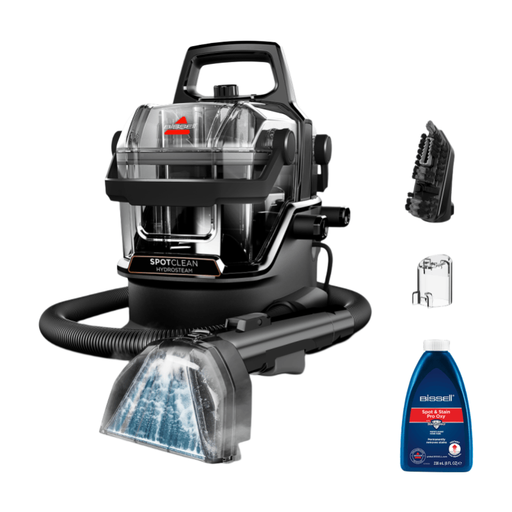
Why it stands out: Perfect for handling everyday spills and messes, big or small. The HydroSteam technology is designed to tackle the sticky, greasy, and set-in stains typical in homes with children or pets. Its versatility makes it effective on sofas, carpets, and even in the car.
It combines powerful suction with steam, tackling the stain at its source instead of just soaking it. The large-capacity tanks (1.9 L / 1.5 L) prevent constant refills.
HydroSteam Technology: combines steam, water, and cleaning solution. Triple Action System: it sprays, scrubs, and suctions in a single pass. A significant time-saver.
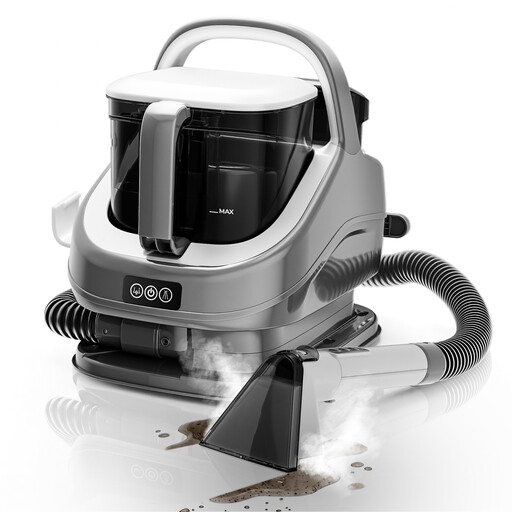
Why it stands out: Its compact design, 1.1 m hose, and 3 m cable make it the perfect tool for confined areas like a car interior or a staircase. Its three modes (cold water, hot water, steam) offer great versatility for treating different types of dirt.
It doesn't sacrifice performance for a compact size. With 13 kPa, its suction is very respectable for its size, avoiding the trap of leaving fabrics soaked. Its dual-tank system is hygienic and easy to manage.
Three cleaning modes: adapts to the type of stain (light, greasy, set-in). Portable design: easy to carry and store, perfect for car maintenance.

Why it stands out: For those who want raw, no-frills performance. This model focuses on the essentials: extremely high suction power for a deep clean and fast drying. A pragmatic choice for results you can see.
It bets everything on the #1 criterion: suction power. With its 18 kPa, it outperforms many competitors and avoids the pitfall of anemic suction. It does one thing, but it does it perfectly.
18,000 Pa suction: guarantees maximum extraction of water and dirt. 2-in-1 tanks: simplify filling and emptying.
Explore our full selection of products that meet our performance criteria and safety standards.
A standard steam cleaner projects dry steam to loosen dirt and disinfect, but it doesn't suction. It's therefore ideal for hard surfaces (tiles, windows). A spot cleaner, on the other hand, sprays a mixture of water and detergent, then immediately vacuums up the dirty liquid. It deep cleans and dries textiles, which a steam cleaner alone cannot do.
Drying time mainly depends on the device's suction power, the ambient temperature, and the room's ventilation. With a high-performance machine (over 13?kPa), a car seat or a section of a sofa can be dry to the touch in 2 to 4?hours. For a complete, deep-down dry, it's safer to wait 6 to 8?hours.
No, and this is a critical point: it is imperative to only use cleaning solutions specifically formulated for spot cleaners. These products are low-foaming and designed not to damage the machine's internal components (pump, motor). Standard detergents create too much foam, which reduces suction and can easily damage your device and void its warranty.