
Livraison le jour même ou le lendemain

Qualité garantie

Débloquez vos offres de bienvenue: Livraison GRATUITE | Jusqu'à -80 % | 30 jours d'essai gratuits à JoyPlus
Téléchargez l'application
A coffee stain on the brand-new sofa, muddy paw prints on the carpet, car seats that have seen better days… These are situations many of us know all too well. The spot cleaner is often touted as the miracle solution for a deep clean of fabrics and upholstery. However, faced with an overwhelming market full of sometimes misleading claims, it's easy to get lost and make the wrong choice.
As a Product Recommendation Manager at Joybuy, my mission is to demystify this market for you. Together, let's break down the pitfalls to avoid and the real criteria that matter for choosing a truly effective device, far from the marketing hype.
Before we even get into the technical specs, let's review the common mistakes that turn a promising purchase into a real disappointment.
To ensure you make the right choice, here are the three parameters that separate a mere gadget from a true cleaning ally for your sofa cleaner.
As we've said: raw power isn't enough. The value in Pascals (Pa) remains a good benchmark, with a range between 12,000 Pa (12 kPa) and 18,000 Pa (18 kPa) being a good starting point for a portable carpet cleaner. However, this figure must be correlated with the design of the cleaning head. A brush with stiff bristles helps dislodge embedded dirt from the fibres, while a well-shaped suction nozzle concentrates power for optimal water extraction.
A good upholstery cleaner must separate clean water from dirty water.
The ability to use hot water is a major asset. Some devices allow you to add hot water (up to 50-60°C), while more advanced models integrate a steam mode.
Rather than an endless catalogue, we've selected three models that meet specific needs, applying our criteria for performance and practicality.

Why it stands out: Perfect for apartment living or as a backup solution to act fast on everyday little disasters. Its compact size makes it easy to grab for a spilled drink or a muddy print on a car seat.
It doesn't promise outrageous power but delivers a very respectable and effective 15 kPa of suction for its size, thus avoiding the underpowered device trap. Its tank system is simple but functional for tackling targeted stains.
Compact and lightweight design. Well-calibrated 600W power and 15 kPa suction for quick jobs.
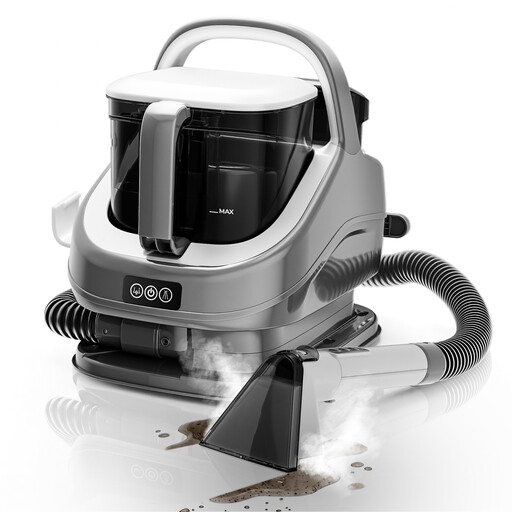
Why it stands out: Between kids and pets, stains are as varied as they are unpredictable. This versatile model can tackle everything from a spilled drink (cold water) to food stains (hot water) or sanitise a play mat (steam).
It bypasses the 'cold water only' trap by offering hot water and steam modes, dramatically increasing its effectiveness. Its separate tanks (1400 ml clean / 1200 ml dirty) provide ample runtime, enough to tackle an entire sofa.
Absolute versatility thanks to its 3 cleaning modes. 1300W power and 13 kPa suction.
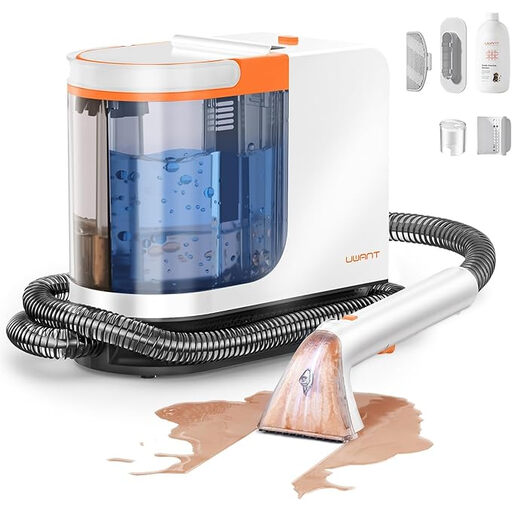
Why it stands out: For those who want no compromises on performance: restoring a car interior, tackling a heavily soiled carpet, or lifting out old stains. The self-cleaning function is a real convenience for effortless maintenance.
Here, the performance promise isn't an empty one: its 18 kPa, combined with a wide 14 cm brush, ensures powerful and effective extraction. This is far from a simple marketing claim; the results speak for themselves.
Heavy-duty 18 kPa suction for tough jobs. Self-cleaning function for the hose and brush.
Explore our complete selection of products, all rigorously chosen based on our performance criteria and current safety standards.
A wet/dry vacuum simply sucks up liquids and solids. A spot cleaner, or upholstery extractor, goes a step further: it injects a cleaning solution deep into the fibres and then immediately extracts it along with the dislodged dirt. This two-step process ensures a deep clean that is far superior to simple suction.
No, and this is a crucial point. It is imperative to use detergents specifically formulated for carpet and upholstery cleaners. Their key characteristic? They are low-foaming. Using dish soap or standard laundry detergent would create a mountain of foam that could overflow from the dirty water tank and eventually damage the motor.
Caution is advised. The golden rule: always perform a test on an inconspicuous area (the back of the sofa, under a cushion, etc.). Apply the solution, extract it, and let it dry completely to ensure there is no discolouration or damage to the fabric once dry. Some very delicate or non-water-resistant materials are not compatible with this type of cleaning. When in doubt, always refer to the furniture manufacturer's care recommendations.