
Livraison le jour même ou le lendemain

Qualité garantie

Débloquez vos offres de bienvenue: Livraison GRATUITE | Jusqu'à -80 % | 30 jours d'essai gratuits à JoyPlus
Téléchargez l'application
A sponge might seem like a trivial purchase. Yet the wrong choice can quickly leave scratches on a ceramic hob, cause lingering odours, or lead to the abrasive layer peeling off after just a few uses. Spontex scouring sponges come in several versions, with different levels of abrasion, materials and uses.
To pick the pack best suited to your home, it pays to look beyond the colour or a simple promise of durability. Here are the criteria to examine so you can effectively compare a washing-up sponge, a non-scratch sponge or a machine-washable sponge.
A sponge labelled as non-scratch isn't necessarily suitable for every surface. Grains of sand, food residue or limescale trapped between the sponge and the surface can leave marks. Non-stick coatings, glass, lacquered surfaces and certain hobs therefore require a test on a small, inconspicuous area first.
The pressure you apply also plays a role. A scouring layer designed for stubborn grime may be fine for a stainless steel pan, but not necessarily for a non-stick frying pan.
Even a long-lasting sponge needs to be rinsed after each use, wrung out and left to air dry. A sponge that stays damp will lose its shape more quickly and can develop odours. How often you should replace it varies depending on the model and how intensively you use it.
Some products can be washed in the washing machine or dishwasher, but you must follow the temperature stated on the packaging. This option doesn't replace the need for regular replacement for hygiene reasons.
A pack of cleaning sponges can be economical, but three identical sponges won't necessarily cover all your needs. A family kitchen, a bathroom exposed to limescale, and delicate surfaces often call for different textures.
A multi-purpose sponge is fine for everyday tasks. For mirrors, shower screens or taps, a microfibre sponge with a layer suited to limescale will be more appropriate.
The scouring layer should be suited to both the dirt and the material. For heavily soiled pans, a reinforced surface can make cleaning easier. The SPONTEX Scrubbing Sponges Carbon-Reinforced Scouring Surface model has a carbon-reinforced scouring layer and is made from cellulose. It is designed for stubborn dirt, but should not be used on a hot surface.
For delicate surfaces, look for a specific mention such as non-scratch for delicate surfaces, rather than a simple promise of versatility. Even a sponge designed not to scratch should be tested before first use.
Vegetable cellulose absorbs water and cleaning product effectively. A microfibre layer makes it easier to wipe away smears on glass and mirrors. Two-sided models let you move from scrubbing to finishing without changing tools.
The SPONTEX Reinforcement Microfibre Scouring Sponges model combines an absorbent vegetable sponge layer, a scouring surface and a microfibre layer. Its product information states it can be machine washed at 40 °C and recommends replacement roughly every two months. It is not intended for non-stick utensils or particularly fragile surfaces.
A machine-washable sponge must be cleaned according to the manufacturer's instructions. The SPONTEX Flex & Wash Bathroom Sponge can be washed up to 52 times, in the washing machine or dishwasher according to the information provided, at a maximum temperature of 40 °C. The product information also states that the microfibre layer is intended for glass and mirrors, while the scouring layer is for tackling limescale.
Regarding microbiological claims, the product information mentions results obtained by an independent laboratory on certain surfaces, using water alone. These indications do not constitute a general guarantee for all uses, nor a medical endorsement. Rinsing, drying and replacement remain essential.
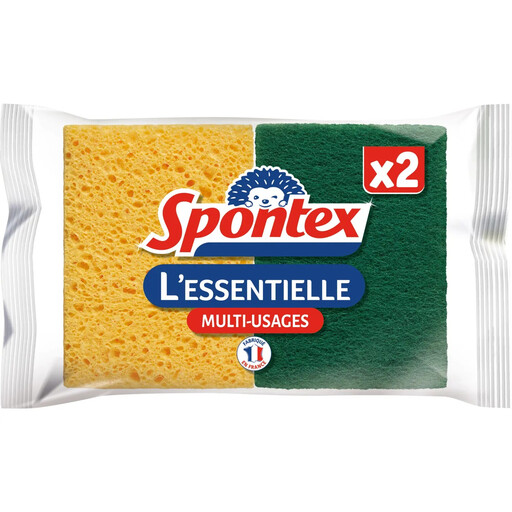
Why this choice suits this profile: This two-sided pack is ideal for everyday kitchen tasks and light household cleaning. Its compact size makes it easy to reach into corners and store under the sink.
The separation between the scouring layer and the soft layer stops you using an abrasive texture for every task. A test on a hidden area is still recommended.
Two distinct layers, a PEFC-certified vegetable sponge and manufacture stated in France.
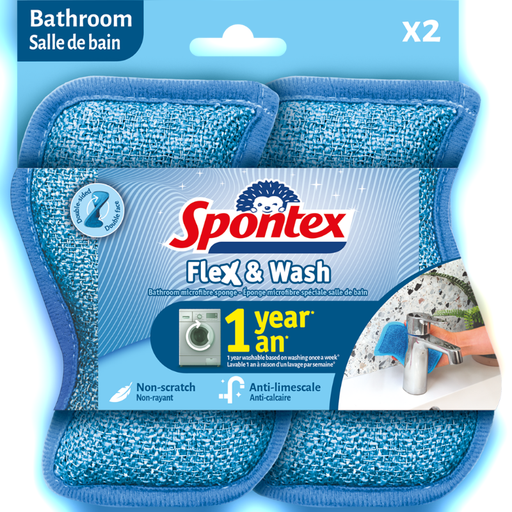
Why this choice suits this profile: This sponge for delicate surfaces is designed for the bathroom, particularly mirrors, glass, shower screens and limescale marks. Its washable design suits households that want to avoid replacing it too often.
The microfibre layer is for wiping, while the scouring layer tackles limescale. The product information states up to 52 washes, provided you follow its care instructions.
Microfibre layer made from recycled fibres, machine or dishwasher washing indicated, and a medium-level scouring texture.
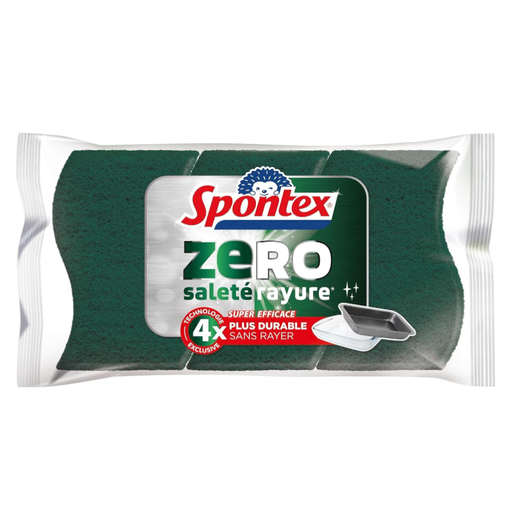
Why this choice suits this profile: This pack is aimed at kitchens where pans, dishes and surfaces are regularly heavily soiled. It suits users looking for a durable scouring layer that can be washed at 40 °C.
The durability promise should be understood in the context intended by the manufacturer. It claims four times the resistance of a standard sponge – this comparison depends on the reference product, however.
Pack of three, washing at 40 °C indicated, and vegetable fibres made from cotton, wood pulp and flax.
We have compiled a comprehensive list, updated in real time, of products that fully meet these strict selection criteria and European safety regulations.
A limescale sponge with a suitable scouring layer and a microfibre layer can work well on shower screens, taps, basins and mirrors. The Flex & Wash Bathroom Sponge is designed to alternate between removing limescale and a streak-free finish. Always check its compatibility with the material in question.
The lifespan depends on how often you use it, the dirt it encounters and how you care for it. Some models claim up to 52 washes, while others recommend replacement roughly every two months. These indications are not interchangeable – refer to the instructions for each product and change the sponge as soon as its condition deteriorates.
Not necessarily. Even a layer labelled as non-scratch can trap abrasive particles or be used with too much pressure. Read the instructions, favour the soft layer and test it on a small area before cleaning the whole surface.