
Livraison le jour même ou le lendemain

Qualité garantie

Débloquez vos offres de bienvenue: Livraison GRATUITE | Jusqu'à -80 % | 30 jours d'essai gratuits à JoyPlus
Téléchargez l'application
A spiral notebook can accompany you through lectures, meetings, journaling, or even sketching. But two models can be very different, even if they look alike at first glance. Size, paper weight, ruling, and binding quality all directly affect your writing comfort.
So before you place an order, it's worth knowing the main pitfalls to avoid.
The A5 size, measuring approximately 148 × 210 mm, slips easily into a bag. It's suitable for lecture notes, lists, journaling, and meetings. A spiral A5 notebook is therefore a practical option for students and everyday travel.
For diagrams, tables, project plans, or detailed note-taking, a size close to A4 offers a more generous working surface. The Rhodia pad measuring 21 × 31.8 cm meets this need, with a rigid back that lets you write comfortably even without a desk.
Smaller sizes, like A7, are more suited to quick reminders, shopping lists, and ideas jotted down on the go.
The choice between a lined notebook and a grid notepad depends mainly on how you write:
Expressed in g/m², the paper weight gives an indication of the paper's density. The models featured here include 70 g/m², 80 g/m², and 100 g/m² options. A higher paper weight often feels more premium, but the nature of the paper and the type of pen you use matter just as much.
The Clairefontaine vellum-surfaced 80 g/m² paper in the Rhodia pad is stated as PEFC certified. This certification relates to the sustainable management of the forests from which the wood used to make the paper is sourced. It does not guarantee results with every writing instrument.
A hard cover protects the pages better from creases and allows you to write on your lap. An elastic band can also keep the notebook closed during transport.
Twin-ring binding makes turning pages easier and generally allows the notebook to lie flat. For heavy use, check that the perforations stay properly aligned and avoid folding the covers back against their natural opening direction.
For watercolour, the deciding factor isn't the spiral, but the paper itself. The Clairefontaine Aquapad watercolour sketchbook uses 100% cellulose paper, with a medium fine grain, double-sized and stated as acid-free. It is designed for watercolour, gouache, and various wet practice techniques.
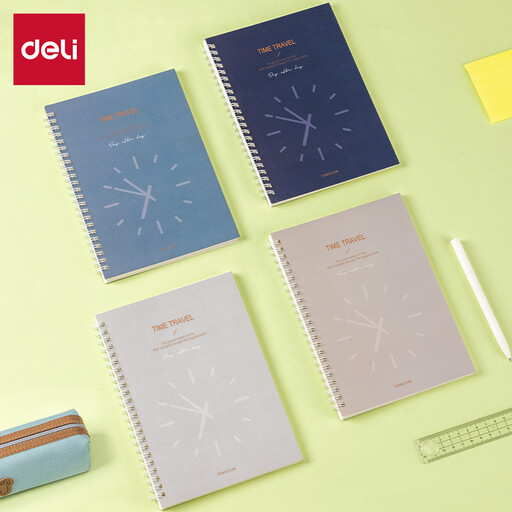
Why this suits this profile: This pack lets you organise subjects, projects, or different uses without having to buy several notebooks separately. The A5 size remains easy to carry to school, university, or the office.
The listing details the pack contents and specifies the A5 size, making it easy to compare with a notebook sold individually.
Four A5 notebooks, lined paper, 60 sheets per notebook, and spiral binding.
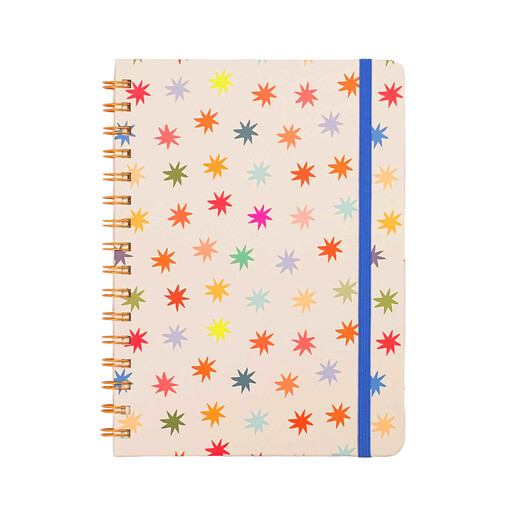
Why this suits this profile: Its hard cover, 100 g/m² cream paper, and elastic closure make it a suitable companion for a personal notebook, a diary, or a polished professional use.
The hard cover limits warping in a bag, while the elastic helps keep the notebook securely closed.
A5 size, 96 sheets, 100 g/m² cream lined paper, and twin-ring binding.
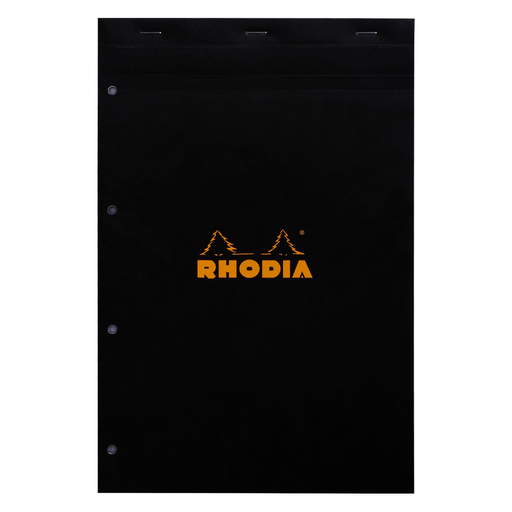
Why this suits this profile: Its large format, close to A4, is suitable for files, diagrams, plans, and extensive note-taking. Its rigid cardboard back provides welcome support when you're writing away from a desk.
The 80 micro-perforated sheets tear out cleanly, avoiding unevenly ripped pages.
80 sheets, 5 × 5 mm grid, 80 g/m² PEFC-certified paper, and rigid cardboard back.
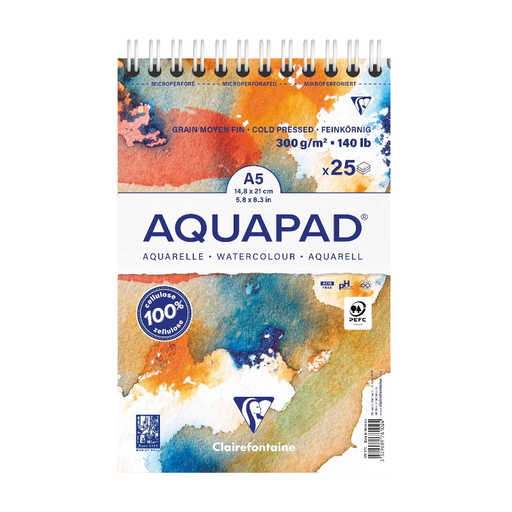
Why this suits this profile: This sketchbook is designed for watercolour, gouache, and wet media practice. Its thick paper meets a very different need from that of an office notebook or a lined journal.
Its 300 g/m² weight and double sizing are specifically designed for wet media.
100% cellulose paper, medium fine grain, acid-free, and designed for both watercolour and gouache.
We've compiled a complete, real-time updated selection of products that meet these exacting criteria, as well as European safety standards.
A lined A5 size is suitable for lectures and revision cards that are easy to carry. For maths, plans, or tables, go for a grid notepad. A pack of notebooks can also be handy for separating subjects.
Both terms often refer to a ring-bound pad, but their use differs slightly. A notebook is generally associated with lectures or office work, whereas a spiral-bound journal is often more compact and intended for personal notes, journaling, or sketches. In any case, check the size, number of sheets, and type of cover.
Store it away from moisture, avoid bending the covers, and don't overload the rings with sheets that are too thick. For a watercolour sketchbook, keep it flat and let the pages dry completely before closing it.