
Livraison le jour même ou le lendemain

Qualité garantie

Débloquez vos offres de bienvenue: Livraison GRATUITE | Jusqu'à -80 % | 30 jours d'essai gratuits à JoyPlus
Téléchargez l'application
By our product experts, July 19, 2026
Lifting golden-brown fries from boiling oil, draining a portion of al dente pasta, or fishing out meatballs from a fondue pot... These everyday tasks require a tool that is both precise and safe. The wrong utensil can ruin a dish or, worse, lead to a nasty burn. With a jungle of available models, it's hard to know where to start.
To help you make the right choice, this guide breaks down the essential criteria for a quality stainless steel spider strainer. We've also selected several models that stand out for their design and ingenuity, so you can find the perfect partner for your culinary adventures.
Before you decide, let's review the features that separate an excellent utensil from a mere gadget.
This is the number one criterion. For utensils that come into contact with heat, 304 stainless steel is non-negotiable. Renowned for its excellent resistance to corrosion and rust, it stands up to moisture, acidic foods, and salt. Its non-porous surface is also a guarantee of hygiene: it cleans in a flash and prevents residue from building up. In short, it's the durable choice for a frying utensil that will last you for years.
When handling boiling oil, safety is non-negotiable. A long, well-insulated handle is therefore essential to keep your hands safe from heat and splatters. Hollow-handled models, for example, combine light weight with effective thermal insulation. The shape and size of the basket (the "head") are also important. A wide, deep basket allows you to remove more food in a single pass, perfect for a pasta skimmer or for serving a large group. Finally, small details often make all the difference: a hole for hanging or a hook to rest it on the rim of a pot are everyday game-changers.
The secret to good draining lies in the mesh. A stainless steel strainer with a very fine mesh will be perfect for filtering the smallest impurities from oil or for handling delicate foods. Conversely, a wider mesh, typical of a skimmer ladle, is ideal for fries, doughnuts, and ravioli, as it allows liquid to drain away in record time. The choice will therefore depend entirely on your cooking habits.
We've sifted through several models to offer you a varied selection, suited to different uses and budgets.
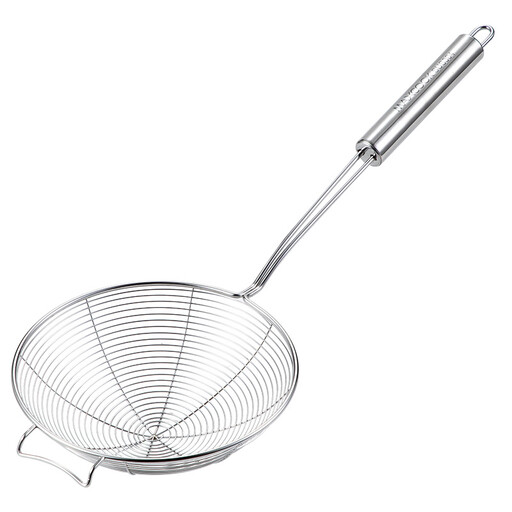
Key Feature: This model stands out with its ingenious pot rest hook. It allows you to rest the strainer on the rim of a saucepan or stockpot. The result: you can keep your hands free during cooking or serving. A real plus for a hot pot, for example.
What we like:
Who is it for? For those who appreciate clever details and often prepare dishes where the utensil needs to be kept close at hand (fondues, broths, etc.).
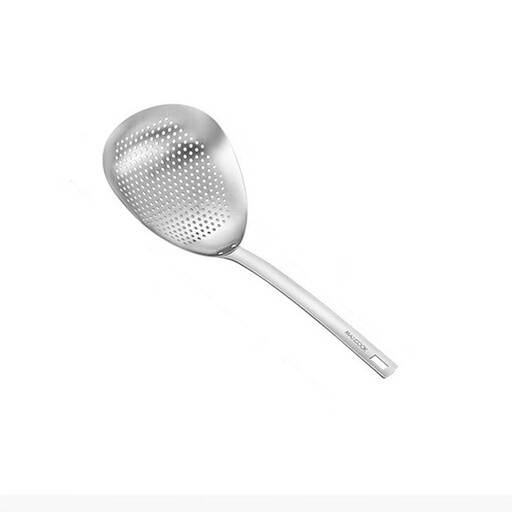
Key Feature: This model combines an elegant brushed finish with a design built to last. Its wide basket and long handle make it the perfect tool for large gatherings: ideal for scooping out a batch of fries or skimming a pot of stew.
What we like:
Who is it for? For large families and anyone looking for a sturdy, safe, and high-performance frying utensil for cooking in large quantities.

Key Feature: This set of three strainers in different sizes (12, 13.2, and 15.5 cm) offers formidable versatility to handle any kitchen situation. Their tightly woven mesh is a model of efficiency: it filters the smallest particles without ever slowing down the draining process.
What we like:
Who is it for? The smart choice for all-rounder cooks and families who juggle different preparations daily.
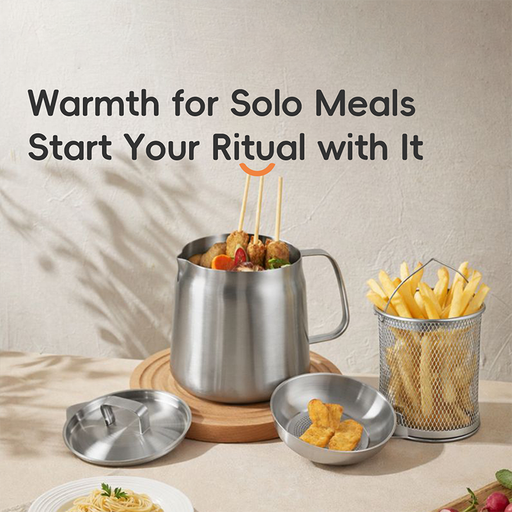
Key Feature: Much more than a simple strainer, this is an all-in-one solution for managing frying oil. This 2-litre oil filter pot comes with a fine-mesh strainer and a frying basket. It not only allows you to cook, but also to filter and store oil for reuse.
What we like:
Who is it for? For home frying enthusiasts who want a durable and hygienic solution for recycling their cooking oil.
If our selection doesn't quite meet your needs, feel free to explore our full catalogue. There you'll discover an even wider range of utensils to complete your kitchen arsenal.
Discover all our stainless steel kitchen gadgets
1. How do I properly clean a stainless steel spider strainer? Most stainless steel models are dishwasher safe. For hand washing, hot water, dish soap, and a soft sponge are sufficient. Never use a wire brush or scouring powder, as they will scratch the metal. Be sure to dry it thoroughly after washing to maintain its shine and store it away from moisture.
2. What's the difference between a skimmer and a spider strainer? Although the terms are often used interchangeably, the difference is simple. The "spider strainer" has a basket made of crisscrossing metal wires, like a web. The "skimmer" has a flatter, perforated head with holes. In practice, the spider strainer is king for lifting food out of hot oil or boiling water. The skimmer, as its name suggests, is also very useful for removing foam or fat from the surface of a broth.
3. Why is 304 stainless steel so important? 304 stainless steel is a food-grade alloy (containing chromium and nickel) that makes it ultra-resistant to rust and corrosion. It is completely neutral, meaning it won't react with foods, even acidic ones, or impart any taste or odour. Its strength makes it the ideal material for kitchen utensils designed to last, even with heavy use.