Households that regularly refill the biscuit tin
A multipack lets you keep some biscuits in reserve without opening them all at once. Carrefour France lists Lotus Biscoff in a 6 × 125 g pack.


To keep your biscuit tin topped up, choose a multipack that lets you open the packets as you need them. The Lotus Biscoff 6 × 125 g pack gives you 750 g of speculoos in total. If you enjoy them less often, focus on how much of the pack will remain sealed between refills. In France, Nutri-Score labelling is voluntary, while nutrition information is compulsory for most prepacked foods, according to the Ministry of the Economy and the DGCCRF. Check which letter is actually displayed before making it a deciding factor.
A multipack lets you keep some biscuits in reserve without opening them all at once. Carrefour France lists Lotus Biscoff in a 6 × 125 g pack.
If you top up your tin gradually, individual sachets or two separate packets let you keep some of your supply sealed. Auchan lists a 500 g pack in sachets, while E.Leclerc offers a 2 × 250 g multipack.
If shown on the product, the Nutri-Score letter is no substitute for the nutrition information per 100 g or the ingredients list. The Ministry of the Economy confirms that displaying the logo is voluntary in France.
If you’ll be topping up your biscuit tin over several days, first check the total quantity and number of packets, then look at the label for the exact product you’re ordering.
| What to consider | What to check | Who is it for? |
|---|---|---|
| Pack size | Compare the total net weight and number of packets: a 750 g multipack in 6 × 125 g packets isn’t used in the same way as a single 500 g packet. | If you refill your biscuit tin often, having several packets to open matters just as much as the total quantity. Around 40% of shoppers first look for enough to enjoy over several occasions. |
| Keeping the rest fresh | Look for individual sachets or separate packets, and check the storage instructions for after opening. | If you eat the biscuits gradually, I’d rather keep the rest of the pack sealed than expose the whole supply to moisture. Splitting the pack into smaller portions is the main priority for around 30% of shoppers. |
| Label and allergens | Check the Nutri-Score letter if one is shown, the nutrition information per 100 g and the ingredients in the variant you’re ordering. | Before placing an order, I want to be able to check the sugars and allergens in the exact product, rather than infer a Nutri-Score letter from its absence on the product page. For around 30% of shoppers, checking the label comes first. |
In France, the Ministry of the Economy says that displaying this logo is voluntary. The DGCCRF distinguishes this labelling from nutrition information, which is compulsory for most prepacked foods. So if a product page doesn’t show a letter, you can’t assume a score for the biscuits.
If the letter matters to you, look for it on the packaging image. Also check the sugars, saturated fat and salt per 100 g.
A single packet and a multipack with the same total weight won’t leave the same amount sealed after you first open them. Auchan recommends keeping its speculoos away from heat and moisture.
If you’ll be filling your tin gradually, check how many sachets or packets are included, and keep any unopened ones away from moisture.
E.Leclerc says that the Nutri-Score E shown for its P’TIT DELI 2 × 250 g speculoos uses the old calculation method. This is worth bearing in mind when comparing labels based on different methods.
Read the information provided alongside the letter for each product, and compare their nutrition information too.
Carrefour France lists its Original speculoos in a family-size 6 × 125 g multipack, giving you 750 g in total.
Carrefour France lists a 500 g packet of Original speculoos.
Auchan lists its traditional speculoos in a 500 g pack, described as 2 × 30 biscuits in freshness sachets.
E.Leclerc lists these speculoos in two 250 g packets.
If you want to fill your biscuit tin a little at a time, this Lotus Biscoff multipack gives you 750 g of speculoos in six 125 g packets.
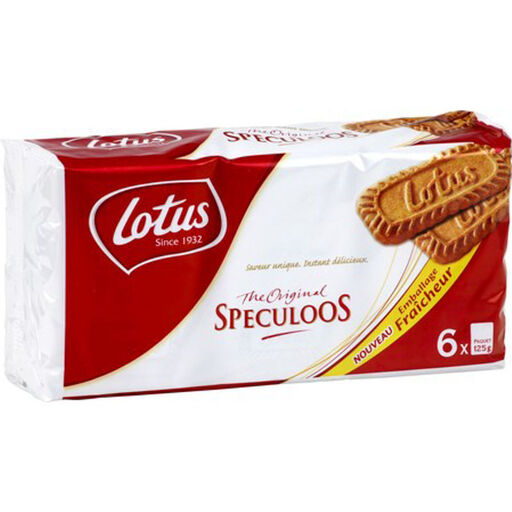 Image unavailable
This multipack is a good choice if you want to open the biscuits gradually as you top up your tin. The Joybuy France product page lists wheat and soya as allergens; check the packaging when it arrives if you need to avoid these ingredients. If Nutri-Score is a deciding factor for you, check which letter is actually shown before ordering.
No. According to the Ministry of the Economy, displaying Nutri-Score is voluntary in France. The DGCCRF says that nutrition information is compulsory for most prepacked foods, so check the values per 100 g even when no letter is shown.
No. If no letter is visible, you can’t conclude that the score is either favourable or unfavourable. If this matters to you, check the packaging image for the exact product and look at its nutrition information.
It tells you which method the displayed letter is based on. E.Leclerc notes that the Nutri-Score E for its P’TIT DELI 2 × 250 g speculoos uses the old calculation method. Bear this in mind when comparing labels.
The Joybuy France product page for the Lotus Biscoff Original 6 × 125 g multipack lists wheat and soya. Check the ingredients list and the information on the packaging you receive for the product you’ll be eating.