Who is this guide for?

Anyone choosing by Nutri-Score

If you avoid certain letters, check the score on the pack you’re planning to buy rather than relying on the biscuit’s name. E.Leclerc product pages show an E for P'TIT DELI and ECO+; the P'TIT DELI page notes that the score uses an older calculation method.

Anyone planning to share

Whether you’re serving biscuits with coffee, adding them to a dessert or putting on an Easter tea, the pack weight matters as much as how many times you’ll serve them. A larger pack tells you nothing about what the biscuits contain.

Anyone checking the recipe

If you need to avoid certain ingredients or allergens, read the label for the exact product. Carrefour’s Lotus Biscoff listing, for example, flags wheat and soya; its Karéléa listing describes a different recipe, with sweeteners and several allergens to check.

Which criteria should you prioritise?

First decide whether a Nutri-Score letter is an important filter for you. Then check the recipe and how much you’ll need for Easter. A “digestive” biscuit and a speculoos shouldn’t be treated as the same product.

CriterionWhat to checkWho is this for?
Nutrition information The letter shown for the exact product, followed by the nutritional values per 100 g. If the letter is based on the previous calculation method, check the current label before comparing it with an updated score. I want to rule out products that don’t meet my nutrition criteria, without guessing a score from the product name: around 40% of consumers put this first.
How much you’ll be sharing The pack weight and the amount you’ll need for the number of guests and desserts planned. For Easter entertaining, I want enough biscuits without buying an unnecessarily large pack; around 30% of consumers prioritise pack size first.
Ingredients and allergens The ingredient list, any allergens highlighted and, where relevant, the sweeteners in the exact product. Some ingredients aren’t suitable for the people I’ll be sharing the biscuits with. This is the top priority for around 20% of consumers.
How you’ll use them Check that they are speculoos biscuits, and that the pack size suits how you plan to serve or use them. I’m looking for biscuits to serve with coffee or add to a dessert, rather than another product with a speculoos flavour; around 10% of consumers prioritise this use first.

Common points of confusion

  • Assuming Nutri-Score is compulsory

    In France, the DGCCRF distinguishes between Nutri-Score, which is voluntary, and the nutrition declaration, which is compulsory for most prepacked foods. So, if there’s no logo, you can’t assume a letter for the biscuit.

    If your choice depends on a particular letter, look for it on the exact product. Otherwise, compare its nutritional information per 100 g and its ingredient list.

  • Assuming “sugar-free” means a good Nutri-Score

    Carrefour’s Karéléa listing describes the speculoos as “sugar-free” and mentions sweeteners, among other ingredients. This description alone doesn’t tell you the product’s Nutri-Score.

    Check the recipe, allergens and values per 100 g, then look for the letter if it appears on the pack.

  • Buying a large pack without thinking about how you’ll use it

    A sharing-size pack could contain more than you need for coffee or a single Easter dessert. Pack weight doesn’t change the biscuits’ ingredients either.

    Estimate how many portions you’ll serve and what you’ll make before choosing a pack size.

  • Comparing scores calculated in different ways

    E.Leclerc notes that the E shown for P'TIT DELI uses the previous Nutri-Score calculation method. Don’t assume it’s directly comparable with a score calculated using the updated method without checking first.

    To compare scores, check the current packaging of the products in question. It’s also useful to have their nutrition tables per 100 g to hand.

Brands to consider

Lotus Biscoff

Carrefour lists its Original speculoos in a 250 g pack, suitable for serving with coffee or using in a dessert.

  • Carrefour’s listing provides nutritional values per 100 g and flags wheat and soya.
  • If you’re choosing this product based on a Nutri-Score letter, check the score on the current packaging.

Carrefour Original

Carrefour lists this speculoos product in a 500 g pack. Consider whether that’s the right amount for what you plan to serve.

  • Carrefour’s listing gives details of the ingredients, including wheat flour, sugar, vegetable oils, candy sugar syrup and cinnamon.
  • If the Nutri-Score letter will affect your choice, check it on the product.

P'TIT DELI

E.Leclerc lists these speculoos in two 250 g packs.

  • E.Leclerc’s listing gives nutritional information per 100 g and a Nutri-Score of E.
  • E.Leclerc notes that this letter uses the previous calculation method. Check the current packaging if you’re comparing scores.

ECO+

E.Leclerc lists ECO+ speculoos in a 600 g pack.

  • E.Leclerc displays nutritional values per 100 g and a Nutri-Score of E for this product.
  • If you rule out products with an E, a larger pack won’t change that.

Karéléa

Carrefour lists a Karéléa product as “sugar-free speculoos”. Consider it a different recipe from the classic speculoos mentioned here.

  • Carrefour’s published ingredient list includes the sweeteners maltitol and isomalt.
  • The listing flags ingredients and allergens to check, including wheat, butter and eggs. The product description doesn’t mean it has a good Nutri-Score.

A selection of speculoos on Joybuy

This multipack of classic speculoos could be a good choice if you’re planning to serve them more than once over Easter. If you’re choosing biscuits by Nutri-Score, check the letter on this product’s packaging before you buy.
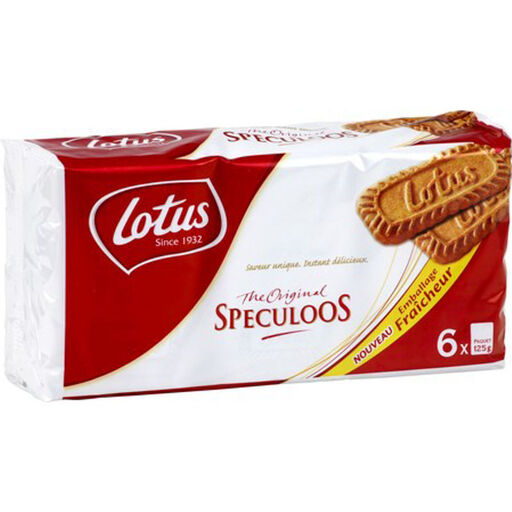
Lotus Biscoff Original speculoos multipack, six 125 g packs

Lotus Biscoff Original, 6 × 125 g

If you’re planning to serve classic speculoos on several occasions over Easter, this multipack contains six packs. Before choosing it based on nutrition criteria or ingredients to avoid, check the label for the exact product: the pack size tells you nothing about its Nutri-Score or allergens.

View on Joybuy

Frequently asked questions

Is Nutri-Score compulsory on speculoos sold in France?

No. The DGCCRF says Nutri-Score is voluntary, while a nutrition declaration is compulsory for most prepacked foods. To compare biscuits without a logo, look at the values shown per 100 g, among other details.

How can I compare two speculoos if one doesn’t display a Nutri-Score?

Compare their nutritional values per 100 g, including energy, fat, saturates, sugars and salt, then check their ingredient lists. Don’t try to guess a Nutri-Score letter from just one value.

Is “sugar-free” enough to choose speculoos by Nutri-Score?

No. Carrefour’s Karéléa listing mentions the sweeteners maltitol and isomalt, among other ingredients, but the description doesn’t tell you the Nutri-Score letter. If a score is shown, check the packaging, along with the ingredients and nutritional values.

What should I do if a listing shows an old Nutri-Score?

Check the current packaging before comparing its letter with that of a product scored using the updated calculation method. E.Leclerc specifically states that the E shown on its P'TIT DELI listing uses the previous calculation method.

Which allergens should I check before serving speculoos at Easter?

Read the ingredients and allergen information for the product you’ll be serving. Carrefour’s listings for the products mentioned here flag wheat, and some recipes also mention soya, butter or eggs. Check the exact packaging for warnings about possible traces of other allergens too.