Hosts looking to serve an alcohol-free drink
If some of your guests prefer not to drink alcohol, look for this wording on the exact bottle you’re buying rather than relying on the word ‘sparkling’ alone.


For drinks where avoiding alcohol matters, first choose a product explicitly labelled ‘alcohol-free’. Then compare the ingredients, information about the apples and the bottle size: a 75 cl bottle makes it easier to serve several people, while a smaller size can help minimise leftovers.
If some of your guests prefer not to drink alcohol, look for this wording on the exact bottle you’re buying rather than relying on the word ‘sparkling’ alone.
The ingredients list and nutritional information let you compare recipes, including whether they contain CO2 and how much sugar they contain per 100 ml.
The labels ‘organic’, ‘in conversion to organic farming’ and ‘French apples’ provide different information. Check which one matches your priorities.
Start with the essentials for your guests, then choose a bottle size to suit the other drinks you plan to serve.
| Criteria | What to check | Who is it for? |
|---|---|---|
| Alcohol-free | The exact product’s name and an explicit ‘alcohol-free’ label. | If I’m hosting people who don’t drink alcohol, I want to be able to identify the drink I’m serving them clearly. Around 33% of consumers put this need first. |
| Ingredients and sugars | The ingredients list and the ‘of which sugars’ figure per 100 ml. | When comparing two apple-based recipes, I want to distinguish their ingredients from their nutritional values. Around 25% of consumers put this criterion first. |
| Organic status, origin and production | The exact wording about organic status or conversion, and the origin of the apples where stated. | When provenance or farming practices guide my choice, I don’t want to mistake a stated origin for an organic label. Around 25% of consumers make this their priority. |
| Size and serving | The bottle size and storage instructions after opening. | If I’m offering several drinks, I prefer to open an amount that helps me manage leftovers. Bottle size is the top criterion for around 17% of consumers. |
An apple juice drink can contain sugars that occur naturally in the fruit, even if no sugar has been added to the recipe.
Check the ingredients list and the ‘of which sugars’ figure per 100 ml on the bottle you choose.
Whether a drink is sparkling does not, by itself, tell you whether it contains alcohol.
If this is essential for your guests, check that the exact product is explicitly labelled ‘alcohol-free’.
A product described as ‘in conversion to organic farming’ does not carry the same claim as one labelled organic.
Check the wording and label on the bottle to make sure it has the status you’re looking for.
A 75 cl bottle may suit a shared serving, while a 33 cl bottle lets you open less if you’re offering several choices.
Estimate how much you’ll serve and read the storage instructions for the specific product.
Auchan’s product listing describes CHAMPOMY Original as a 75 cl bottle containing 99% pure apple juice.
Auchan’s listing describes a 75 cl sparkling apple drink labelled alcohol-free and made with French apples.
E.Leclerc lists Bio Village organic sparkling apple juice as an alcohol-free drink in a 75 cl bottle.
Carrefour lists TRANSITION sparkling apple juice containing 99.5% apple juice and CO2.
Carrefour lists MAISON SASSY sparkling apple juice in a 33 cl bottle.
This 750 ml sparkling apple drink could work well for sharing. If it needs to be alcohol-free, check the label before choosing it.
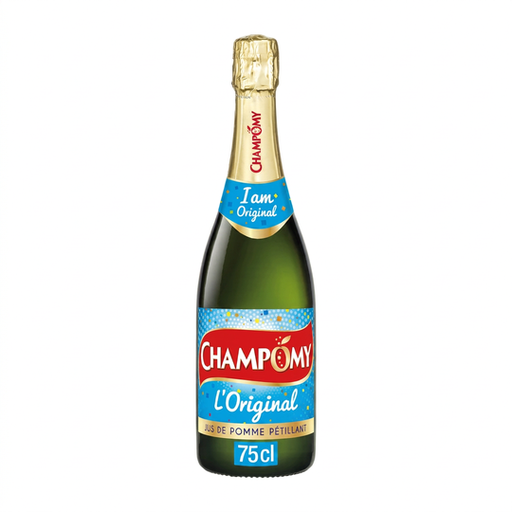 Image unavailable
The 750 ml size is suitable for sharing at a drinks gathering.
Joybuy’s listing states that it contains 99% pure apple juice. If it’s important for your guests that the drink is alcohol-free, check the label on this bottle. You can also compare the sugar content in its nutritional information.
For CHAMPOMY Original 75 cl, Auchan’s listing says to refrigerate after opening and consume within five days.
No. Sugars that occur naturally in apples may still be present in the juice. To compare bottles, check the ‘of which sugars’ figure in the nutritional information per 100 ml; don’t assume a drink is sugar-free just because it says no sugars have been added.
The word ‘sparkling’ alone doesn’t tell you. If you need to serve an alcohol-free drink, look for this claim on the exact product. The Auchan listing for COEUR DE POM' and the E.Leclerc listing for Bio Village both make this clear for the bottles featured here.
Follow the storage instructions on the bottle you’ve opened. For CHAMPOMY Original 75 cl and COEUR DE POM' 75 cl, Auchan’s listings say to refrigerate after opening and consume within five days.
Compare the product name, ingredients list and nutritional information per 100 ml. If the origin of the apples or organic status matters to your purchase, read the claim on each specific product rather than assuming these details mean the same thing.