
Livraison le jour même ou le lendemain

Qualité garantie

Débloquez vos offres de bienvenue: Livraison GRATUITE | Jusqu'à -80 % | 30 jours d'essai gratuits à JoyPlus
Téléchargez l'application
Buying sparkling water online seems straightforward. Yet a naturally sparkling mineral water, a flavoured sparkling water and a fruity fizzy drink all differ in taste, composition and price per litre. Whether for home, the office, a restaurant or a reception, the packaging matters too: a one-litre bottle doesn't meet the same needs as an individual can.
A few common pitfalls to watch out for:
A naturally sparkling water contains carbon dioxide from the source, which may be reintroduced under conditions regulated by law. A natural mineral water to which carbon dioxide has been added can also be sold as sparkling water. If in doubt, it's best to check the exact wording on the label.
Badoit and San Pellegrino, for example, are marketed as natural mineral waters with added carbon dioxide. Their profile is nothing like that of a flavoured fizzy drink. At the table, a natural water offers a more neutral taste and a sugar-free composition.
The levels of calcium, magnesium, bicarbonates and sodium vary from one source to another. This information, expressed in milligrams per litre on the label, allows for a far more reliable comparison than claims like "refined taste".
As a guide, product listings indicate approximately 150 mg of sodium per litre for Badoit Rouge, 180 mg/L for Badoit Vert, 31.2 mg/L for San Pellegrino and 6.5 mg/L for Evian sparkling. La Salvetat, meanwhile, has a sodium content of 0.005 g/L. These values come from packaging or commercial data available at the time of writing: always check the labelling on the product you receive before consuming it.
To compare packs of sparkling water, look at the price per litre rather than the price per case. A pack of six one-litre bottles gives you six litres, while a pack of 24 cans of 330 ml gives you 7.92 litres.
Once opened, reseal bottles quickly and store them in the fridge, following the manufacturer's instructions. An opened can should generally be consumed straight away to enjoy its fizz at its best.
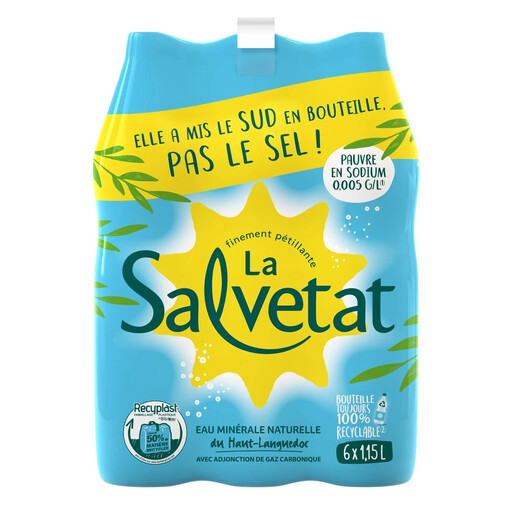
Why this choice fits: With 6.9 litres in total, this pack is ideal for family meals, the office fridge or regular home storage.
The listing describes a lightly carbonated natural mineral water and states a sodium content of 0.005 g/L. The contents and volume are clearly specified.
Six bottles of 1.15 L, with no sugar or flavouring stated, sourced from a spring in the south of France.
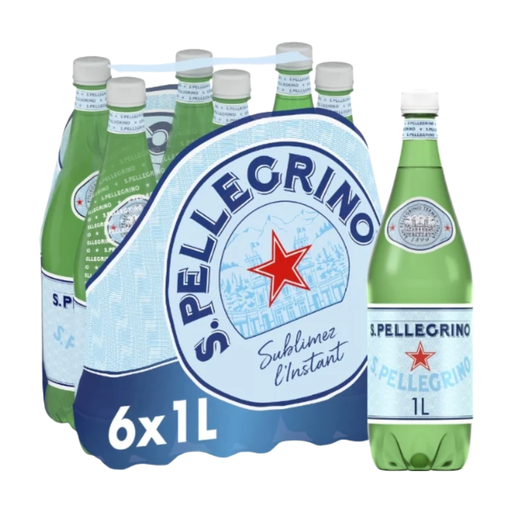
Why this choice fits: The one-litre bottles are easy to share around the table, whether at home or in a restaurant.
The product is presented as a natural mineral water with added carbon dioxide, not as a sweetened flavoured drink.
Pack of six litres, origin stated as Italy and detailed mineral composition on the listing.
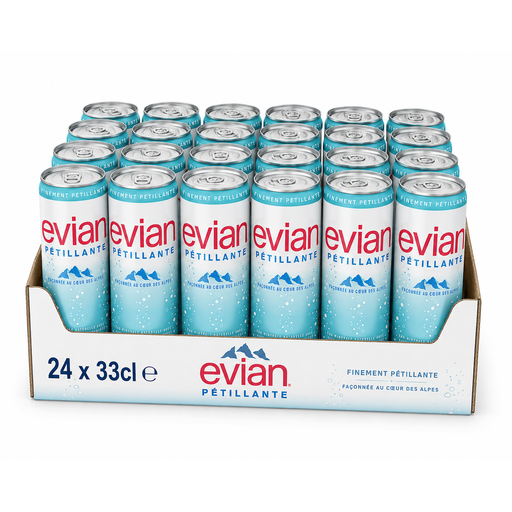
Why this choice fits: Individual cans are easy to hand out at meetings, buffets, picnics or catering services.
The small format limits leftovers once a can is opened. However, do check the price per litre, which is often less favourable than for larger bottles.
24 cans of 330 ml, French mineral water with added carbon dioxide, no sugar stated.
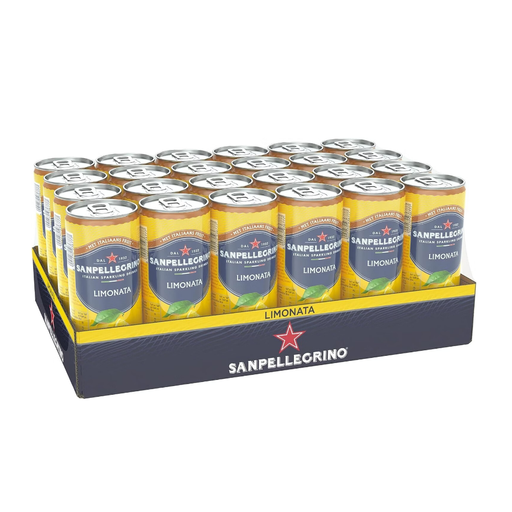
Why this choice fits: This lemon-flavoured sparkling drink is for those who want a fruity alternative to natural sparkling water.
This is not a natural mineral water: the listing mentions sugar and concentrated lemon juice. Check the ingredients before ordering.
Pack of 24 cans of 330 ml, with 11% lemon juice from concentrate according to the product listing.
We've put together an updated selection of products to suit different formats, compositions and uses in France.
To accompany a meal, go for a natural sparkling water in a 50 cl or one-litre bottle. Look at its mineralisation, sodium content and the level of fizz stated by the brand. Badoit, San Pellegrino and La Salvetat offer formats suited to the table, but with different compositions.
An opened bottle gradually loses its fizz. Reseal it carefully, place it in the fridge and follow the recommendations on the packaging. The listings for several products recommend drinking it within 24 to 72 hours. An opened can should be consumed straight away.
No. A drink may show zero sugar while still containing sweeteners, flavourings or acidity regulators. Some flavoured sparkling waters, for example, contain sucralose. To buy a genuine sparkling water, check that the ingredients list only natural mineral water and, where applicable, carbon dioxide.