Parents planning a family lunch
You’re looking for a sparkling drink to share with guests of different ages. The product name, ingredients, bottle size and storage instructions after opening will help you choose what to serve.


For a lunch to share, start by choosing the type of drink and ingredients that suit you. Sparkling apple juice may simply contain juice and carbon dioxide, while other sparkling fruit drinks can have a different composition. Then compare the sugars listed per 100 ml, the bottle size and the storage instructions after opening. ‘No added sugars’ does not mean ‘sugar-free’.
You’re looking for a sparkling drink to share with guests of different ages. The product name, ingredients, bottle size and storage instructions after opening will help you choose what to serve.
You want to tell the difference between juice with added carbon dioxide and other fruit drinks, then check the information about flavourings, colourings, sulphites and sugars.
You’re deciding between a 75 cl organic bottle to share and a 33 cl bottle that would leave less to finish after the meal.
For lunch, first check what’s in the bottle, then compare the nutritional information and the amount you’re likely to serve.
| What to consider | What to check | Who is it for? |
|---|---|---|
| Type and ingredients | Read the product name and ingredients list to distinguish sparkling juice from other fruit drinks. If the packaging could be misleading, also check the information about alcohol. | If I want to serve sparkling juice rather than a different type of fruit drink, what the product is matters more than anything else; around 36% of shoppers prioritise this. |
| Sugars | Compare the ‘of which sugars’ figure per 100 ml with the amount you plan to serve. ‘No added sugars’ doesn’t mean the juice contains no sugars. | If the meal already includes other sweet foods, I want to take the sugars in the glass into account; this is the top priority for around 29% of shoppers. |
| Bottle size and storage | Choose between 75 cl to share and a smaller bottle, depending on the number of guests. Check the storage instructions after opening on the bottle you choose. | There won’t be many of us drinking it, and I’d rather not leave a large bottle open; around 21% of shoppers prioritise bottle size and storage. |
| Organic and origin | If these matter to you, check the organic labelling and stated origin on the exact product variant. | I’m mainly looking for an organic product or one with a clearly stated origin; this is a priority for around 14% of shoppers. |
Juice can contain sugars that occur naturally in fruit. Auchan’s product pages for Coeur de Pom’ fines bulles and Champomy l’Original both list 10 g of sugars per 100 ml, even though the former is labelled ‘no added sugars’.
Compare the ‘of which sugars’ figure on the bottle you buy and take the serving size into account.
The word doesn’t tell you what type of drink it is or, by itself, how much alcohol it contains. If a bottle looks festive, read the label carefully before serving it to children or anyone who doesn’t drink alcohol.
Check the product name and ingredients, and look for information about alcohol if needed.
A bottle to share may leave some drink behind. Auchan’s product pages for Champomy l’Original and Coeur de Pom’ fines bulles say to consume within five days of opening.
Choose a size that suits the number of people who’ll be drinking it, and follow the storage instructions on the bottle you buy.
If you don’t finish the remainder within the stated time, some of the bottle may go to waste.
The 75 cl l’Original is a sparkling apple juice designed to share around the table.
The 75 cl fines bulles variant is a good choice if you’re looking closely at the ingredients and bottle labelling.
E.Leclerc’s Bio Village product is a 75 cl organic sparkling apple juice with no alcohol.
Carrefour describes this 75 cl product as sparkling apple juice from the Orléanais region.
Carrefour’s 33 cl organic product is a smaller option for a more intimate gathering.
These two Champomy options include a 750 ml bottle to share at lunch and a pack of three 75 cl bottles for serving on several occasions. Choose according to how many bottles you’ll use, then check the label on the product you receive.
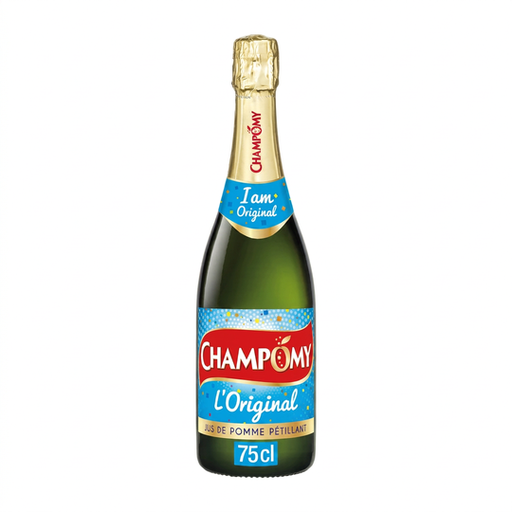 Image unavailable
A bottle to consider if several people would like some with lunch.
Size: 750 ml. To compare sugars and plan how to store any leftovers, check the nutritional declaration and storage instructions after opening on the exact bottle.
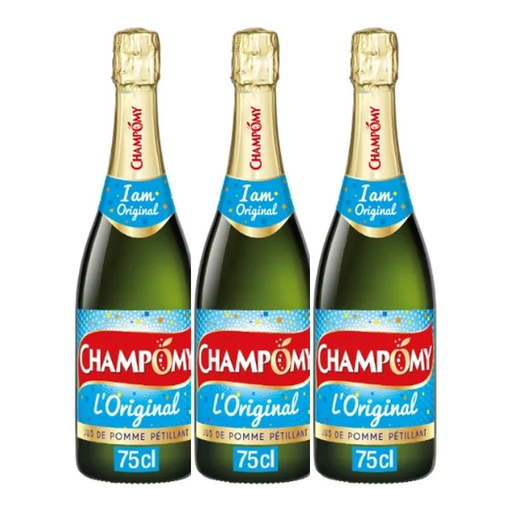 Image unavailable
A pack of three separate bottles is a good option if you’re planning several occasions rather than just one bottle for lunch.
Size: 3 × 75 cl. Check the sugars listed and storage instructions after opening on the bottles you receive.
Don’t assume a drink’s alcohol content from the word ‘sparkling’ alone. If the packaging suggests a celebratory drink, check the product name and information about alcohol before serving it.
No. Juice can contain sugars that occur naturally in fruit. Auchan’s product pages for Champomy l’Original and Coeur de Pom’ fines bulles both list 10 g of sugars per 100 ml; check the figure on the bottle you choose.
Water can be the drink served throughout the meal, with sparkling juice offered separately. Manger Bouger recommends limiting fruit juice and sugary drinks as much as possible, so adjust the amount of juice you serve with the meal.
Follow the time limit and storage conditions stated on the bottle you buy, as these vary by product. Auchan’s product pages for Champomy l’Original and Coeur de Pom’ fines bulles say to consume within five days of opening; Champomy’s page also says to keep it refrigerated.