Hosts planning an alcohol-free drinks reception
You’re looking for a sparkling drink for guests who don’t consume alcohol and want to check this on the product itself, rather than relying on the bubbles alone.


For an alcohol-free birthday drinks reception, choose a sparkling apple juice whose bottle is explicitly labelled “alcohol-free”, then compare the ingredients and the sugar content per 100 ml. If you need several bottles, also consider the size and storage instructions after opening. “No added sugars” does not mean that the juice contains no sugars.
You’re looking for a sparkling drink for guests who don’t consume alcohol and want to check this on the product itself, rather than relying on the bubbles alone.
You want to check the ingredients, understand the difference between “no added sugars” and the amount of sugar in the drink, and compare nutritional information on a consistent per-100 ml basis.
You’re planning to share bottles and need to consider their size, how they’ll be served and how long any leftovers can be kept after opening.
When choosing sparkling apple juice for a birthday party, first check that the bottle is labelled alcohol-free. Then compare the ingredients and nutritional information, before working out how many bottles you’ll need and how to store any leftovers.
| What to consider | What to check | Who is this for? |
|---|---|---|
| Alcohol-free labelling | Look for an explicit alcohol-free statement on the bottle and check the product description. | If some guests don’t consume alcohol, I want to be able to identify the drink clearly before serving it. Around 36% of consumers would make this their top priority. |
| Ingredients and sugars | Compare the ingredients and the “of which sugars” line per 100 ml; check separately for any organic or origin claims that matter to you. | I want to choose based on the ingredients or stated origin without mistaking “no added sugars” for “sugar-free”. This would be the top priority for around 29% of consumers. |
| Size and availability | Check the bottle size and availability of your chosen products before deciding how many bottles to buy. | When serving a group, I need to be sure I can get enough bottles. Around 21% of consumers would prioritise this. |
| Serving and leftovers | Read the serving instructions and check how long each bottle can be kept after opening. | If we don’t finish every bottle, I want to know how to store the leftovers and how long they’ll keep. Around 14% of consumers would put this first. |
The sugars naturally present in apples still count. Auchan’s Cœur de Pom’ listing states that no sugars have been added, but also gives the sugar content as 10 g per 100 ml.
To compare two bottles, check the “of which sugars” figure on the same per-100 ml basis.
Bubbles alone don’t tell you whether a drink contains alcohol.
If you’re planning an alcohol-free drinks reception, check that this is stated explicitly on every bottle you choose.
Storage times vary between products: Auchan’s listings say that Cœur de Pom’ should be used within five days of opening, while Transition should be used within two days.
Plan how many bottles to serve, and follow the refrigeration and consumption instructions for the product you buy.
An opened bottle kept for longer than recommended could end up going to waste.
Carrefour’s listing describes a 75 cl sparkling apple juice, intended in particular for celebrations.
Auchan describes this 75 cl sparkling apple drink, with fine bubbles, as suitable for serving before a meal.
E.Leclerc’s listing describes a 75 cl organic, alcohol-free sparkling apple juice.
Auchan lists a 75 cl sparkling apple juice whose product details highlight its French origin.
Auchan’s listing describes a 75 cl organic sparkling apple juice.
This 750 ml sparkling drink is a shareable option for a birthday drinks reception. Before serving, check the alcohol-free labelling and nutritional information on the packaging.
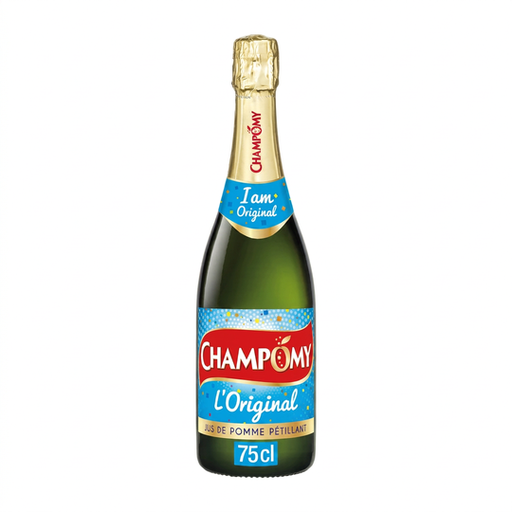 Image unavailable
At 750 ml, it’s a bottle you could share for a toast. The listing describes a sparkling drink made with apple juice and carbon dioxide. Check the bottle for alcohol-free labelling and the sugar content per 100 ml.
Look for an “alcohol-free” statement on the bottle rather than relying on the word “sparkling” alone. The listings for Cœur de Pom’ at Auchan and Bio Village at E.Leclerc describe them as alcohol-free, but check the specific product you’re buying.
No. This claim doesn’t mean that the juice is free from naturally occurring sugars. Auchan’s Cœur de Pom’ listing gives the sugar content as 10 g per 100 ml. To compare bottles, check their nutritional information per 100 ml.
Follow the storage instructions on the bottle you buy, as they vary from product to product. Auchan’s listings say that Cœur de Pom’ should be used within five days of opening, while Transition should be refrigerated and used within two days.
First, read the product description and ingredient list to identify the drink and its recipe. The DGCCRF lists these among the information required on food labels. When comparing sparkling juices, also check the sugar content per 100 ml and the instructions for after opening.