Runners who track their carbohydrate intake
You want to know how many grams of carbohydrates each serving provides, then factor that into your fuelling plan. A value given per 100 ml lets you calculate the amount for the volume you plan to drink.


Sparkling apple juice can contribute to your carbohydrate intake during a marathon if you know how much each serving contains and have tried the drink in training. The GIBUS product listing published by E.Leclerc states that it contains 11.0 g of carbohydrates per 100 ml, or 27.5 g per 250 ml. Take this into account alongside the other drinks and foods in your plan, rather than assuming the juice alone will meet all your needs during the race.
You want to know how many grams of carbohydrates each serving provides, then factor that into your fuelling plan. A value given per 100 ml lets you calculate the amount for the volume you plan to drink.
If you’re concerned about the bubbles or the amount you’ll drink during exercise, try the drink and the serving size you have in mind during training. World Athletics recommends practising your race nutrition plan before the event.
You may simply want an apple drink to enjoy socially around the marathon. The ‘alcohol-free’ label meets that preference, but it doesn’t tell you how many carbohydrates a serving provides.
If you’re considering sparkling apple juice during a marathon, start by checking the amount of carbohydrates per serving, then make sure you can tolerate that serving size during training. If the drink is for a social occasion, its product claims don’t replace the nutritional information table.
| Criterion | What to check | Who it matters to |
|---|---|---|
| Carbohydrates per serving | Check the carbohydrates per 100 ml and calculate the amount for the volume you plan to drink. The E.Leclerc GIBUS listing states 11.0 g per 100 ml. | To include a drink in my fuelling plan, I want to know what it provides rather than simply count glasses. Around 46% of consumers prioritise calculating their carbohydrate intake. |
| Tolerance during exercise | Try the product and the volume you’re considering for race day during training. | If the bubbles or a large serving might bother me while running, I’d rather find out before the start. Around 36% of consumers prioritise digestive comfort. |
| Alcohol-free drink | Check the ‘alcohol-free’ label and distinguish ‘no added sugars’ from the amount of sugars listed per 100 ml. | For a social occasion around the event, I’m mainly looking for an alcohol-free sparkling apple drink. This is a priority for around 18% of consumers. |
Fruit juice can contain sugars that occur naturally in fruit. The ‘no added sugars’ label doesn’t tell you how many carbohydrates are in your serving.
To calculate this, check the carbohydrates per 100 ml on the label of the bottle you choose.
Based on the 11.0 g of carbohydrates per 100 ml stated by E.Leclerc, a 75 cl bottle of GIBUS contains 82.5 g of carbohydrates. That doesn’t mean this amount is suitable to drink during a race.
Decide on the serving size you have in mind, factor it into the rest of your fuelling plan and try it during training.
The Joybuy listing for CHAMPOMY Original describes a recipe made with 99% apple juice, but also states 0 g of carbohydrates and 0 g of sugars per 100 ml. These figures don’t give you a reliable value to use for your serving.
Check the nutritional information on the label of the bottle you actually receive before including it in a race plan.
These products illustrate the information that can help you choose a specific bottle. Their inclusion here isn’t a recommendation to drink them during a race.
E.Leclerc describes a 75 cl bottle of non-alcoholic carbonated apple juice.
Auchan lists a 75 cl fine-bubble sparkling apple drink, which its product listing says is made with 99.6% apples and 0.4% CO₂.
Carrefour lists a 75 cl organic sparkling apple juice whose stated ingredients include apple juice and carbon dioxide.
CHAMPOMY Original is a 75 cl sparkling apple drink; its Joybuy listing describes a recipe made with 99% apple juice.
This bottle may suit you if you’re looking for a non-alcoholic sparkling apple drink to enjoy around the marathon. If you’re considering drinking it during exercise, check its nutritional values on the packaging and try your planned serving during training first.
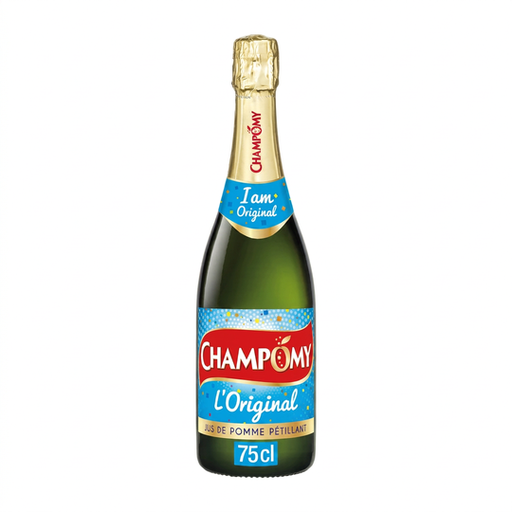 Image unavailable
For a non-alcoholic drink to enjoy socially around the race, the listing describes a drink made with 99% apple juice and carbon dioxide. However, it also states 0 g of carbohydrates and sugars per 100 ml. Check the label on the bottle you receive before calculating a serving. If you’re considering drinking it during exercise, try it in training first to see how you tolerate the bubbles.
Don’t rely on sparkling apple juice as your only source of fuel based on its carbohydrate content. World Athletics considers endurance carbohydrate intake across all the drinks and foods consumed during exercise. You also need to take into account the volume you plan to drink and how well you tolerate it.
A 250 ml glass contains 27.5 g of carbohydrates, based on the 11.0 g per 100 ml that E.Leclerc lists for GIBUS. This calculation tells you what’s in the serving; it doesn’t determine how much you should drink during your marathon.
No. A juice with no added sugars can still contain sugars that occur naturally in fruit. To find out how much a particular bottle provides, check its nutritional information per 100 ml, then calculate the serving you have in mind.
Try it during training before planning to drink it during a race. World Athletics recommends practising your event nutrition plan. Using the same product and serving size you’re considering will help you see how comfortable you are with the bubbles during exercise.