Families looking for alcohol-free bubbles
You’re looking for a sparkling drink to share with lunch during the school holidays. The product name and ingredients help you tell sparkling juice apart from still apple juice.


For a school holiday lunch, choose a bottle clearly labelled as sparkling apple juice if bubbles are a must, then check that it’s alcohol-free. Compare recipes by looking at the ingredients, the sugars per 100 mL, the origin or farming approach that matters to you, and how long the juice keeps once opened.
You’re looking for a sparkling drink to share with lunch during the school holidays. The product name and ingredients help you tell sparkling juice apart from still apple juice.
You want to read the ingredients list and compare the sugars per 100 mL before choosing a bottle to serve with your meal.
You’re looking for clear information about organic farming, conversion to organic farming or the origin of the apples, without confusing these different claims.
For this lunch, start by looking for alcohol-free bubbles, then compare the recipes and practical details that will help you choose between bottles.
| Criteria | What to check | Who it matters to |
|---|---|---|
| Alcohol-free bubbles | Look for the description ‘sparkling apple juice’ and an alcohol-free claim on the bottle you choose. | If I want to serve bubbles with lunch without offering an alcoholic drink, I need to know exactly what’s in the bottle; around 29% of shoppers would make this their top priority. |
| Recipe and sugars | Check the ingredients list and the ‘of which sugars’ line in the nutritional information, per 100 mL. | When comparing drinks to serve at the table, I want to know what they contain rather than rely on the front of the pack; this would be the main consideration for around 29% of shoppers. |
| Organic status and origin | Check the exact wording of any organic or conversion claim, and the origin of the apples if it’s given. | I want to choose based on the farming approach or stated origin, while recognising that these are separate criteria; around 21% of shoppers would make this their top priority. |
| Buying and storage | Check the pack size, any date shown and the storage instructions once opened. | For a single lunch, I’d rather plan for bottles that guests can finish within the stated timeframe; around 21% of shoppers would put this need first. |
Juice can still contain sugars even when this claim appears on the packaging. Don’t compare sparkling juice recipes based on this phrase alone.
Check the ‘of which sugars’ line per 100 mL on the exact bottle, as well as its ingredients list.
Auchan’s storage guidance varies by product: Transition should be kept in the fridge and consumed within two days of opening, compared with five days for Champomy and Cœur de Pom’.
Choose the number of bottles to suit your guests and follow the storage instructions on each one.
A partly used bottle kept beyond its recommended consumption period could go to waste.
Still apple juice won’t meet the same need if bubbles are what make lunch feel special.
Check that the product is described as ‘sparkling’ and that carbon dioxide appears in the ingredients, rather than choosing by the fruit name alone.
An alcohol-free sparkling option in a 75 cL bottle, ideal for sharing over a meal.
A sparkling option that E.Leclerc describes as organic and alcohol-free.
An option for shoppers who want to check where the apples are said to come from.
Check the precise wording of this product’s farming claim: conversion to organic farming is not the same as organic certification.
A sparkling option for shoppers interested in the stated regional origin of the apples.
This product suits anyone looking for an alcohol-free sparkling apple drink to share at lunch. Compare its label with your requirements for ingredients and storage.
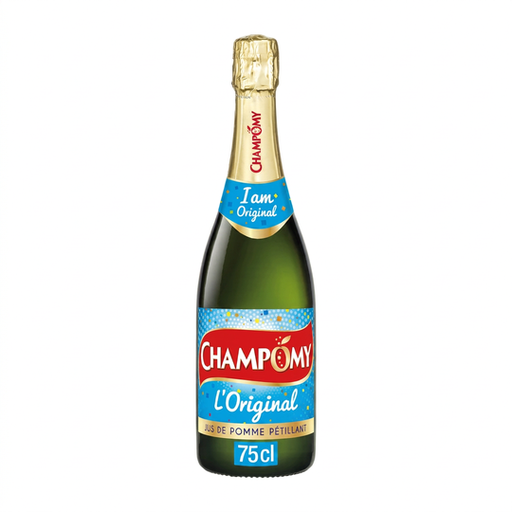 Image unavailable
If you’re looking for alcohol-free bubbles to serve with lunch, this drink combines apple juice and carbon dioxide.
Size: 750 ml. Compare the sugars per 100 mL and follow the storage instructions on the bottle you choose.
Don’t assume so: check the label on the bottle you choose. Bio Village and Cœur de Pom’ are described as alcohol-free on their respective E.Leclerc and Auchan listings.
No. This wording doesn’t mean the juice contains no sugars. To compare two bottles, check the ‘of which sugars’ line per 100 mL in their nutritional information.
Follow the guidance for the product you’ve bought: Auchan’s listings say to refrigerate Transition after opening and consume it within two days, while Champomy and Cœur de Pom’ should be consumed within five days. Plan how many bottles to open based on the number of guests.
Read the exact wording on the bottle: E.Leclerc describes Bio Village as being from organic farming, while Carrefour says Transition’s apple juice comes from farms converting to organic farming. These descriptions don’t mean the same thing.