For a holiday toast, choose a bottle clearly labelled as sparkling and alcohol-free, and check the ingredients rather than relying on its celebratory look. If the recipe, organic status or how to store an opened bottle matters more to you, check these details for the exact product before you set off.
Who is this a good choice for?
Families planning an alcohol-free toast
If you want to share a pre-dinner drink or a meal with adults and children, look for both bubbles and a clear “alcohol-free” label. Carrefour and Auchan describe Champomy L’Original as a sparkling apple juice for just such occasions.
Holidaymakers who check the ingredients
If ingredients, sugar content or farming status influence your choice, compare the details on the exact bottle. Carrefour, for example, describes a Transition recipe made with apples from farms converting to organic agriculture. This is worth distinguishing from full organic certification.
People organising several meals
When a bottle might be left open, the number of guests and the time between meals both matter. For Champomy L’Original, Auchan recommends refrigerating the bottle and drinking it within five days of opening. Check the packaging for any other product.
Which criteria should you prioritise?
For your holiday, first decide whether your priority is an alcohol-free toast, the ingredients, how much to buy or how to store the bottle after opening. Each of these criteria means checking different information on the bottle.
| Criteria | What to check | Who it matters to |
|---|
| Bubbles and no alcohol |
The drink’s name and the “alcohol-free” label on the bottle you choose. |
For a toast with children and adults, I want a sparkling drink without serving alcohol; around 42% of consumers would put this need first. |
| Ingredients and farming status |
The ingredients, sugars per 100 ml and the precise meaning of any organic or “in conversion” claim. |
When the recipe guides my purchase, I want to be able to distinguish the ingredients and claims on the label; around 33% of consumers would make this their priority. |
| Quantity and storage |
The bottle size, how many bottles you need and the instructions for storing it after opening. |
If meals are spaced out or there are only a few guests, I want to avoid leaving an opened bottle for too long; this would be the main concern for around 25% of consumers. |
Mistakes to avoid
-
Assuming “sparkling” means “alcohol-free”
Bubbles alone don’t tell you what kind of drink it is. Alcohol-free sparkling apple juice is not the same as cider.
Before you buy, check the product name, ingredients and alcohol information on the exact bottle.
-
Confusing “no added sugars” with “sugar-free”
Apple juice can contain sugars that occur naturally in the fruit. A claim highlighted by a brand won’t necessarily apply to all its varieties.
Compare the “sugars” figure per 100 ml in the nutritional information for the products you’re considering.
-
Forgetting how to store the bottle after opening
A large bottle opened for a small group could be left unfinished between meals. For Champomy L’Original, Auchan recommends refrigeration and drinking it within five days of opening.
Choose the number of bottles to suit your guests and follow the instructions on each pack.
An opened bottle that can’t be finished within the recommended time could go to waste.
Brands to know when comparing recipes
Champomy
A 75 cl alcohol-free sparkling drink for sharing at a toast.
- Carrefour lists apple juice and carbon dioxide in the ingredients for Champomy L’Original.
- Don’t assume that bubbles mean it contains no sugars; check the nutritional information on the bottle you buy.
Cœur de pom’
A range of sparkling fruit drinks with recipes that should be compared individually.
- Cœur de pom’ describes one product as containing 99.6% apple juice and CO2.
- Check the name and nutritional information for the variety you choose: a claim about one recipe won’t necessarily apply to the whole range.
Bio Village
A 75 cl bottle of organic, alcohol-free sparkling apple juice listed by E.Leclerc.
- The full product name confirms its organic status and bottle size.
- When comparing it with another recipe, check the ingredients and nutritional information on the bottle too.
Transition
A recipe to consider if the farming status of the apples matters to you.
- Carrefour lists 99.5% apple juice and CO2 for the sparkling Transition product.
- The apples are described as coming from farms converting to organic agriculture; this is not the same as full organic certification.
An option for your toast
This bottle suits anyone looking for a sparkling drink to share at an alcohol-free toast. Check the nutritional information and storage instructions on the bottle you receive.
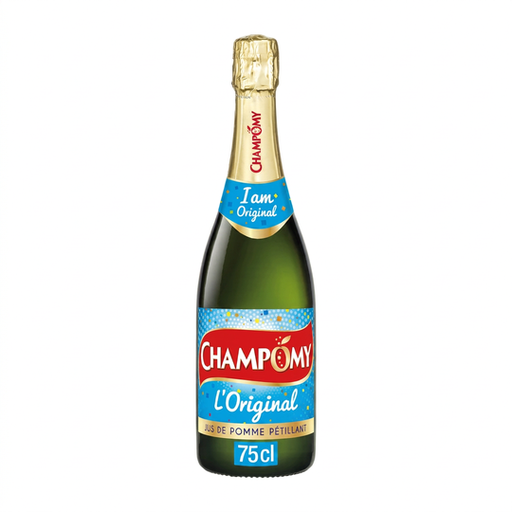 Image unavailable
Champomy Original, sparkling drink, 750 ml
A bottle to share at an alcohol-free toast. It holds 750 ml; check the sugar content and instructions for storing it after opening on the packaging.
View on Joybuy
Frequently asked questions
Is sparkling apple juice always alcohol-free?
No: “sparkling” describes the bubbles, not the alcohol content. Carrefour and Auchan describe Champomy L’Original as alcohol-free. Check the label on any other bottle, and don’t confuse it with cider.
How can you tell the difference between apple juice and apple nectar?
Start by checking the product name, then read the ingredients list. The DGCCRF notes that the product name is one of the labelling details to check on fruit juices and nectars.
Does “no added sugars” mean “sugar-free”?
No: juice can contain sugars that occur naturally in fruit, even when no sugars have been added. To compare two bottles, check the sugars per 100 ml in their nutritional information.
How long can you keep a bottle after opening?
Follow the storage method and time stated on the bottle you choose. For Champomy L’Original, Auchan recommends refrigeration after opening and drinking it within five days; don’t automatically apply this guidance to another product.


