Households planning to serve several glasses
You’re looking for a non-alcoholic sparkling drink for a meal or a get-together, without buying more bottles than you need.


For your weekly shop, choose a sparkling apple juice based on how much you plan to serve, then compare the ingredients, the sugars listed per 100 ml and any claims that matter to you, such as the origin of the apples or whether they’re organic. A 75 cl bottle could be just right to share, but check how long it keeps once opened if you plan to drink it over several days.
You’re looking for a non-alcoholic sparkling drink for a meal or a get-together, without buying more bottles than you need.
You read the ingredients and nutrition information, or look for a specific claim such as ‘no added sugars’, ‘sulphite-free’ or organic. These claims don’t mean you can skip checking the sugars naturally present in the juice.
You want to know where the apples are said to come from and choose a bottle your household can finish within the stated time after opening.
Start with how much you’re likely to drink, then compare recipes according to what matters most to you: ingredients, nutrition information, origin or storage.
| What to consider | What to check | Who is it for? |
|---|---|---|
| How much you need | The bottle size and how many bottles you’ll need for the glasses you plan to serve. | For a shared meal, I want to have enough juice without buying bottles I don’t need; around 29% of consumers would put the quantity they need first. |
| Ingredients and sugars | The ingredients list and the ‘of which sugars’ figure per 100 ml, rather than just the claims on the front of the bottle. | If I choose a recipe for its ingredients, I also want to know how much sugar the juice contains; ingredients would be the top priority for around 36% of consumers. |
| Origin, pure juice and organic status | The product description, the origin actually stated and any logos on the bottle. | When the origin of the apples or organic status guides my choice, a specific claim matters more to me than the word ‘sparkling’ alone; around 21% of consumers would make this their top criterion. |
| Storage | The refrigeration instructions and the stated time for that product after opening. | If I don’t finish the bottle with the same meal, I want to be able to follow its storage instructions; this would come first for around 14% of consumers. |
Apple juice can contain sugars that occur naturally in fruit. Auchan’s product pages for Coeur de Pom’ and Thomas Le Prince list 10 g and 11 g of sugars per 100 ml respectively, despite carrying a ‘no added sugars’ claim.
Compare the ‘of which sugars’ figure per 100 ml with the portion you plan to serve, rather than relying on the front of the bottle alone.
According to Auchan’s product pages, Transition should be refrigerated and consumed within two days of opening, compared with five days for Champomy and Coeur de Pom’.
Before adding a 75 cl bottle to your weekly shop, read the instructions for the product you’ve chosen and think about how many glasses you plan to serve.
The word doesn’t tell you where the apples come from, whether it’s described as ‘pure juice’ or any other details you might be looking for.
Decide what matters most to you, then check the product description, ingredients and claims on the bottle.
The 75 cl Original is described as a non-alcoholic sparkling apple juice to share.
Its 75 cl sparkling apple juice is aimed at people looking for a recipe described as having no added sugars and being sulphite-free.
Auchan describes the 75 cl sparkling bottle as pure apple juice associated with production in Centre-Val de Loire.
The Auchan product page highlights French origin for its 75 cl sparkling bottle.
The 75 cl sparkling version is shown with the AB and Euro-leaf logos and a ‘no added sugars’ claim.
These two Champomy Original options let you choose between a single bottle to share and a pack of three 75 cl bottles for several occasions.
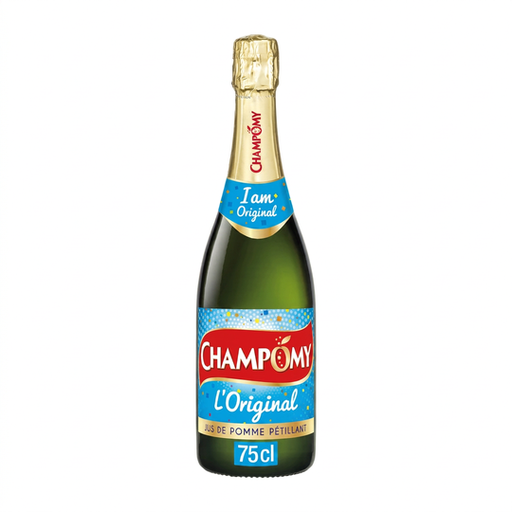 Image unavailable
A bottle to consider for a meal or a get-together without alcohol.
Size: 750 ml. Check the ‘of which sugars’ figure on the label and how long it keeps after opening.
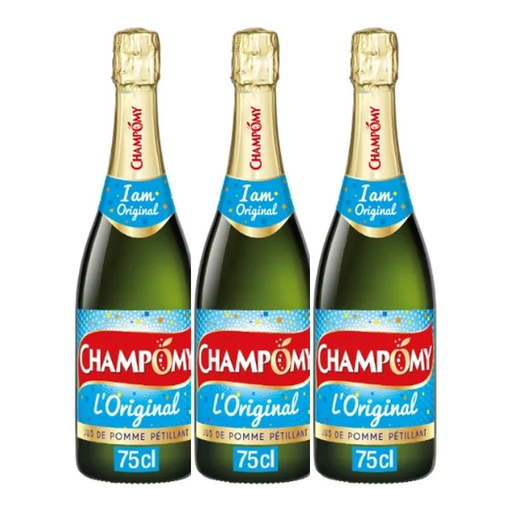 Image unavailable
A pack to consider if you’re planning several get-togethers during the week.
Three 75 cl bottles. Check the nutrition information and storage instructions after opening on each one.
No. The juice can contain sugars that occur naturally in fruit. To compare two bottles, check the ‘of which sugars’ figure per 100 ml in their nutrition information; the claim on the front doesn’t replace this value.
Follow the stated time and refrigeration instructions on the bottle in question. Auchan’s product pages give Champomy and Coeur de Pom’ five days after opening, but Transition two days. Don’t assume the time stated for one product applies to another.
Check the product description, ingredients, net quantity and nutrition information, especially the sugars per 100 ml. The French Directorate-General for Competition Policy, Consumer Affairs and Fraud Control highlights the importance of this information on prepacked foods; also check the date and storage instructions on the bottle you choose.